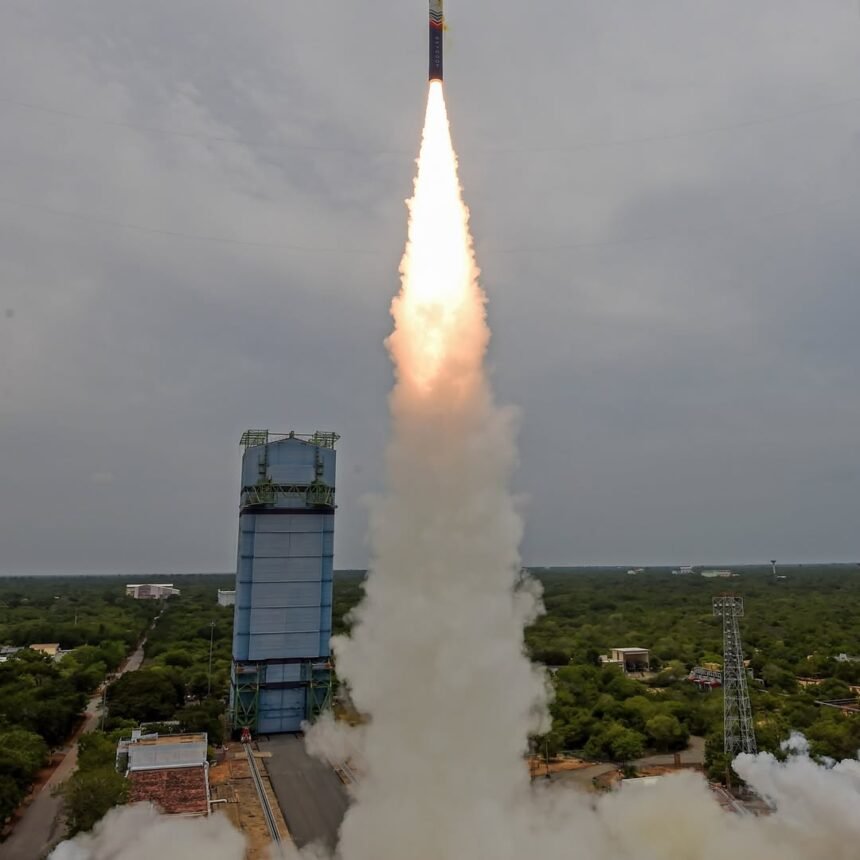
Reaching orbit has, for the entire commercial space age, belonged to a tiny club: SpaceX, Rocket Lab, and a handful of Chinese firms. On 18 July 2026, a Hyderabad startup muscled India into it — on its very first try. Vikram-1, Skyroot Aerospace’s orbital launch vehicle, lifted off from the First Launch Pad at the Satish Dhawan Space Centre in Sriharikota at 12:05 pm IST and was in a 450-kilometre orbit about fifteen minutes later. The company calls it India’s arrival in the private launch business: the third country in the world, it says, with private orbital launch capability.
A rocket built like a racing car
Vikram-1 stands about 22 metres tall — seven storeys — and is, in the company’s words, one of India’s first all-carbon-fibre rockets. The carbon-composite structure keeps mass down, which is the whole game in launch economics: every kilogram of structure saved is a kilogram of payload or margin gained. Co-founder and COO Naga Bharath Daka has described it as “extremely efficient and light.” The vehicle flies three solid-fuel stages — Stage 1 is the Kalam 1200 motor — topped by a liquid-fuel Orbital Adjustment Module carrying 3D-printed engines, which provides the precise final burns that let it drop multiple payloads into different slots. Skyroot’s published specs put capacity at up to 350 kg to low-Earth orbit and 260 kg to Sun-synchronous orbit.
Twelve minutes that rewrote the order
The launch itself had drama. The countdown was halted minutes before the planned 11:30 am liftoff, then restarted; Vikram-1 cleared the tower at 12:05. Stage separation followed, then the Orbital Adjustment Module fired, and launch-site commentators announced “Hello, space. We have arrived” as payload injection was confirmed. First-attempt orbital success is genuinely rare — SpaceX’s Falcon 1 failed three times before it reached orbit, and Rocket Lab’s Electron needed two attempts. As Bellatrix Aerospace co-founder Yashas Karanam put it, “having a launch vehicle succeed on the first attempt, at full scale — a lot of countries have actually failed to do that.”
The payload manifest
Mission Aagaman carried six payloads: technology demonstrators from Cosmoserve Space (Embrace, an in-orbit test of robotic arms for space-debris removal), Grahaa Space (Solaras, demonstrating new capabilities in low-Earth orbit), Germany’s DCubed (the uD3PP and mD3RN test payloads) and Skyroot’s own SCOPE experimental platform — alongside symbolic cargo: Cosmos Diamonds’ lab-grown “Cosmic Bloom” artwork, a micro-art piece with gold sculptures of C.V. Raman, Vikram Sarabhai and A.P.J. Abdul Kalam, and a handwritten postcard from Prime Minister Narendra Modi bearing the message “Vande Mataram,” plus notes from scientists, engineers and astronauts.
The road to the pad
Skyroot was founded in 2018 by Pawan Kumar Chandana and Naga Bharath Daka, both former ISRO scientists. The company has a habit of firsts: its Raman engine was the first privately developed rocket engine in India, and its Vikram-S flight in November 2022 — Mission Prarambh — was the first privately built Indian rocket to reach space. Development now runs out of the MAX-Q Campus at the GMR Aerospace and Industrial Park in Hyderabad, billed as the country’s largest private rocket-development facility under one roof. Earlier in 2026 the company crossed a $1 billion valuation, widely reported as India’s first space-sector unicorn.
What comes next
The company says Mission Aagaman was a test flight and a few more development flights will follow before routine commercial service begins — the real exam, as a recent Business Today cover story frames it, is whether Indian launch firms can now compete globally. Early signs point to cadence: the first stage of the second Vikram-1 has already been shipped to Sriharikota. And Vikram-II, a cryogenic-powered vehicle for up to 900 kg to low-Earth orbit, is slated for 2027.
More Read
Two honest caveats. First, this was a test flight, and commercial launch cadence — the thing that actually builds a launch business — remains unproven; the company itself says several development flights come first. Second, while the launch itself is beyond dispute, one space-industry analyst has noted mixed outcomes among the payloads, and Skyroot has not published a detailed payload-by-payload account — so judge the rocket’s success, not every payload’s. Either way, an eight-year-old private Indian company flying its own orbital rocket on the first attempt is exactly the kind of engineering the country used to wait for other nations to do.