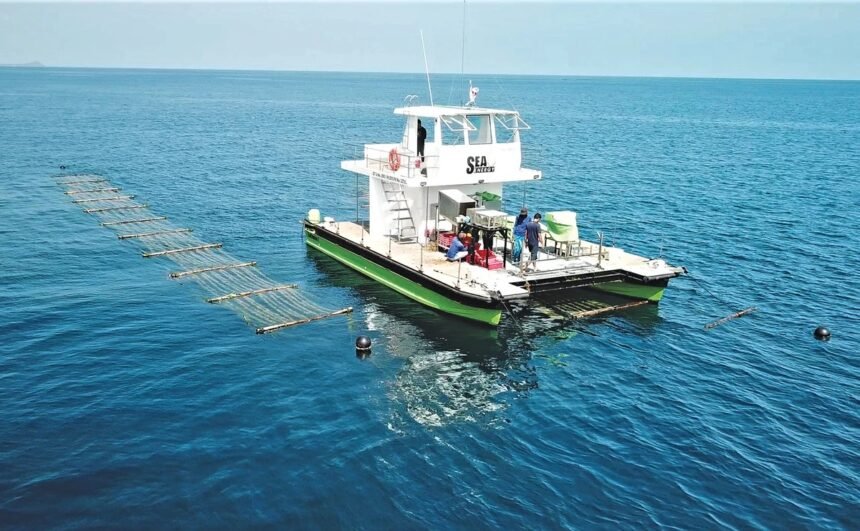
The most audacious energy bet in India isn’t a solar gigafactory or a green-hydrogen electrolyser — it’s a farm on the open ocean. Sea6 Energy, a Bengaluru company founded in 2010 by four IIT Madras alumni, operates what it describes as the world’s first large-scale mechanised tropical seaweed farm: one square kilometre off Lombok, Indonesia. The endgame, per the company: converting seaweed into biocrude at a scale that could one day dent crude-oil imports. The honest version of that sentence requires 120,000 square kilometres of ocean — and this post will keep that number front and centre.
Sea6 was founded by Nelson Vadassery, Shrikumar Suryanarayan, Sri Sailaja Nori, and Sowmya Balendiran — IIT Madras alumni who have now spent over a decade on ocean agriculture. That longevity matters: seaweed biofuel has a long history of hype cycles, and Sea6 is one of the few companies to survive them by building real mechanisation rather than slideware.
The SeaCombine: a tractor for the ocean
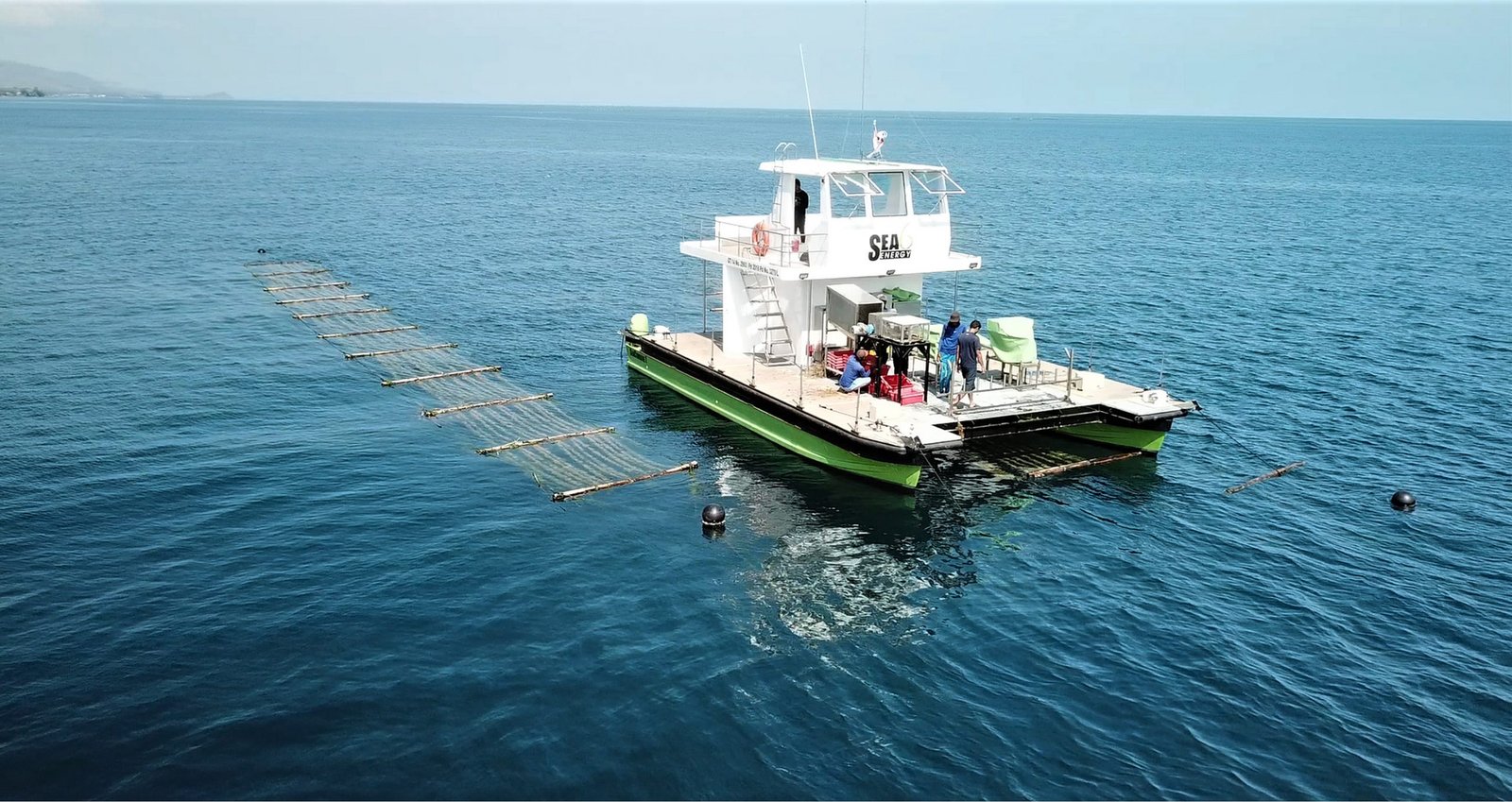
The core invention is the SeaCombine — a catamaran-like automated “ocean tractor” that seeds and harvests seaweed and operates in deeper water than manual farming allows. It is patented, and it is the reason the company’s “world’s first” claim has any weight: tropical seaweed farming has historically been manual, near-shore labour. Mechanising it — and proving it at a full square kilometre since 2024 — is a genuine engineering achievement, even with “world’s first” kept as an attributed company claim.
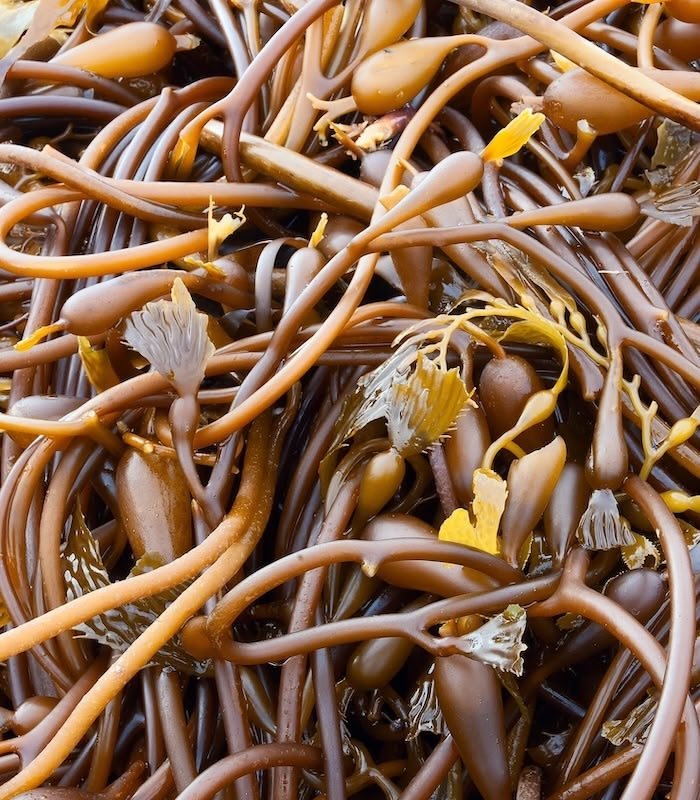
The conversion step is hydrothermal liquefaction (HTL): wet seaweed subjected to roughly 350°C and up to 200 bar of pressure, producing a biocrude with energy density comparable to crude oil — in minutes rather than millions of years. Tropical seaweed’s 45-day harvest cycle is the feedstock advantage: few biomass sources regrow that fast without freshwater, fertiliser, or arable land, and without competing with food crops.
The scale math — stated plainly
Here is where this post departs from the hype. Sea6’s own estimates, via IIT Madras’s Shaastra publication, put India’s crude-import replacement at roughly 1 billion tonnes of seaweed biomass per year — requiring 120,000 to 285,000 square kilometres of ocean farming. The current farm is 1 square kilometre. That is not a criticism; it is the defining fact of the story. “Replacing crude oil” is a decades-scale aspiration, and anyone presenting it as imminent is selling something.
The company’s nearer-term business is more grounded. Sea6 already sells seaweed biostimulants for agriculture — AgroGain and AG Silon — with patents granted across the US, EU, South Africa, Australia, India, and Japan — deep-tech IP with global reach, like Solavio’s solar-cleaning robots now exporting from India.
— deep-tech IP with global reach, like Solavio’s solar-cleaning robots now exporting from India.
(4 granted, 3 filed). That revenue base is what funds the long biofuel bet, and it is a smarter structure than most deep-tech moonshots manage.
One square kilometre of mechanised ocean farm exists — a long-horizon infrastructure bet on the ocean, the way Indra Water bets on electricity replacing chemicals in industrial water treatment.
Replacing crude oil needs 120,000 of them. That gap is the story.
The HPCL relationship needs precise framing. On 9 December 2024, Sea6 signed an MoU with Hindustan Petroleum for joint R&D on converting tropical seaweed biomass into sustainable fuels and chemicals — pairing HPCL’s Green R&D Centre in Bengaluru with Sea6’s ocean farms, with sustainable aviation fuel among the applications. That is a research partnership, not a commercial fuel-supply contract. HPCL is not buying seaweed biofuel today, and this post does not imply it is.
Funding has been patient capital: $9 million from Aqua-Spark (Netherlands) in 2021, and a place in Tata Capital’s Innovations Fund portfolio. The seaweed value proposition for net-zero 2070 — zero freshwater, zero fertiliser, fast growth, carbon capture — keeps strategic investors interested even at decade timescales.
Key takeaway
The takeaway: Sea6 has built real, patented ocean-farming machinery and a working square kilometre. The crude-replacement vision is genuine long-term ambition — 120,000+ sq km away — not a near-term product.
What to watch: whether the Lombok farm scales beyond 1 sq km, whether the HPCL R&D MoU produces published conversion results, and whether the biostimulant business keeps funding the biofuel dream. Seaweed’s advantages — no land, no freshwater, 45-day cycles — are real. The question was never the chemistry; it is the square kilometres.
More Read
Sources & further reading
Sources & further reading
- Sea6 Energy — official site — SeaCombine, farm, and HTL process details
- IIT Madras Shaastra on scale estimates — Crude-replacement scale math
- HPCL MoU announcement (Dec 2024) — R&D partnership details
Frequently Asked Questions
What does Sea6 Energy do?
The Bengaluru company builds mechanised ocean farms for tropical seaweed (via its patented SeaCombine tractor) and converts the biomass into biocrude through hydrothermal liquefaction, plus an existing biostimulant business for agriculture.
Can seaweed really replace crude oil?
Not imminently. Sea6’s own estimates say replacing India’s crude imports needs ~1 billion tonnes of seaweed a year from 120,000–285,000 sq km of ocean. The current farm is 1 sq km. It is a decades-scale bet.
Is HPCL buying Sea6’s biofuel?
No. The December 2024 HPCL agreement is a joint R&D MoU on converting seaweed biomass into sustainable fuels and chemicals — not a commercial supply contract.
What is the SeaCombine?
Sea6’s patented catamaran-like automated “ocean tractor” that seeds and harvests seaweed in deeper water — the mechanisation behind its “world’s first” large-scale tropical farm claim (company claim, attributed).
Who funds Sea6?
$9 million from Aqua-Spark (2021), plus backing via Tata Capital’s Innovations Fund. Founded 2010 by four IIT Madras alumni.