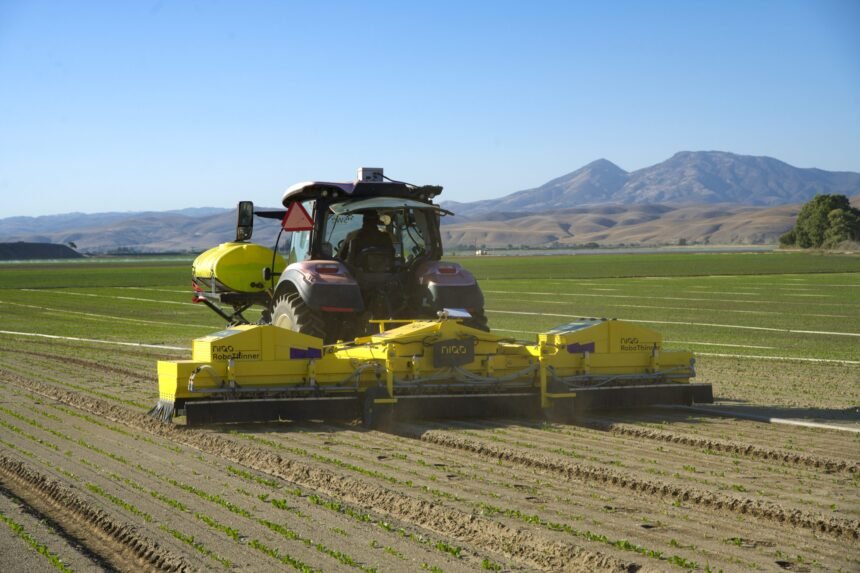
A lettuce field in California’s Salinas Valley doesn’t look like the front line of robotics. But look closer at the tractor implement rolling between the rows: twelve cameras underneath, each making crop-versus-weed decisions in milliseconds, each commanding its own spray nozzle or thinning mechanism. This is the RoboWeeder from Bengaluru’s Niqo Robotics — and it is selling in America, one of the hardest farm-equipment markets in the world to crack — Indian agri-machinery is exporting ambition: Bullwork’s electric BEAST tractor targets the same farmer with a different machine.
What the robot actually does — and the chemical question
Let’s settle the most important point first, because social media gets it wrong. The RoboWeeder is not chemical-free. It does spray herbicide — but through individual nozzles aimed only at identified weeds, at millimetre accuracy, rather than broadcast-spraying entire fields. The company’s own site is explicit: the system can “use any chemicals, including acid.” The thinning function is mechanical. So the honest framing is this: precision spraying uses a fraction of the chemicals of conventional broadcast application. “Without chemicals” as a blanket claim is wrong, and this post won’t use it.
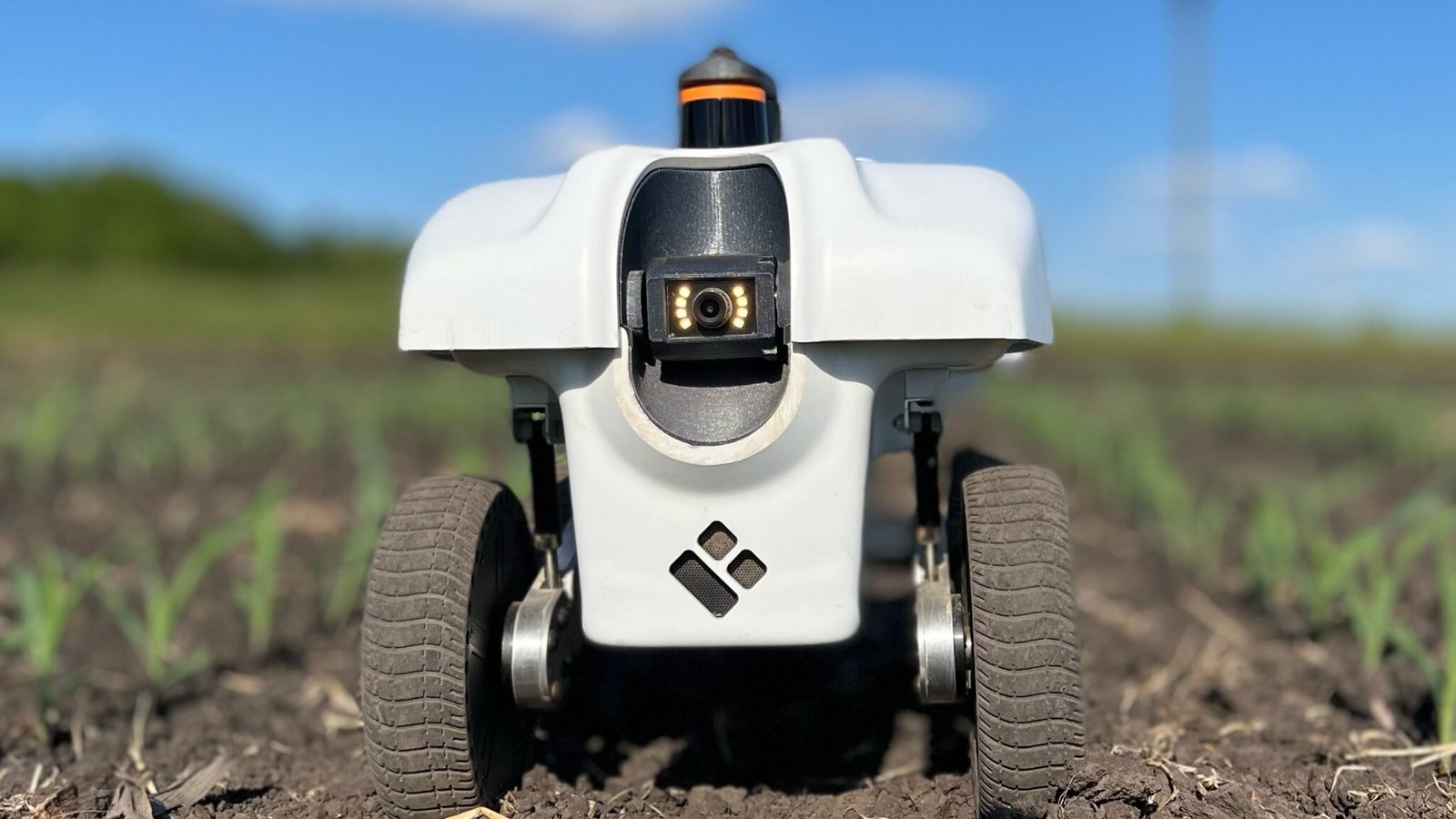
The mechanism is straightforward in concept and hard in execution. Computer vision — the company’s “Niqo Sense” cameras — discriminates crop from weed at millimetre accuracy. For weeding, individual nozzles fire precise doses. For thinning (removing surplus crop plants), the action is mechanical. The implement spans roughly 20 feet, runs at up to 4.5 mph, and the RoboThinner variant covers about 5 acres per hour, per AgFunderNews and Grainews coverage.
From Tartan Sense to Niqo
The company was founded in 2015 as Tartan Sense and rebranded to Niqo Robotics in 2022. Founder and CEO Jaisimha Rao is himself a coffee grower — the agricultural roots are personal, not hired. The Bengaluru headquarters now has a North American subsidiary to serve the US market. Lettuce is the core crop, with the algorithm library expanding toward onions, tomatoes, broccoli, kale, melons and turf grass — 15-plus crops planned, according to AgFunderNews.
Selling in America
The US footprint covers California’s Salinas Valley, Yuma in Arizona, and Georgia. On unit counts, be careful with dates: AgFunderNews reported 11 units in the US in May 2026, while the company’s September 2026 reel claims 18. Both can be true at different times — use the attributed figures, not an unqualified number. The company reports 50-plus units operating in India. The machine was showcased at the Southwest Ag Summit in Yuma, Arizona in February 2026, and covered by Canada’s Grainews — the kind of third-party validation that matters in farm equipment, where farmers, as AgFunderNews put it, “don’t want AI hype, they want ROI.”
Farmers don’t want AI hype — they want ROI. Niqo’s pitch is measured in acres per hour, not algorithms.
The business case
The commercial model is deliberately old-school: a one-time purchase, zero recurring fees, 24/7 service with locally stocked parts. The company says it is “on track for profitability in FY2026-27” — note the phrasing, because it matters. That is a company target, not an achieved result, and the “industry first” framing around it is the company’s own. Still, a hardware startup selling into US specialty crops with a no-subscription model is a genuinely interesting bet — and the expansion targets (Pacific Northwest turf grass, then Europe and Australia, with a next-generation robot expected in the second half of 2026) show where the company thinks the model travels next.

Key takeaway
Niqo’s robots aren’t chemical-free — they spray herbicide with millimetre precision, using a fraction of broadcast volumes. That honest distinction is the whole value proposition.
More Read

Do Niqo’s robots really use no chemicals?
No — that’s a misconception. The RoboWeeder sprays herbicide through individual nozzles aimed precisely at weeds. The thinning function is mechanical, and precision spraying uses far less chemical than broadcast spraying — but the human side of farm automation matters too: the labourers training India’s robots are part of the same story, but it is not chemical-free.
Where is Niqo Robotics selling?
In the US across California, Arizona and Georgia (11 units per May 2026 reporting, 18 claimed by the company in September 2026), plus 50-plus units in India.
Who founded Niqo Robotics?
Jaisimha Rao, founder and CEO, who is himself a coffee grower. The company started as Tartan Sense in 2015 and rebranded to Niqo Robotics in 2022.
How does the weeding technology work?
Twelve “Niqo Sense” cameras under a ~20-foot tractor-mounted implement identify crops versus weeds at millimetre accuracy; individual nozzles spray precisely or mechanical tools thin surplus plants, at up to 4.5 mph.
Is Niqo Robotics profitable?
Not yet — the company says it is “on track for profitability in FY2026-27,” which is a target, not an achieved result.
Sources & further reading
- AgFunderNews — Niqo Robotics expands reach, targets profitability — US deployment, unit counts, business model and profitability target
- Grainews — Robot performs precision weeding and thinning in specialty crops — Technical details on vision and thinning mechanism
- Niqo Robotics — RoboWeeder Solo product page — Official product specifications