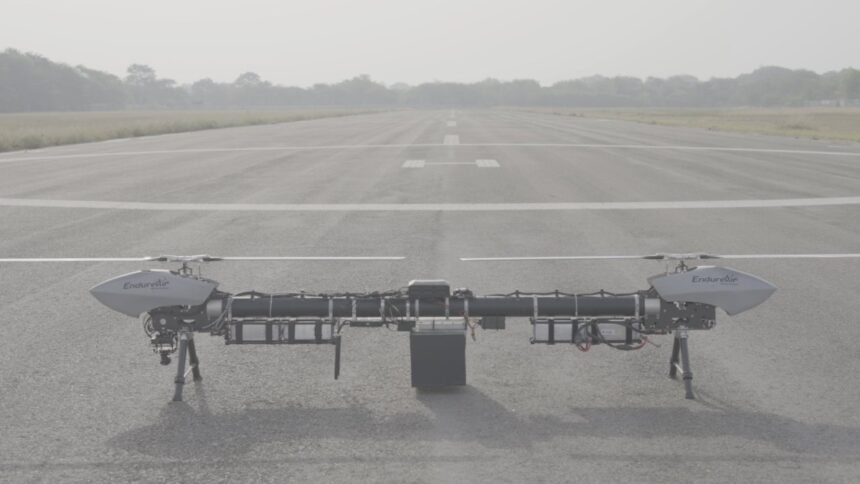
Supplying a Himalayan outpost is a logistics nightmare: thin air, sub-zero cold, and trails that take hours or days. The Indian Army has begun answering it from the air. EndureAir Systems, a Noida startup incubated at IIT Kanpur, has had its SABAL-20 tandem-rotor drone inducted by the Army’s Eastern Command for high-altitude logistics — PTI-verified, not a company press release.
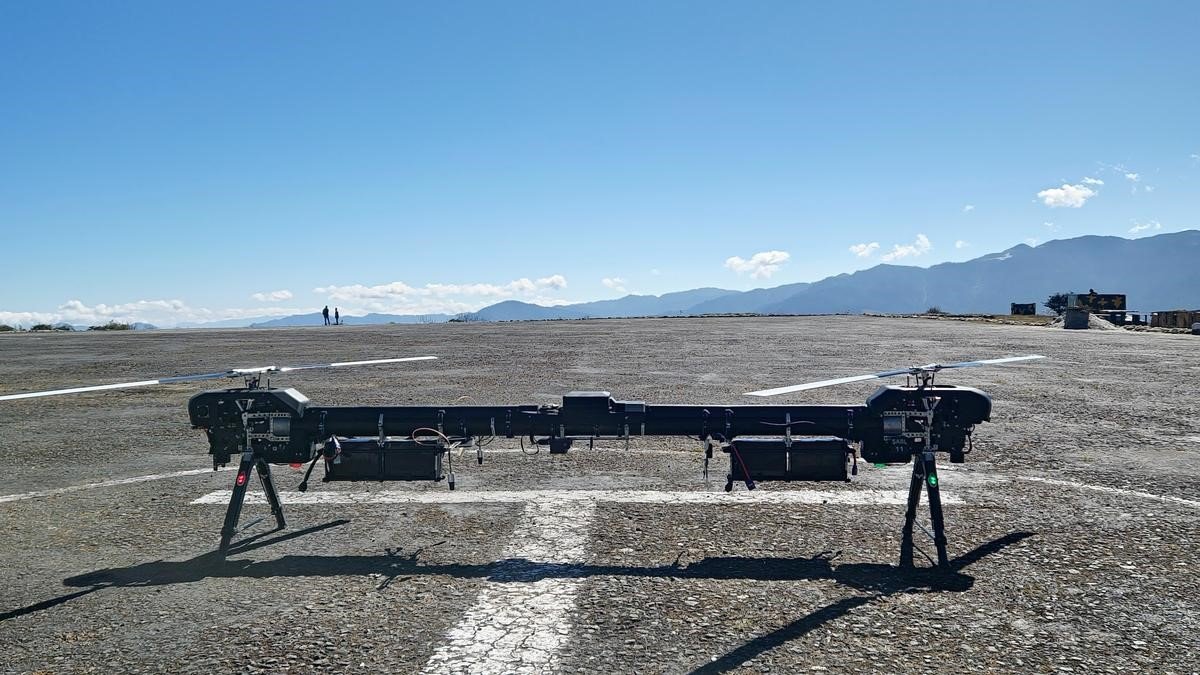
The SABAL-20 looks unusual for a drone: two rotors in tandem, Chinook-helicopter style, instead of the familiar quadcopter layout. The configuration is a deliberate choice for heavy lift — the aircraft carries a 20-kg payload, roughly half its own weight, at 50–60 km/h with about 40 minutes of endurance and 10+ km range. It takes off and lands vertically, flies quietly on low-RPM rotors, and carries dual GPS, auto return-to-home, an emergency parachute, and an optional EO/IR camera. The company claims 65% indigenous components.
What the Army induction actually means
Precision matters here, because defence-tech coverage loves to blur it. PTI’s reporting confirms the SABAL-20 has been inducted and delivered to the Army’s Eastern Command — defence-tech earning institutional trust, the same milestone Pravaig’s VEER is working toward with the forces, and the aircraft has been tested in Ladakh-type high-altitude, sub-zero conditions. (A related variant, the SABAL-40, was tested at 15,000 feet.) Some outlets have used the phrase “active service” — that is single-source; this post sticks to PTI’s induction wording.
EndureAir was founded in 2018 by Dr Abhishek — an IIT Kanpur aerospace professor — with former students Rama Krishna and Chirag Jain. The company has raised over ₹60 crore in total, per BusinessLine, including ₹25 crore led by IAN Alpha Fund around September 2025, and holds 8 patents in flight dynamics and autonomy according to the company (reported by Entrackr).
Key takeaway
Key takeaway: SABAL-20 is real, delivered hardware doing Army logistics work. Everything about the 200-kg follow-on belongs in a separate paragraph — it does not exist yet.
The ₹30 crore grant — and the drone it funds
In May 2026, EndureAir became the first drone company in the first cohort of five startups under the Centre’s ₹1 lakh crore RDI scheme, receiving a ₹30.01 crore grant for the SABAL-200. Two things must be said plainly. First: it is a grant — patient capital for taking the technology from TRL 5 to TRL 9 — not an equity round or an investment. Calling it “funding” without the qualifier misleads.
Second, and more important: the SABAL-200 does not exist yet. It is a 200-kg payload-class VTOL design with a turbocharged internal-combustion engine, variable-pitch rotors, 2.5-hour endurance and 200-km range — on paper. The Instagram reel that surfaced this story merges the two generations into a “200-kg Himalayan drone.” That aircraft has never flown. The 20-kg one has; the 200-kg one is a development programme.
The ₹30 crore is a grant for development, not a purchase order — and the 200-kg SABAL-200 is a blueprint, not an aircraft. The 20-kg SABAL-20 is the one doing the work.
Beyond the battlefield
EndureAir is not a single-product company. Its tandem-rotor family spans the SABAL-20, 40 and 70, and it builds smaller aircraft too: Vibhram, used in Telangana’s “Medicine from the Sky” programme, and the Alakh nano-UAV, deployed in Chamoli and in Turkey’s earthquake rescue. A Bhutan demonstration delivered 20 kg to a monastery in about 10 minutes — a trek that takes hours on foot. On Republic Day 2025, two Sabal drones hoisted a 50×33 ft national flag in a Guinness record attempt.
The company is also co-developing high-altitude logistics drones with Bharat Electronics (BEL) — the kind of public-sector partnership that signals institutional seriousness beyond startup hype.
The honest read: EndureAir has done the hardest thing in defence tech — gotten real hardware inducted by a real customer. The SABAL-200 grant gives it runway to attempt something genuinely ambitious. But until that aircraft flies, the story is the 20-kg workhorse, not the 200-kg promise.

More Read

What is the SABAL-20?
A 20-kg-payload tandem-rotor logistics drone built by Noida-based EndureAir Systems. It has been inducted by the Indian Army’s Eastern Command for high-altitude logistics, per PTI reporting.
What is the SABAL-200?
A planned 200-kg payload-class VTOL aircraft currently in development, backed by a ₹30.01 crore grant under the Centre’s RDI scheme. It has not been built or flown yet.
Is the ₹30 crore an investment in EndureAir?
No. It is a grant — patient capital under the RDI scheme for developing the SABAL-200 from TRL 5 to TRL 9 — not an equity funding round.
Who founded EndureAir?
Dr Abhishek, an IIT Kanpur aerospace professor, with former students Rama Krishna and Chirag Jain. The company was founded in 2018 and incubated at IIT Kanpur.
Does EndureAir make other drones?
Yes — the SABAL family (20/40/70), the Vibhram medical-delivery drone, and the Alakh nano-UAV used in disaster response. Cargo drones are a crowded Indian bet — LogiXair’s 300-kg VTOL “flying truck” is chasing the same logistics prize from the civilian side.
Sources & further reading
- EndureAir Systems — official site — Product specs, company background, SABAL family details
- PTI via LatestLY: SABAL-20 Army induction — Verified reporting on Eastern Command induction
- BusinessLine: EndureAir RDI grant and funding — ₹30.01 cr RDI grant, ₹60+ cr total raised