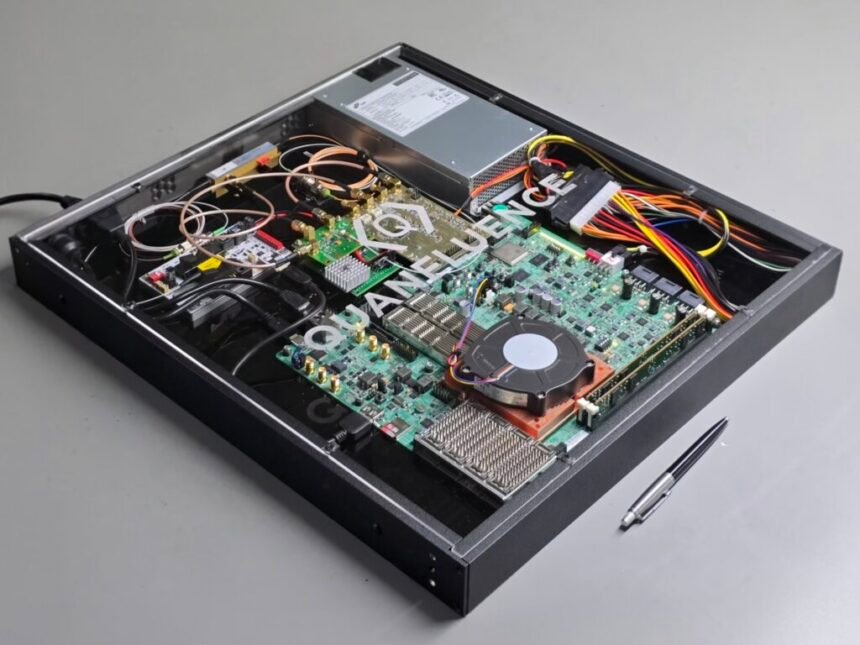
Most quantum computers in the world live inside dilution refrigerators, cooled to a fraction of a degree above absolute zero. The machine on a workbench in Bengaluru runs on light — photons, not superconducting loops — at ordinary room temperature. Its makers say it can chew through certain optimisation problems up to a hundred times faster than conventional computing. And they are already selling it.
Quanfluence, founded in 2021 and incubated at the IIT Madras Incubation Centre, is building what it describes as a full-stack photonic quantum computing system: indigenously designed photonic chips, control electronics and software, in a single architecture. In early October 2026, the company raised $10 million (around ₹92 crore) in a round led by Chiratae Ventures, with participation from Rainmatter by Zerodha and existing investor Pi Ventures — money earmarked for the long road to a general-purpose quantum computer.
The machine that already works
The centrepiece of Quanfluence today is not a quantum computer at all — it is an optical Ising machine, a specialised system the company designed for optimisation problems. It works by encoding a problem as an array of interacting spins, then letting the physics of light settle toward the lowest-energy configuration, which corresponds to the best answer. The company says its hybrid architecture processes hundreds of interconnected variables simultaneously, and claims speeds up to 100 times faster than traditional optimisation methods on certain workloads.
Why that matters: a vast class of real industrial problems — delivery routes, financial risk models, factory schedules, supply-chain allocations — are NP-hard combinatorial puzzles where the number of possible combinations explodes with each added variable. Ten agents making ten deliveries is already 10 billion possibilities. Quanfluence’s current system handles 128 interconnected variables and processes around 10,000 permutations; the company says it is now testing an advanced version capable of handling 10 to 25 million permutations.
Unlike conventional quantum systems, the whole thing runs at room temperature. There is no cryogenic cooling infrastructure — the company combines optics with high-speed FPGAs instead. The technical twist, per Quanfluence’s own engineering writing: matrix multiplication and spin-spin coupling are offloaded to FPGAs for precise, programmable control, while the photonic subsystem handles the nonlinear dynamics and bifurcation behaviour that drive the system’s energy-minimising search. The company calls its latest design a time-multiplexed coherent Ising machine, which it says can tackle problems with up to 100,000 variables.
Commercialised, not just demonstrated
What sets Quanfluence apart from much of the quantum field is that its optical Ising machine is a product, not a lab demo. Co-founder and CEO Sujoy Chakravarty told Inc42 the company has already commercialised the machine, selling physical systems to customers as well as offering remote access on a usage-based model. The company has sold around three machines and is currently running paid pilots with 10 to 15 corporations.
Its flagship platform, OPTIQON, packages the Ising machine as a hardware-accelerated optimisation platform for large-scale combinatorial problems. The company also sells quantum hardware modules built along the way: a high-speed balanced detector for homodyne measurement, room-temperature single-photon detectors, and a high-speed quantum random number generator for cryptographic systems.
From 4 qubits to a million
The $10 million round is aimed at the harder problem: a universal photonic quantum computer. Since its $2 million seed round in December 2024, Quanfluence says it has designed and fabricated multiple photonic integrated circuits and electronic integrated circuits, developed low-loss chip-to-fibre coupling designs, and demonstrated the generation of quantum light states.
The roadmap, as the company describes it: a four-qubit machine in the near term, early processors by 2027, a prototype of around 100 qubits by 2029, and a fault-tolerant, general-purpose machine over the following five to six years. The team of 25 is expected to grow to about 40 within a year.
The founders bring serious semiconductor pedigree. Sujoy Chakravarty, Ravi Mehta, Biman Chattopadhyay, Anil Prabhakar, Aditi Vaidya and Sandeep Goyal started Quanfluence in 2021; three of the founders previously built Silicon and Beyond, a semiconductor intellectual property company that was acquired by Synopsys. Chakravarty has said the company’s goal has “never been to build a better experiment” — it is, in his words, “to build a useful quantum computer.”
India’s quantum moment
Quanfluence is riding a genuine wave. The Indian government’s ₹6,003.65-crore National Quantum Mission is knitting startups, researchers and government-backed quantum hubs together, and photonics is one of the platforms it backs. Indian peers are moving too: QpiAI raised a $32 million Series A backed by the National Quantum Mission, QuBeats raised $15 million from Zoho Corporation and others, and BosonQ Psi (now BQP) raised about $5 million for quantum-inspired simulation.
Two caveats, honestly stated. An optical Ising machine is not a universal quantum computer — it is a specialised optimiser, excellent at one class of problems, unable to run the broader quantum algorithms a general-purpose machine would. And the performance claims — 100x faster, millions of permutations — are the company’s own, not independently benchmarked in public. Customer identities and revenue figures have not been disclosed. As Inc42 observed, Quanfluence’s immediate challenge is less about proving the concept than integrating components, scaling manufacturing, and navigating long chip-production and hardware-delivery cycles.
Still, the trajectory is notable: real hardware, designed and fabricated in India, sold to paying customers today, with the full quantum computer as the prize. In a field where most startups sell roadmaps, Quanfluence is selling machines.