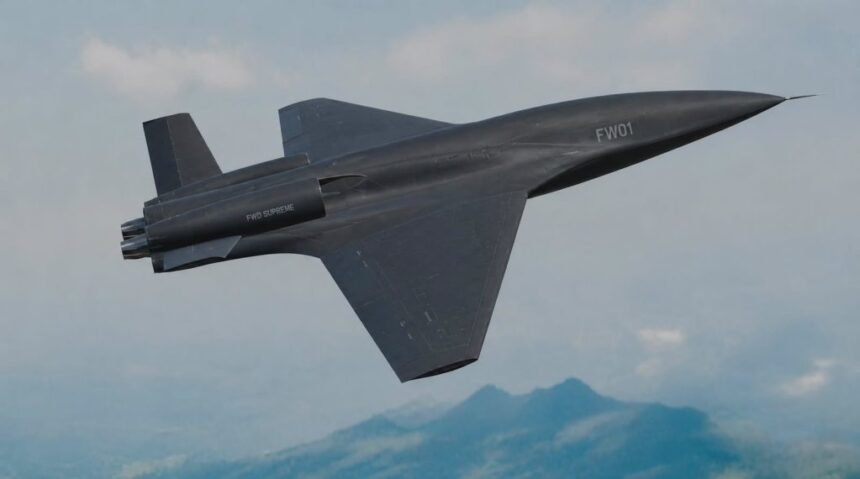
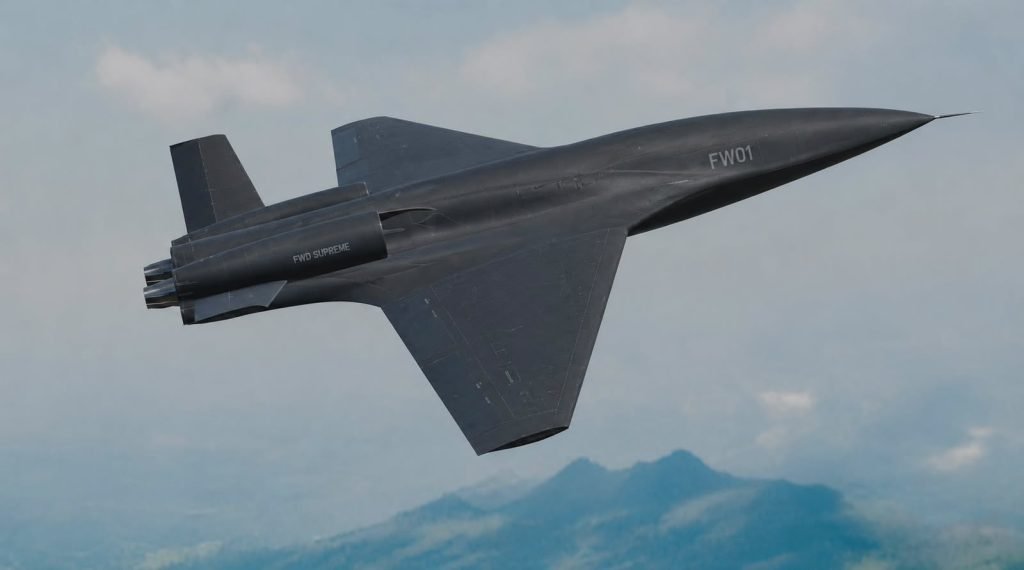
On Tuesday, 13 October, in New Delhi, Bengaluru-based startup Flying Wedge Defence & Aerospace (FWDA) unveiled a full-scale static prototype of the FWD Supreme Heavy — the aircraft it proposes as India’s first AI-piloted fighter jet. The company positions India among a small group of countries — alongside the United States, China and Turkey, by its framing — actively developing autonomous combat aviation.
Two aircraft, one programme
FWD Supreme is a family, not a single aircraft. The Heavy variant unveiled this week is a roughly 1.5-tonne-class aircraft, with configuration frozen and detailed design described by the company as halfway complete. Its stated Phase 1 parameters: a flying-wing layout of about 10 by 10 metres with an internal weapons bay, 350 kg payload, 5 kN of thrust, top speed of Mach 0.8 to 0.85, cruise at 500–600 kmph, range beyond 1,500 km, endurance over two hours, satellite-communication equipment, and — notably — the option to configure it as a manned platform.
The lighter sibling is FWD Supreme Lite, a roughly 250 kg technology demonstrator and flying test bed. The company says two smaller variants in this class have completed taxi trials and will pursue airworthiness certifications from the Centre for Military Airworthiness & Certification (CEMILAC) and NATO over the next couple of months, with a maiden flight ahead. Technologies validated on Lite feed directly into the Heavy variant.
The Mobbing Doctrine
Founder and CEO Suhas Tejaskanda’s pitch is built around what the company calls the Mobbing Doctrine: multiple AI-piloted aircraft operating as a coordinated swarm against high-value targets, where the loss of individual aircraft doesn’t end the mission — the survivors press on. It’s an attritable-mass logic: conventional fighters cost on the order of USD 100 million, the company told BusinessWorld, while its platforms are being developed at around USD 3–4 million, allowing airpower to be bought in numbers.
The Phase 2 roadmap is more ambitious still: supersonic performance approaching Mach 2, low-observable features, advanced AI mission autonomy and multi-aircraft collaborative combat teaming. A future phase aims at true air-dominance roles.
The team behind the bid
This is not a paper startup. Flying Wedge was founded in 2022 in Bengaluru and has flown real hardware: the FWD-200B unmanned bomber completed its maiden flight in September 2024, and the company says it was the first private Indian firm to secure a DGCA type certification for indigenous UAV technology, followed by an international order for 35 of its FWD-100 ISR aircraft and a loitering-munition unveiling at the Paris Airshow 2025.
More Read

The FWD Supreme programme is led by CTO Girish G. Dixit, a former member of DRDO’s Aeronautical Development Agency lab team that developed the LCA Tejas, alongside aerospace veterans including former Tejas project director V. Subba Rao and specialists in airframes, propulsion and avionics. That matters: this is a company whose leadership has shepherded manned fighters to flight before.
The cost and capability argument
The company’s core claim is economic: India’s defence sits between expensive fighter jets and cheap small drones, and autonomous fighter-class aircraft — affordable enough to field in fleets, smart enough to fly and fight without a pilot — can fill the gap. The AI layer is meant to deliver autonomous take-off, mission execution, sensor fusion, situational awareness and autonomous decision-making with minimal human intervention, rather than the remote piloting of today’s combat drones.
Caveats, honestly stated
Read the announcement for what it is: a static, non-flying prototype of the Heavy variant, with the detailed design still being completed and no announced timeline for its first flight. Every performance figure — the Mach numbers, the range, the payload, the 5 kN — is a company-stated design parameter, not a demonstrated result. The “only three other nations” framing is the company’s own characterisation. A. Anbarasu, Additional Secretary and Director General (Acquisition) in the Ministry of Defence, attended the unveiling and congratulated the team, but encouraged them to move forward “in a calibrated and coordinated manner” — a presence, not a procurement.
Still: a four-year-old Bengaluru startup that has already flown indigenous combat drones, holds a DGCA type certificate and an export order, and is now attempting fighter-class autonomy with a tested lighter demonstrator in the loop — that is precisely the kind of engineering ambition this site exists to showcase. The next answer the programme has to give will not be a rendering or a ceremony. It will be in the sky.