Most construction is poured, laid, or assembled. MiCoB prints it. The Ahmedabad startup has delivered more than 650 3D-printed structures across 13 Indian states, according to the company — including over 550 impact- and blast-resistant bunkers for defence applications — making it one of the few construction 3D-printing firms anywhere to operate at true industrial scale.

MiCoB was founded in 2018 by Shashank Shekhar, Ankita Sinha and Rishabh Mathur, who began the work as researchers at IIT Gandhinagar after identifying the chronic weaknesses of conventional construction — delays, material wastage, inconsistent quality and high cost. After an R&D phase, the company commercialised its technology in 2021 and now runs a 3D concrete printing plant at Indrad, Gujarat, alongside its Ahmedabad office.
A full stack, not just a printer
The company describes its product as a “Digital Construction Manufacturing” platform rather than a single machine: proprietary printable concrete mixes (fine-particle concrete instead of coarse aggregates, with industrial by-products such as fly ash to cut environmental impact), automated batching, controlled extrusion, and robotic deposition, all driven by its own slicing and simulation software, Krypton. Every build follows the same engineered sequence — design, engineer, prepare, print, integrate, build — which the company says turns construction into a controlled, manufacturing-led process rather than a labour-dependent site activity.
From bunkers to beach resorts
The breadth of deployment is what sets MiCoB apart. On the defence side, the company has delivered 3D-printed construction for the Indian Army, Navy and Air Force — blast-resistant bunkers that won it an iDEX challenge from the Ministry of Defence for “ballistic protection portable bunkers with cooling effect.” CEO Shashank Shekhar told YourStory its systems have been deployed in conditions ranging from coastal environments to climates of -20°C to +50°C and altitudes up to 20,000 feet.
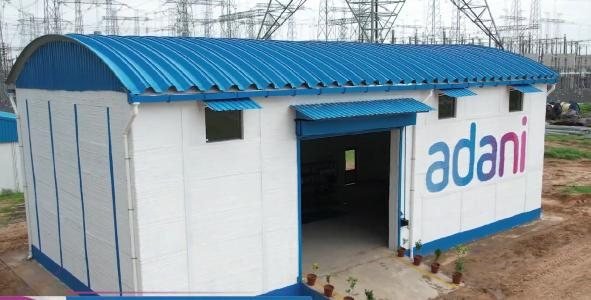
On the civilian side: a 2,200 sq ft 3D-printed store warehouse for Adani Energy at Lakadia, Bhuj; 600 sq ft canteen buildings at Ashoka University in Sonipat that drew recognition in architecture circles; and a 12,000 sq ft, 30-room resort at Nagoa Beach in Diu that has been operational for over a year, surviving a corrosive coastal climate that a client testimonial says validated the approach.
Recognition and the road ahead
MiCoB’s honours list includes the National Startup Awards 2022 from the Government of India, the CII Startupreneur Award 2025, a DPIIT-recognised startup registration, eight patent applications, and selection for YourStory’s Tech30 2026. In September 2026 the startup secured a reported ₹30-crore commitment on Episode 7 of Vande Bharatam — jointly offered by Flipkart CEO Kalyan Krishnamurthy and RENÉE Cosmetics co-founder Ashutosh Valani, with Karan Adani of Adani Ports separately offering support for deploying MiCoB’s technology across Adani infrastructure projects. As with any TV-format commitment, the reporting describes an offer rather than a closed round.
More Read
What 650 structures do and don’t prove
The headline figures — 650 structures, 13 states, 550+ bunkers — are company-reported, and the claim of costs “closer to conventional construction” deserves project-level evidence the company hasn’t yet published in full. But the direction of travel is hard to dismiss: an iDEX-validated defence deployment track record, repeat institutional customers, and a resort operating for a year in harsh conditions amount to real-world validation that few construction-tech startups can match. MiCoB’s bet is that the moat isn’t the printer — which, as the company itself notes, anyone can buy — but the integration of material, machine, software and execution discipline. On that measure, it is currently India’s company to beat.