
Praan Inc, a Mumbai deep-tech startup, does not make air purifiers the way the rest of the industry does. Its flagship machines have no filters to replace — a patent-pending system that pulls in polluted air, separates the particulate matter out of it, drops it into a collection tray, and releases cleaner air back into the room or onto the factory floor. The believers in this idea now include Wipro, Pidilite, Blue Tokai, Shapoorji Pallonji, Epsilon and Max Estates, according to the Financial Express — and the company says it has agreements to deploy its newest system across more than six million square feet of luxury real estate in India.

The technology that matters
The workhorse is the MK II (‘Mach 2’), a 6.5-foot-tall industrial unit. As Praan describes it on its official site, the device actively pulls polluted air in from the top, separates the particulate matter using the company’s patent-pending filterless technology, collects it in a collection tray, and releases cleaner air back into the hyperlocal atmosphere. It is, the company says, eight times more powerful than its predecessor the MKOne, moving 1,300 cubic feet of air per minute — and it is designed to be deployed in clusters, placed according to the pollution dynamics of each site, with no new infrastructure required.
The engineering logic is deliberately simple: without filters, there is no recurring filter-replacement cost, which is why the company claims near-zero maintenance. Because the captured dust is separated without changing its chemical composition, it can be fed back into the manufacturing process as raw material rather than landfilled. Each unit also carries industrial-grade sensors and software that monitor environmental conditions in real time and feed back performance and safety insights. The company claims the MK II handles extreme pollution — concentrations of up to 40,000 µg/m³ — which is the factory-floor reality its founder set out to fix.
HIVE and Sanctuary
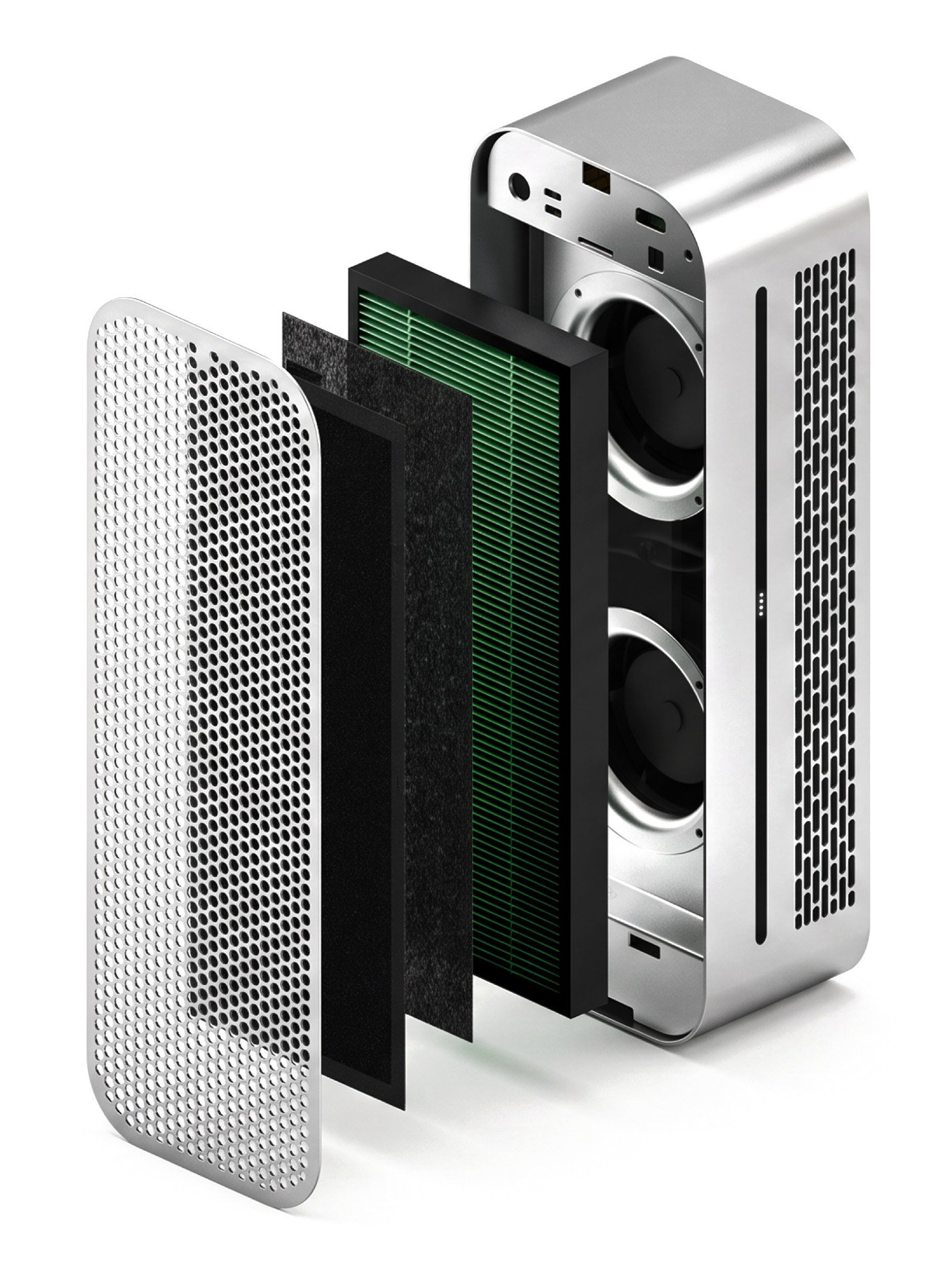
For homes and offices, there is HIVE — a compact, aircraft-grade aluminium unit that the company calls a statement piece rather than an appliance. The current version ships with medical-grade HEPA-14 filtration; the company claims it removes particles up to 166 times smaller and gases up to seven times faster than conventional systems, and the device carries sensors for particulate matter, VOCs, temperature, humidity, CO2 and ambient sound.
Then there is Sanctuary, the bigger bet: an integrated system that unifies HVAC, heating, humidification and purification into a single stack tuned to human physiology — ‘mountain-like air’ in every room, as the company puts it, dynamically adjusting temperature, humidity and air quality. The Financial Express reports Sanctuary agreements covering more than six million square feet of Indian luxury real estate, representing roughly $30 million (about ₹277 crore) in committed projects — with first mass-deployable systems targeted at thousands of homes by 2027.
The road so far
Praan was founded in 2017 by Angad Daryani, who grew up with asthma in Mumbai — his family would leave the city during the toxic winter months. He built robots as a child, collaborated with the MIT Media Lab as a teenager, and then started building air purifiers in his Georgia Tech dorm room; his first prototype was, by his own telling, a paint bucket with a motor. The early work was bootstrapped, built with a team of volunteers, and aimed deliberately at factories, schools and public spaces — the places where, as he saw it, the people who need clean air most cannot afford fancy devices.
More Read

The company has since raised around $2 million, manufactures in its own Mumbai facility (more than 90% of materials sourced locally), quintupled HIVE production capacity by the end of 2025, and is building a new facility targeting roughly 100,000 devices a year in 2026 — including bringing HEPA-14 nano-fibre production in-house. All of Praan’s core patents have received a Notice of Allowance from the US Patent and Trademark Office, per the Financial Express. Coverage of the company includes The Hindu BusinessLine and Inc42.
Caveats, honestly stated
‘The world’s most advanced’ is the company’s own description of its filterless technology, and the extreme-pollution figures are Praan’s claims, not independent test results published for review. Sanctuary’s six-million-square-foot pipeline is a waitlist of committed projects, and the 2027 mass-deployment target is a target, not a fact. And the direct-air CO2 capture sorbents the team is developing are explicitly a moonshot — ‘gigatonne capture goals,’ in the company’s words.
Still: a Mumbai hardware startup that has moved filterless purification from a paint-bucket prototype to named enterprise clients and a hundred-thousand-devices-a-year manufacturing plan — without the filter business model the whole industry runs on — is exactly the kind of engineering-first story worth noting.