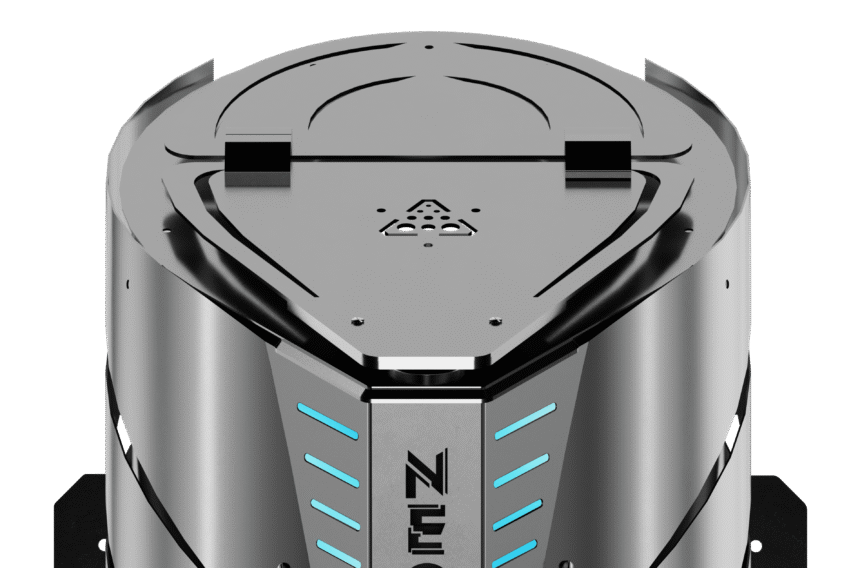
Image credit: Neo San
Every morning, trucks fan out across Bengaluru to collect some 6,000 tonnes of municipal waste. Up to a third of it is reject waste — the sanitary pads, contaminated cloth, packaging and medical refuse that can neither be composted nor recycled. Much of it ends up in landfills or open fires. A Bengaluru startup has decided the fix isn’t a better collection fleet. It’s no collection fleet at all.
The company is Neo San, founded by Dhwaj Bagrecha and Alistair D’Rozario (Neo San Private Limited, incorporated 2022), and its flagship product is the Neo-X — a compact on-site incinerator that destroys reject waste at the source, in minutes, instead of trucking it across the city.
1,200 degrees in two minutes
The Neo-X uses rapid, high-temperature electric heating based on induction principles to reach 1,200°C within about two minutes — roughly three times the temperature of a conventional incinerator — while, according to the company, consuming just 0.2 units of electricity per burn cycle. At that temperature, the company says, reject waste is reduced to a small volume of sterile, non-toxic ash, with dioxins, furans, NOx and sulphur compounds driven down to near-zero.
Neo San publishes its own emissions figures: sulphur dioxide at 2 mg/nm³ versus 250 mg/nm³ from open burning, and overall emissions it claims sit up to 98% below regulatory limits. A single Neo-X unit processes up to 25 kg a day — enough for a building, washroom block or small facility — and every burn cycle is tracked in real time by on-board IoT monitoring that reports each kilo processed.
Deployed, not demoed
The strongest signal for Neo San isn’t its spec sheet. According to the company’s live site, 200+ Neo-X units are deployed across 8 cities, handling 235+ tonnes of waste and offsetting 500+ tonnes of CO2. YourStory, which named the startup to its Tech30 2026 list, reports 50 paying clients across corporate offices, healthcare facilities and government bodies, with the company’s own site showing clients including Taj, JLL and SAP.
More Read
The technology has also been validated at the state level: the Karnataka State Pollution Control Board has reviewed and validated Neo San’s technology for city-wide deployment, and the startup won the World Economic Forum UpLink Yes/Bengaluru Urban Innovation Challenge — a coalition backed by AWS, Cisco, Deloitte, Salesforce, SAP, the Government of Karnataka and the Greater Bengaluru Authority.
That win feeds into SafeDispose Bengaluru, an initiative deploying Neo-X units phase-wise across government schools, primary health centres, women’s hostels and government housing to treat sanitary and biomedical waste at the point of generation — reaching over 5,000 women, according to the company’s deployment partner. The units’ IoT telemetry creates field-verified compliance data under India’s Solid Waste Management Rules 2026, aimed at eliminating open burning and manual handling of sanitary waste at these sites.
Sanitary waste, dignified
One of the Neo-X’s sharpest use cases is in washrooms. The company says a single unit can dispose of up to 1,500 sanitary pads a day, runs with zero smoke inside the restroom, and is safe to operate while the washroom is in use — or can be automated to run after hours. Neo San quotes a guaranteed product life of five years and says its systems are compliant with Bio-Medical Waste Management Rules, cutting medical-waste disposal costs by up to 80%.
The roadmap: bigger machines, wider mandate
Neo-X is the entry point of a three-model family. The Neo-XT, aimed at tech parks, hospitals and commercial complexes at 150 kg a day, is taking bookings; the Neo-AX, an industrial unit for manufacturing plants and airports at 500+ kg a day, is slated for Q1 2027. Neo San reports two granted patents for its thermal processing technology with ten more applications pending, and YourStory reports Rs 26 crore raised in total funding.
The company bills Neo-X as the world’s first decentralised reject-waste incinerator — a claim the industry hasn’t independently tested. What is independently documented is unusual for an early-stage clean-tech startup: in-house hardware manufacturing, pollution-board validation, WEF recognition, 50 paying clients and a city-scale government deployment already underway. If decentralised waste processing has a future in Indian cities, Neo San is currently the company building it at the source.