Image credit: Kubo Care
More than half of serious falls among older adults happen in the bathroom — the one room a camera can never enter. Wearables and panic pendants can help, but only when they are worn, charged and remembered. A Bengaluru startup has decided the fix isn’t a better wearable. It’s no wearable at all.
The company is Kubo Care, founded in 2024 by CEO Ayush Agrawal and COO Anurag Ram Chandran (Kubo Care Private Limited, Bengaluru), and its system watches over ageing residents with something no camera or wristband can offer: 60 GHz millimetre-wave radar.
Radar that reads a room, not a face
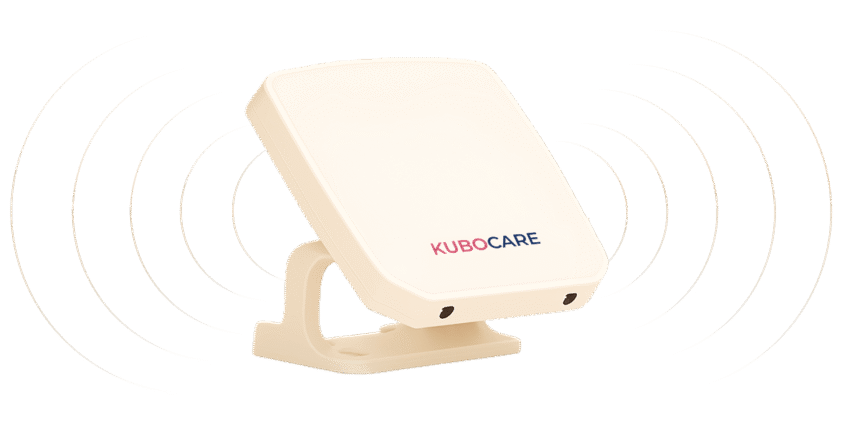
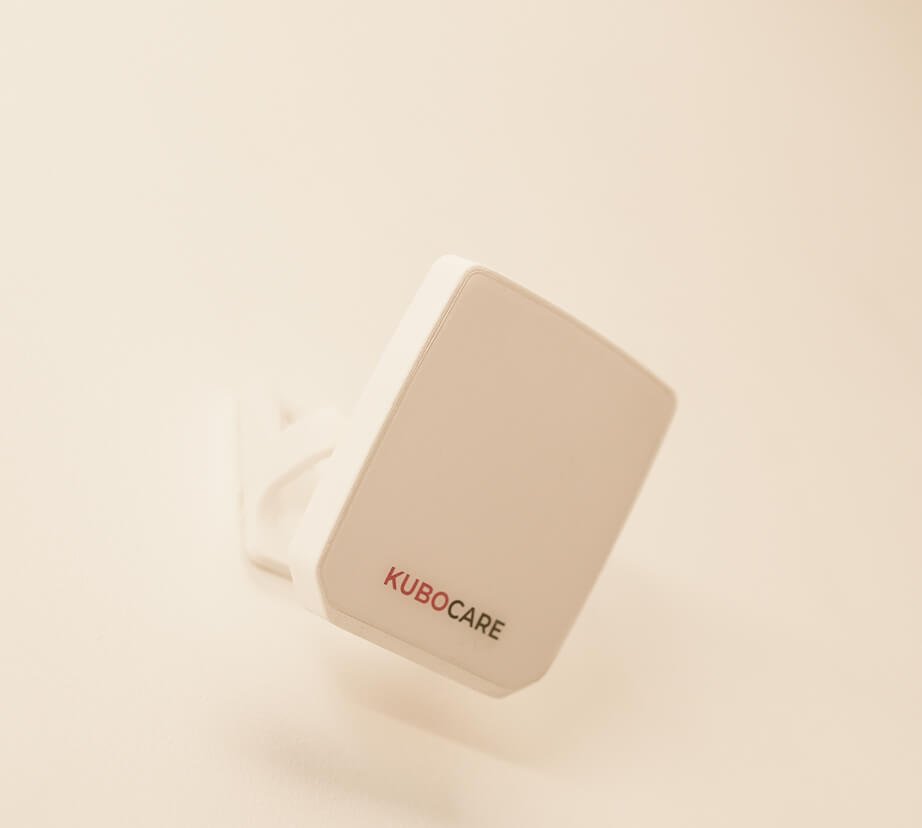
Kubo Care’s main device mounts on a wall or ceiling and transmits radio signals to map a room in three dimensions — echolocation, the way bats navigate — tracking presence and movement without capturing a single frame of video or a second of audio. The company’s own tagline is “Watches Nothing. Understands Everything,” and privacy is the whole pitch: according to the company, no images or personal data are ever recorded, and Kubo Care says it is officially SOC2 certified.
A fall, flagged in under a second
The system uses proprietary AI to analyse radar point-cloud data and identify movement patterns. It can detect a sudden fall in less than a second — while, the company says, distinguishing a genuine fall from someone deliberately lowering themselves to the floor. Kubo Care holds patents in India and the US for software that converts raw point-cloud data into real-time skeletal models to assess posture and gait, plus a patented method it says cuts false alarms by more than 99%. That last number matters: it is the difference between a care team that trusts its alerts and one that learns to ignore them. Fall-severity assessment sits alongside what the company lists as its five core capabilities — presence, motion, falls, severity and vitals.
From emergency alerts to early warnings
Beyond the fall itself, the system tracks contactless vitals — heart rate and respiration rate — and builds a baseline of each resident’s daily habits: sleep restlessness, night-time awakenings, washroom visits. Shifts in those patterns, the company says, can flag possible health issues such as urinary tract infections or gradual vision decline before anyone notices. The hardware also reads the room itself — light, temperature, humidity and air quality — and in larger homes the software hands tracking off between multiple wall-mounted devices as a resident moves between rooms. Everything is built in-house, from the hardware and custom firmware to the cloud platform and AI analytics, with an enterprise portal for care staff and a mobile app for families.
More Read
Two founders, two caregiving stories
Agrawal and Chandran met in early 2024 at Antler’s Bengaluru residency. Agrawal previously co-founded Seniority, a senior-care ecommerce platform, and worked as an AVP at CARS24; he lived the problem firsthand when his father suffered a stroke and fell while home alone, undiscovered for hours. Chandran, a Schwarzman Scholar who previously ran an Indian NGO, became the primary caregiver for his grandmother after an Alzheimer’s diagnosis. YourStory, which named Kubo Care to its Tech30 2026 cohort, reports the startup is currently pre-revenue and running pilots in India, Japan and the US — with retirement-community developers in India integrating its hardware into model homes as standard infrastructure.
Kubo Care’s family onboarding experience, via the company’s official site.
The business: SaaS, B2B first
Kubo Care sells on a software-as-a-service model, planning to charge senior-care operators $50 to $70 per device per month. Over the next year, the company says it will expand its B2B presence across senior-living facilities in Japan, the US and India — the world’s two largest senior-living markets plus home — while preparing a direct-to-consumer launch by late 2027. Dubai-based angel collective AngelSpark has backed the company to scale internationally, according to Elets eHealth. The iteration speed is notable: the company says it shipped seven hardware versions in six months, with a Gen 1.0 device for initial pilots and a Gen 2.0 adding advanced sensors and analytics aimed at prediction and wellness insights.
Kubo Care describes its approach as ambient intelligence for ageing — safety that asks nothing of the person being kept safe. The claims that matter most — sub-second detection, the 99% false-alarm cut, contactless vitals — are the company’s own, validated so far through pilots rather than independent clinical trials. But the direction is hard to argue with: a rapidly ageing world needs monitoring that doesn’t depend on memory, charging cables, or a camera in the bathroom. Kubo Care is building it in Bengaluru, one radar pulse at a time.