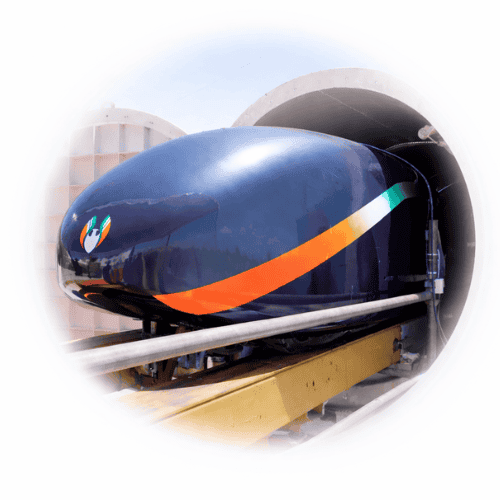
Image credit: TuTr Hyperloop — official company visual.
On 14 October 2026, Larsen & Toubro signed a memorandum of understanding with TuTr Hyperloop, an IIT Madras-incubated deep-tech startup, to jointly explore next-generation mobility infrastructure in India. The announcement, carried by PTI, framed the deal as a framework for evaluating projects across linear induction motor propulsion, vacuum tube infrastructure, pressure management, civil works and systems integration — with freight, logistics, port connectivity and industrial transportation as the first applications. It is worth knowing what L&T is buying into: in December 2024, TuTr helped build India’s first hyperloop test track — a 410-metre facility at IIT Madras’s Discovery Campus in Thaiyur.
India’s first hyperloop test track
The track was a joint effort between IIT Madras’s 76-member Avishkar Hyperloop student team, TuTr and L&T Construction. Union Railway Minister Ashwini Vaishnaw announced its completion in December 2024, posting a video of the facility and crediting “Team Railways, IIT-Madras’ Avishkar Hyperloop team, and TuTr”. In the first tests, the pod reached a reported 100 km/h, with a target of 600 km/h next. The stated plan, widely reported at the time, is to follow with an 11.5-kilometre certification track and eventually a corridor of about 100 kilometres.
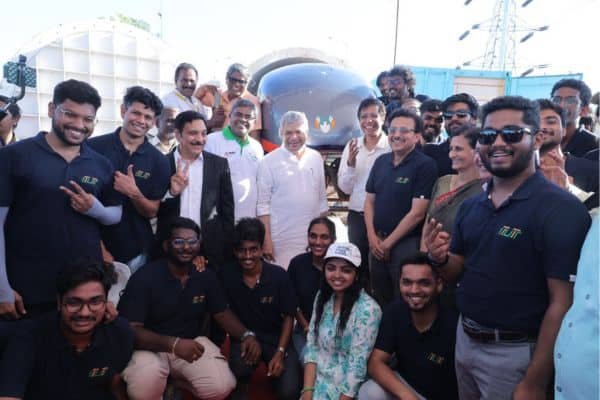
The 410-metre test track at IIT Madras’s Discovery Campus — India’s first. Image: TuTr Hyperloop.
Freight first: the cargo mobility platform
TuTr’s public positioning is deliberately unglamorous: “for freight today, passengers tomorrow”. The company describes a modular, always-on cargo platform built on three technology stacks — linear induction motor propulsion first, then magnetic levitation, then vacuum-based systems — and says the programme is “customer-funded, milestone-driven, and already running”, with 7–10 paid proof-of-concept projects planned across the stacks. The near-term milestones on the company’s roadmap take the LIM train from technology readiness level 6 to 7 by 2028, with a first commercial kilometre thereafter, levitation following by 2030 and a full vacuum network by 2033. These are the company’s stated targets, not achieved results.
More Read
TuTr Hyperloop’s own platform film — official company footage.
The company behind it
TuTr Hyperloop Private Limited was incorporated in February 2022 and sits at the IIT Madras Research Park in Taramani, Chennai. Corporate filings name directors Satyanarayanan Raghuraman Chakravarthy and Aravind Sourirajan Bharadwaj, and the company’s about page lists heavyweight mentors including R. Seshasayee (former chairman of Infosys) and Lakshmi Narayanan (former vice chairman and CEO of Cognizant). In July 2026, Titagarh Rail Systems was reported to have partnered with TuTr on freight-specific hyperloop solutions — a second major-industry validation within months. On its own site, the company says it has won tenders including a $1 million port-scale project and a $3 million container-terminal project, with deliveries slated for October 2026 and June 2027; those figures come from the company alone and have not been independently verified.
What to watch
The L&T pact is a framework, not a confirmed construction contract — every real project will need a separate agreement, and PTI’s own reporting stressed as much. Hyperloop technology remains pre-commercial everywhere in the world, and the speeds demonstrated on the Thaiyur track so far are modest next to the 600 km/h and 1,000 km/h-plus figures in the rhetoric. But the track is real, the industrial partners are serious, and the cargo-first framing is the honest one: before anyone flies through a vacuum tube at aircraft speed, India’s hyperloop story will be proven — or not — in freight, ports and logistics. TuTr, backed by two of India’s biggest engineering names, has put itself at the centre of that experiment.