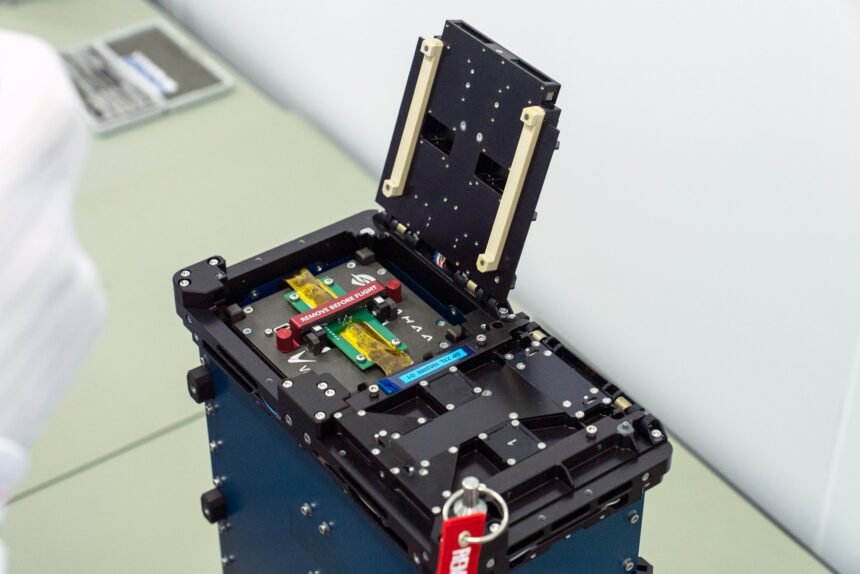
Image credit: Grahaa Space — official company visual.
Nearly every picture of the Earth you have ever seen from orbit is a snapshot — taken hours, days or weeks before you looked at it. For a country responding to a flood, a ship moving through contested waters, or a crop wilting in a district nobody visits, a day-old picture is often a useless one. Grahaa Space, a Bengaluru spacetech startup, is trying to fix that gap at the source: instead of better cameras, it is building the kind of satellite that can stream the Earth live.
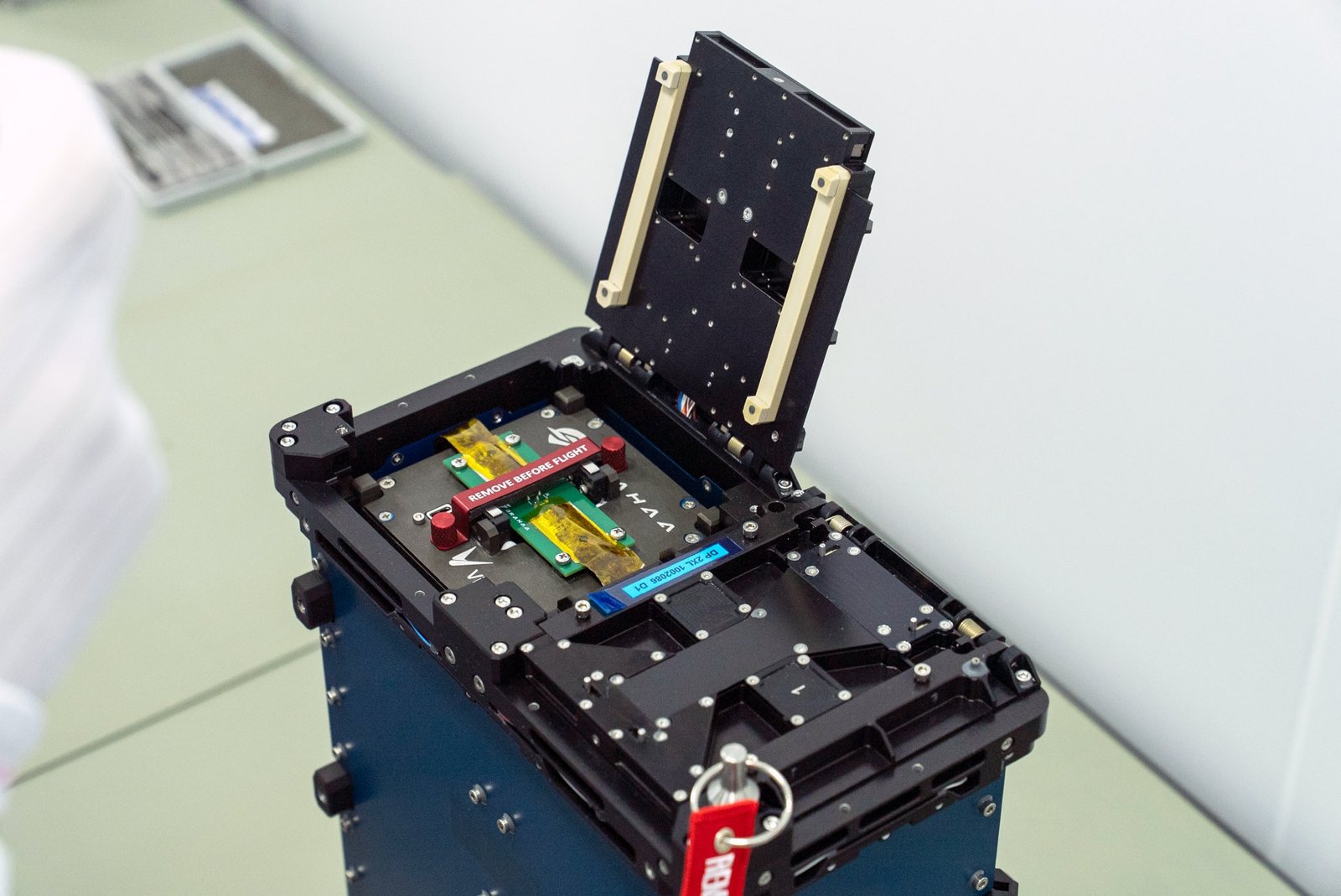
The SOLARAS S2 nanosatellite — the company’s first flight hardware, now in orbit. Image: Grahaa Space.
The bus, not just the camera
Grahaa Space’s core technology is not an instrument but a platform: a proprietary, stackable nanosatellite bus that the company says cuts integration time and mission cost, scaling from a single demonstrator to a full constellation. On top of that bus rides a proprietary optical payload and onboard data-compression technology — innovations the company says it has patented — plus onboard AI and edge computing so raw sensor data is turned into object detections and analytics in orbit before it reaches the ground. The company’s site describes the promise as “orbit to insight”: task the satellite, stream the video, consume the analytics through secure APIs.
What makes the approach unusual is the mission profile. Rather than selling satellite imagery by the square kilometre, Grahaa Space wants to sell decision-making as a stream — near real-time, high-resolution video of client-defined areas of interest from low Earth orbit, for defence, disaster response, agriculture, smart cities and environmental monitoring. Founder and CEO Ramesh Kumar Venkatesan, formerly at IBM and Dell working on livestreaming technologies, traces the idea to NASA’s HDEV experiment, which streamed high-definition video from the International Space Station. “More than 90 per cent of the global imagery is not in real-time,” he told The Hindu BusinessLine.
More Read
Mission SIDDHI: the stack goes to space
The engineering had to prove itself in orbit before any of that vision could be trusted — and on 18 July 2026 at 12:05 IST, it did. Grahaa Space’s SOLARAS technology-demonstration nanosatellite rode into a ~450 km low Earth orbit aboard Skyroot Aerospace’s Vikram-1 maiden flight (“Mission Aagaman”), the first private Indian orbital rocket. The mission, named SIDDHI, set out to validate the stackable nanosatellite bus, the communications systems and a hosted-payload architecture — the flight even carried VISWA-M, an academic research payload developed by VIT-AP University, Amaravati.
Per the company’s subsequent announcement, SOLARAS met all of its mission objectives, transmitted payload data, and its telemetry operations are still continuing — grahaa.space still lists SOLARAS as “ON ORBIT SUCCESS” with an active telemetry feed. The development and post-launch signal verification were supported by the STIIC incubation centre at IIST, and the company thanked IN-SPACe and ISRO for their handholding, plus the global amateur-radio community for helping validate its telemetry.
From one satellite to a video constellation
The company is not waiting around to build on the demo. In a September 2026 interview with The Hindu BusinessLine, Kumar said Grahaa Space is stepping up its launch cadence: two more technology-demonstration missions are targeted for Q4 FY26 and Q1 FY27, with potentially three launches in the second half of FY27. The next mission’s job is to prove the optical payload — the step the company says comes before it starts building the constellation — and it has already signed two customers for its upcoming missions. Once the payload is proven, Kumar said, “we will start building the constellation. There we will sell the data.”
Grahaa Space’s pedigree is worth noting: it was founded in 2018 by Ramesh Kumar (incorporated in 2021, per The Hindu BusinessLine), and its co-founder and mission director is Dr Loganathan, a former ISRO deputy project director for IRS missions with 36 years of ISRO experience. Its listed launch and ecosystem partners include Skyroot Aerospace, IN-SPACe, IIST’s STIIC, Innospace and Microchip.
What to watch
The honest caveat: SOLARAS validated the bus, the comms and the hosted-payload idea — not the end-to-end live-video pipeline the company is ultimately selling. That’s what the next two tech-demo missions are for, and the optical payload is the milestone that matters. If the payload checks out in orbit, Grahaa Space becomes one of the first companies anywhere attempting a dedicated nanosatellite video constellation — and India’s deep-space video layer, built the Indian way: cheap, modular, and flown before it’s hyped.