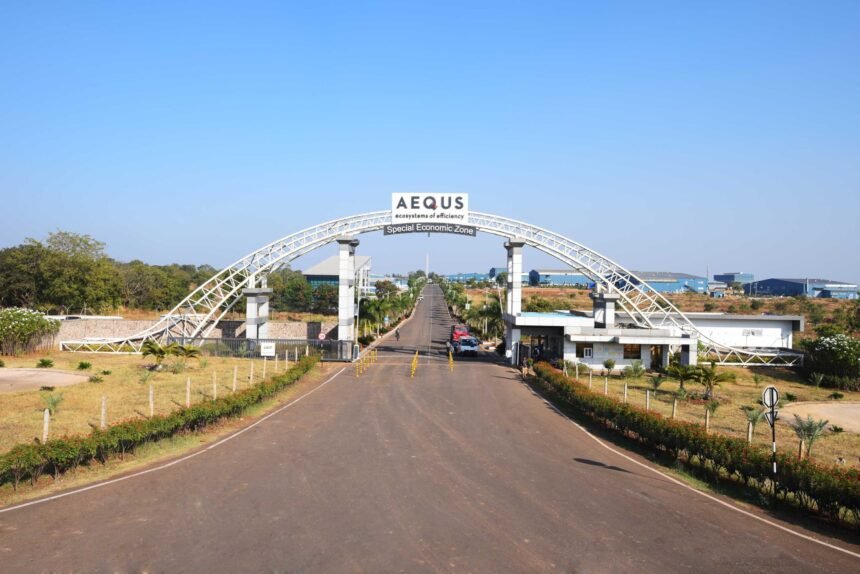
Image credit: Aequs — official company visual. Somewhere over the Atlantic right now, an Airbus A320 is climbing with a piece of Belagavi bolted to its fuselage. That is not a stretch: Safran has just signed long-term supply agreements with Aequs, the Belagavi precision-manufacturing company, for critical aerospace components — superalloy parts machining, complex machining and coating, and landing gear component assemblies for the Airbus A320, A330 and A350 families, plus the Boeing 787 programme. Reported on 17 October 2026, the deals extend a relationship that has run for more than a decade and take it from Safran Landing Systems into Safran Aerosystems. The Belagavi Aerospace Cluster will be the key manufacturing base.
It is the kind of contract that explains how a company from northern Karnataka ended up on the approved-supplier lists of Airbus, Boeing and Safran — and why its executives talk about forging presses the way other CEOs talk about software releases.
The deal: a decade-plus partnership, now for decades more
The new agreements, reported by Machine Maker, build on Aequs’ existing work with Safran Landing Systems and broaden the scope to Safran Aerosystems. The work covers machining superalloy parts, complex machining and coating, and the assembly of landing gear components — all for aircraft programmes with production runs measured in decades. Aravind Melligeri, Executive Chairman and CEO of Aequs, said the agreements reflected the company’s focus on long-term partnerships built around manufacturing capability, reliability and scale, and that the components involved required specialised engineering and production capabilities.
The announcement follows an earlier agreement signed by Aequs and Safran Landing Systems in July 2026 for fully assembled wheels for the Airbus A320 family. That contract runs through 2042 — the company’s first serial production agreement with a duration exceeding 15 years — and the components will be manufactured entirely in India, from aluminium sourcing through final assembly and testing, a programme the company says achieves full domestic value addition. The company also plans an Aequs Engine Components Ecosystem in Hosur, Tamil Nadu, intended for medium and large engine components.
One campus, start to finish
The engineering proposition is the 250-acre Special Economic Zone in Belagavi. Within one campus, Aequs runs the full aerospace manufacturing chain: forging at its SQuAD Forging joint venture with France’s Aubert & Duval, precision machining, surface treatment at a joint venture with Magellan Aerospace, and aerostructure assembly. The forging facility operates what the company describes as India’s first and largest closed-die forging press for aerospace components — a 10,000-tonne hydraulic press — alongside a 1,200-tonne screw press and heat-treatment lines. In September 2026, SQuAD passed the 25,000-wheel milestone at Belagavi, reaching its 25,000th aircraft wheel two years after the 10,000th, according to a PTI report.
More Read
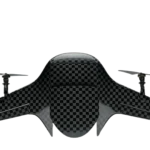
Engineers assembling an aerostructure at Aequs’ Belagavi facility. Image: Aequs.
The company’s own interview record puts the scale in numbers: about 1.5 million machining hours a year, and a surface-treatment unit the company says is the first in India approved by both Airbus and Boeing.
What flies with an Aequs part
The component list reads like an anatomy of a modern airliner. The company says it makes 50% of all the pylons for the Airbus A320 programme — the structures that attach the engines to the wings — and describes itself as the first Indian company to assemble plug doors and over-wing exit doors for Airbus and Boeing. It also makes landing gears for the Airbus A320 family and components for Safran’s M88 and LEAP series engines. Most of the parts it supplies are single-sourced, meaning Aequs is the only approved supplier for them — a position aerospace OEMs do not hand out casually.
The listed company
Aequs is no longer a private venture: it listed on the BSE and NSE on 10 December 2025 after a ₹922-crore IPO that was subscribed 104 times, per CNBC TV18, and listed at ₹140 — a 13% premium to its issue price. The company, founded by Aravind Melligeri, also makes consumer electronics, plastics and durable goods alongside aerospace, with manufacturing clusters in Belagavi, Hubballi and Koppal in Karnataka and operations in the United States and France.
What to watch
Deal values were not disclosed, so the size of the new Safran agreements is unclear — though the programme coverage and the 15-plus-year precedent suggest they are structural, not transactional. Several of the headline statistics — the pylon share, the ‘first and largest’ press — are company claims echoed by publications rather than independently audited figures, and Aequs remains exposed to the cyclicality of global aerospace orders and to customer concentration, with most of its revenue tied to its top customers. But the direction is verifiable: a Belagavi campus that forges, machines, treats and assembles in one place, wheels rolling out in the tens of thousands, and now a French aerospace giant signing on for the long term. That is the machinery behind the claim that much of what flies overhead carries a piece of India.