Image credit: Varaha ClimateAg — official company visual. Every harvest season in Maharashtra’s cotton belt, millions of tonnes of cotton stalks — the woody residue left after the harvest — are cleared the cheapest way available: set on fire. Gurugram-based Varaha ClimateAg has built a company around an alternative. Its industrial gasification reactors convert that agricultural residue into biochar, a charcoal-like material that locks carbon into soil for decades — and it sells the resulting verified carbon-removal credits to some of the largest technology companies on the planet.
The customer list explains why Varaha has become one of the most watched climate-tech companies in India. Microsoft has agreed to purchase more than 100,000 tonnes of carbon-dioxide-removal credits from the company over three years, and Google signed a 100,000-tonne biochar deal with it in January 2025 — Google’s first large-scale carbon-removal deal in India. In September 2026, pharmaceutical giant GSK signed an eight-year agreement for more than 500,000 credits covering 50,000 hectares across Punjab and Haryana, structured by the UK firm Earthly.
The Microsoft deal: 18 reactors in the cotton belt
The Microsoft agreement, announced in January 2026 and re-reported this week by Data Center Dynamics, is the technical anchor of Varaha’s biochar programme. The company says it will operate 18 industrial gasification reactors across Maharashtra’s cotton belt for 15 years, converting cotton stalks from an estimated 40,000 to 45,000 smallholder farmers into biochar — and, the company projects, removing more than 2 million tonnes of CO₂ over the project’s lifetime. The feedstock is exactly the residue that would otherwise be open-burned, which adds a genuine emissions-avoidance benefit on top of the carbon locked into the biochar itself.
The first reactor sits on Varaha’s own 52-acre cotton research farm. Microsoft’s carbon-removal programme director, Phil Goodman, has publicly supported the deal, calling out the combination of durable carbon removal with smallholder-farmer livelihoods.
First in India for biochar credits on a leading registry
Biochar carbon removal only works as a business if the credits can be independently verified and sold on credible markets. Varaha was the first company in India to issue industrial-biochar carbon-dioxide-removal credits through Puro.earth, the leading registry for engineered carbon removal, and it says it was the first in Asia to issue enhanced-rock-weathering credits through an international registry. Its projects also run through Isometric, Verra and Gold Standard, with credits released only after independent audit.
That registry layer is what separates verified removal from generic tree-planting offsets: every credit corresponds to a measurable tonne of CO₂ verified by a third party, priced accordingly by buyers like Microsoft and Google.
More Read

The engineering: reactors plus digital MRV
Varaha describes itself as a technology-enabled carbon project developer, and the technology splits in two. The physical side is the gasification hardware — industrial reactors that turn biomass into biochar and, in some configurations, useful heat. The digital side is its in-house MRV (measurement, reporting and verification) platform, which uses AI, satellite imagery and the company’s Vann mobile app to track farm activity, model carbon outcomes and feed data to independent auditors.
Alongside biochar, the company runs projects in regenerative agriculture, agroforestry and enhanced rock weathering — all monitored through the same digital stack.
The scale claims — attributed
Varaha says it now works with more than 200,000 smallholder farmers across more than 2 million acres in India, Nepal, Bangladesh, Kenya and Côte d’Ivoire, that its projects have sequestered more than 2 million tonnes of CO₂e, that it has paid out more than $4 million to farmers, and that it supports over 2,600 ancillary jobs. It also says it turned a profit in FY26, with revenue of ₹105.2 crore against ₹51.7 crore the previous year.
These are company-reported figures — the independently verifiable core is the registry-issued credits and the named offtake contracts — but the trajectory has drawn serious recognition. Varaha won the ET Startup Awards 2026 Social Enterprise category in August, was named in the TIME 100 Climate list and Forbes Asia 100 to Watch in 2024, was ranked #2 in FastCompany’s most innovative companies in Asia-Pacific for 2026, and is a World Economic Forum Technology Pioneer.
The scrutiny
No company selling environmental credits at this scale should escape scrutiny, and Varaha has faced it. In September 2026, Newslaundry published an investigation asking whether the on-ground benefits of one of Varaha’s projects, in Gujarat’s Banni grasslands, had reached local communities as promised. The story does not dispute the company’s credit-issuance mechanics, but it is a reminder that in carbon markets, the gap between verified tonnes and felt livelihoods is exactly what deserves watching — and what independent auditors, not company reports, are there to measure.
What comes next
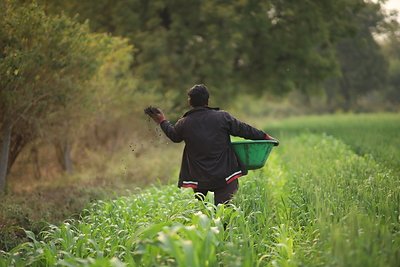
A farmer applying biochar to a crop field. Image: Varaha ClimateAg.
The GSK agreement — 500,000 credits over eight years across Punjab and Haryana — is Varaha’s largest to date and its first in regenerative agriculture at that scale. If it delivers on the contracted credits with clean audits, Varaha will have done something genuinely rare for an Indian climate startup: built a globally tradeable carbon-removal product from Indian farm waste, verified to standards that Microsoft and Google accept. If the farmer-economics questions grow, the same registries that validate the credits will have to validate the claims. Either way, the company’s 2026 is the story of India’s carbon-removal industry growing up — fast.