Most delivery drones fail at the one ratio that matters: the weight of the aircraft versus the weight of the cargo. A typical delivery drone needs about four kilos of machine to lift one kilo of goods — most of the energy goes into carrying itself. In Bengaluru, a three-year-old aerospace startup has decided to invert that equation.
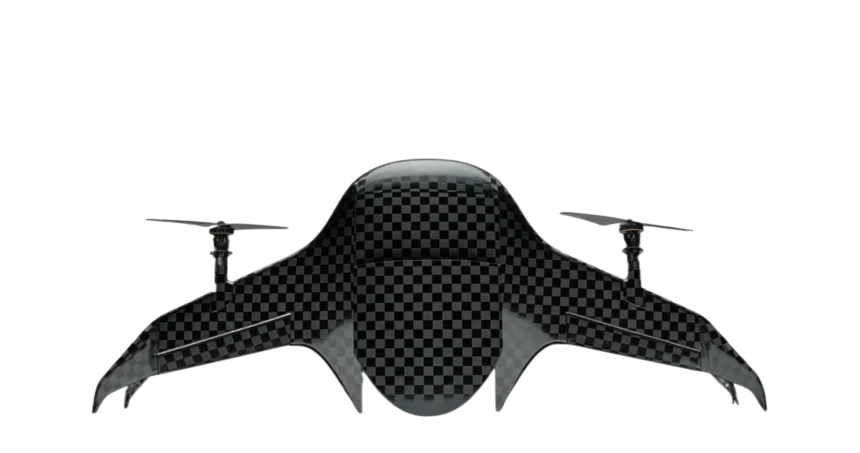
Airbound, founded in 2023 by Naman Pushp, builds the TRT — a blended-wing-body tailsitter drone that stands on its tail, lifts off vertically like a rocket, then tips forward and cruises on its wing at 60 km/h. Pushp started building drones at 15 during the COVID lockdown, hacking together prototypes from foam and stencils, and later deferred admission to Carnegie Mellon University to build the company full-time, Sify reported in a profile this month. The TRT is what that obsession produced: a carbon-fibre aircraft that weighs about 1.5 kg and carries about 1 kg of payload up to 40 km, according to the company’s own specifications — with a 1.4 m wingspan, a lift-to-drag ratio of 12, and noise kept to 60 dB.
The physics pitch is the payload ratio
Pushp’s argument, laid out in a long profile by Not Boring, is that logistics is a physics problem: conventional delivery drones spend most of their energy carrying their own weight, so the aircraft has to get lighter, not the cargo heavier. The TRT’s payload-to-empty-weight ratio is about 0.67x — against roughly 0.15x for Zipline’s P2 and about 0.06x for Amazon’s Prime Air drone, by the same profile’s arithmetic. The company claims four times the aerodynamic efficiency of conventional craft. If those ratios hold in service, the energy — and therefore the cost — per delivery falls off a cliff.
The composites are the trick
Airbound makes its own carbon-fibre composites rather than buying airframes off the shelf. Pushp says the team developed new carbon-fibre manufacturing methods that took the airframe from 6 pounds down to 400 grams, in an early interview — and design and manufacturing stay in-house at a 43,000 sq ft Bengaluru facility, per Dealroom. The company has also built Rudra, a fleet-management system that lets a single pilot manage more than 100 drones at once, Inc42 reported. Vertical takeoff with no runway, no charging pads and no ground crew is the other half of the design: the craft is meant to launch from anywhere roads don’t reach.
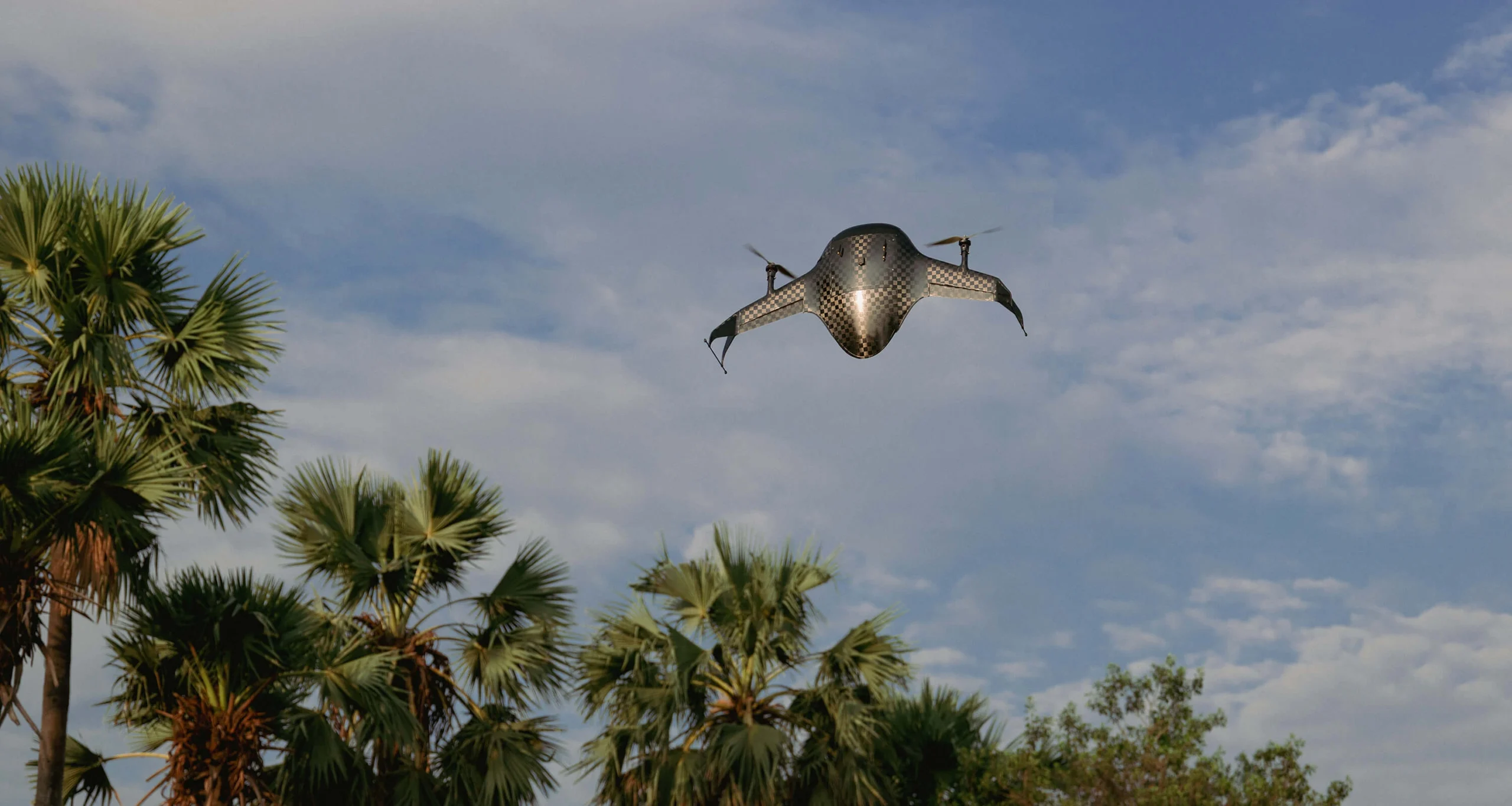
Airbound’s TRT in flight over the Andhra Pradesh countryside at sunrise — the company’s test operations run across Bengaluru and Guntur:

Flying for real, not demoing
Since January 2026, Airbound has been flying diagnostic samples for Narayana Health in Bengaluru — four kilometres in about 10 minutes — and within weeks the hospital stopped sending those samples by road, Interesting Engineering reported this month. The company says it has completed more than 1,000 autonomous flights with Narayana Health, cutting journeys that took hours by road to minutes, with no mission failures in those flights, YourStory reported in August. Across Bengaluru and Guntur, Airbound says it has now logged more than 13,000 autonomous flights — the figure is also the title of the company’s own milestone video, embedded below.
The strongest signal isn’t the flight count. It’s the hospital at Banashankari in Bengaluru, which was designed without an on-site diagnostic laboratory or blood bank — its test samples are expected to travel by air, DNN24 reported. A customer is building infrastructure on the belief that an air route can be as dependable as a road.
The Andhra bet
Under an agreement with the state, Airbound plans to build a three-city drone delivery network in Andhra Pradesh spanning retail, e-commerce and healthcare — eventually targeting up to 10,000 flights a day, YourStory reported. The economics target is stark: the company put a delivery last year at about Rs 24, roughly 25 cents, per Interesting Engineering — with the stated goal of making air delivery as cheap as trucking, and eventually, in Pushp’s words, “essentially free.”
The company’s TRT tailsitter launching in Guntur — the carbon-fibre blended wing body is visible as it climbs vertically before transitioning to winged flight:
The money behind it
Airbound raised $8.65 million in seed funding in October 2025, led by Lachy Groom (co-founder of Physical Intelligence), with Lightspeed, Humba Ventures and executives from Tesla, SpaceX, Anduril and Ather Energy participating. In August 2026 it raised a $37 million Series A led by Greenoaks, with DoorDash, Lachy Groom, Lightspeed and Humba Ventures — DoorDash’s first reported investment in a drone business — taking total funding to nearly $50 million, YourStory reported. The company now employs more than 150 people, per DNN24, and says a next-generation aircraft is in development — the company has spoken of a ~6.6-pound aircraft carrying up to 11 pounds of payload.
The caveats that matter
Three calibrations are essential. First, regulation is the bottleneck: beyond-visual-line-of-sight (BVLOS) approvals decide whether these aircraft can fly far without a human watching them directly, and without that, no delivery network scales — both Interesting Engineering and DNN24 flag it. Second, the company earns very little revenue so far despite 150+ employees and thousands of flights, DNN24 notes — a promising aircraft and a large round do not yet add up to a mature network. Third, the next-generation payload figures and the “essentially free” delivery goal are company targets, not demonstrated results, and the payload-ratio comparisons come via friendly profiles rather than independent testing. The verified core is real enough: an original aircraft design, 13,000+ autonomous flights, and a hospital customer that has already stopped using roads for some routes.
Why this one is worth watching
India has no shortage of drone startups, but most assemble imported parts or write logistics software around commodity quadcopters. Airbound is the rare one that started from the physics — a blended-wing tailsitter designed so the aircraft weighs less than its cargo — and then built the composites, the fleet software and the manufacturing to make that design real. If BVLOS regulation opens up, the Andhra Pradesh network becomes the experiment that decides whether truck-cheap air delivery survives contact with scale. A hospital has already redesigned itself around the assumption that it will.