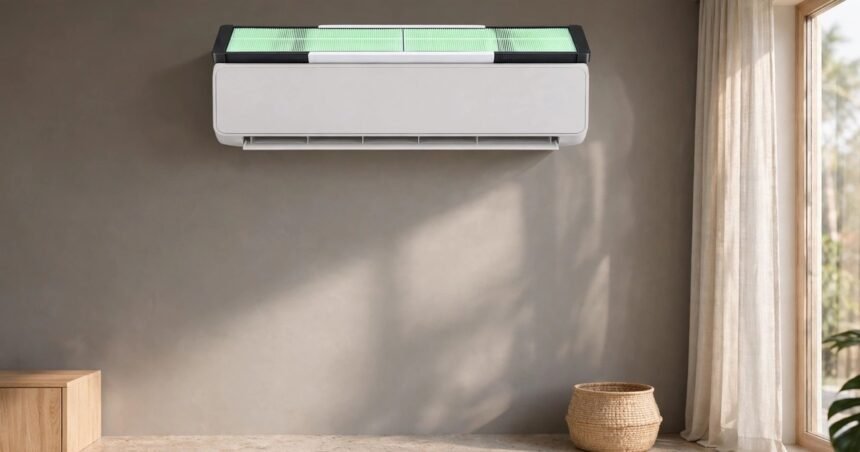
Image credit: Exceptional Technology — AI-generated illustrative scene for AIRTH’s AC air purifier, built from the company’s official product photograph; the company’s own product images all carry marketing text overlays.
An air purifier, at its heart, is a fan and a filter. And the fan already hanging on your wall — your split AC — moves about three times more air than a typical standalone purifier. A New Delhi startup called AIRTH spotted that simple mismatch and built its whole company around it: a slim filter module that sits on top of the AC you already own and turns it into an air purifier, with no extra electricity and no extra machine humming in the corner.
The idea is landing at exactly the right moment. As November smog settles over north India and indoor air turns as worrying as the air outside, AIRTH says more than 65,000 homes are already breathing through its filters — and the company says it now delivers over 7,00,000 cubic metres of clean air every single day.
The purifier hiding inside your AC
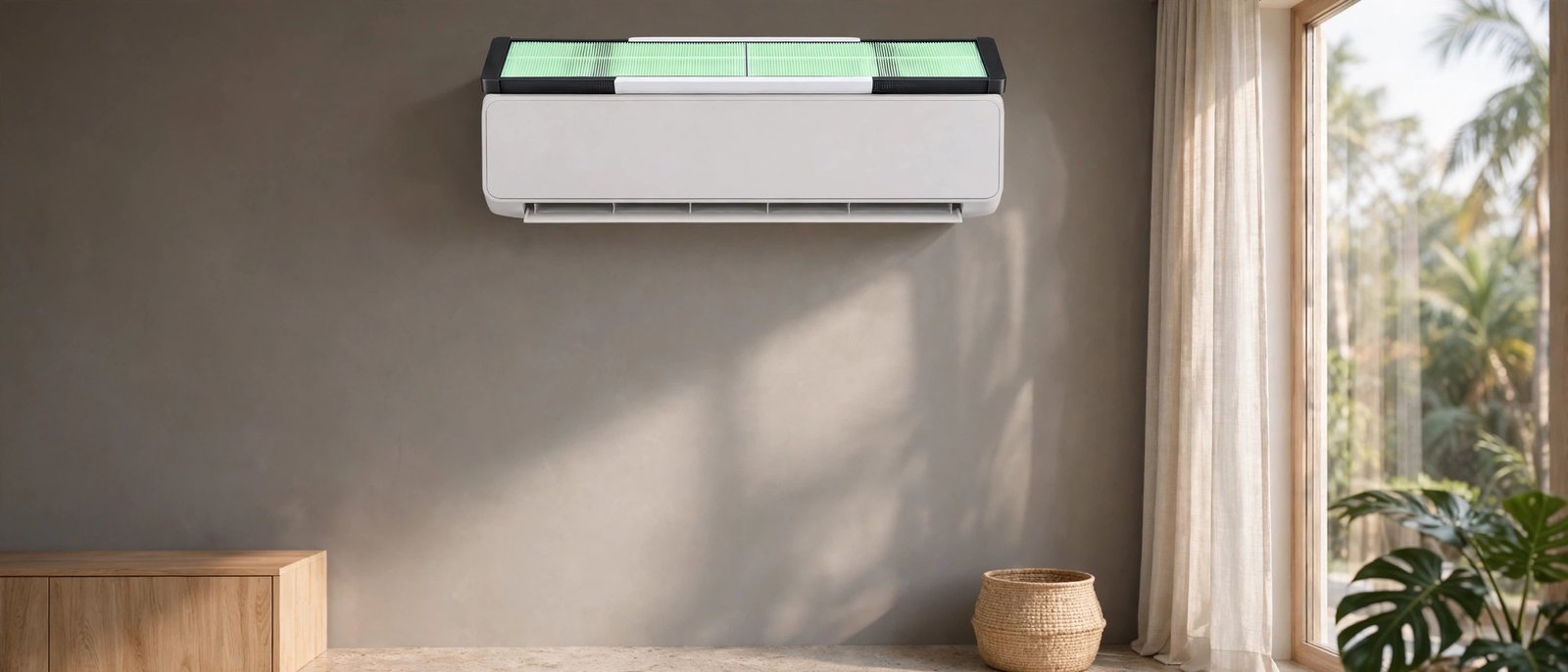
AIRTH’s module is a filter frame that rests on top of a split AC’s indoor unit, like a cap. Room air is drawn in through it before it reaches the AC’s own mesh filter, so every breath of cooled air has already passed through the company’s FILTRIX technology — a patent-filed coated HEPA filter with an antimicrobial layer. The company says it captures 99.97 percent of PM2.5, pollen and microbes as small as 0.3 microns, and cuts indoor pollution by up to 80 percent within 30 minutes.
The module fits all split ACs, measures 52 x 20 x 5 cm, and installs in minutes with no tools and no technician. AIRTH sells two versions: a Summer edition for AQI below 300 and a Winter edition with a double HEPA layer for denser smog. The Summer edition lists at ₹2,199 and the Winter edition at ₹3,199, with e-commerce sales regularly bringing the base model down to around ₹1,499. A replacement HEPA filter costs ₹1,250, and the company says one filter lasts a full season.
Because the AC’s own fan does the work, the module draws no power of its own — the company says a 1.5-ton AC moves roughly 1,000 cubic metres of air an hour, against 200–300 for a typical standalone purifier. The filter is also built to hold 2.5 times more dust than a standard HEPA, so it keeps working through a long smog season without choking the airflow.
More Read

Tested at three IITs
What makes AIRTH more than a clever accessory is the science behind the filter. The technology was developed at IIT Kanpur and IISc Bengaluru, and AIRTH is incubated at IIT Kanpur’s Startup Incubation and Innovation Centre. Its performance has been tested at three IITs: IIT Bombay’s Department of Chemical Engineering, IIT Kanpur’s National Aerosol Facility, and IIT Delhi’s Centre for Atmospheric Sciences.
The numbers from those labs are striking. At IIT Bombay, the clean air delivery rate rose from 50 to 245 cubic metres per hour — five times more clean air than the AC alone. Across the three institutes, the company reports up to 96 percent fewer airborne particles with the AC it already owns. The filters are also tested in NABL-accredited laboratories, and the company says the antimicrobial coating is plant-based, using polyphenols and polycationic polymers.
From a Shark Tank pitch to 65,000 homes
AIRTH was founded in 2020 by Ravi Kaushik, an aerosol scientist from IIT Bombay who set out to fix indoor air after watching his mother battle asthma, and later joined by co-founder Abhimanyu Kumar. In January 2025 the pair pitched on Shark Tank India Season 4, asking for ₹60 lakh for a 1 percent stake — and walked out with a ₹96 lakh joint offer from Aman Gupta and Vineeta Singh. The company says sales rose fivefold after the show aired.
Today the module is in homes, hotels and gyms across India — the company counts the Taj, cult.fit, DLF The Magnolias and Tanishq among its customers — and AIRTH has grown the same idea into filters for window and cassette ACs, air coolers, fan-coil units and large AHU systems, plus its own air-quality monitors and a fresh-air unit. It is a beautifully Indian answer to a very Indian problem: instead of asking families to buy yet another expensive machine, it makes the machine they already own do double duty — and the air in the room gets cleaner every time the AC runs.
Keep reading: Steel That Refuses to Rust: Inside Hindustan Zinc’s VedAZ and VedAyush, the Alloys for India’s Harshest Places · From Dead Batteries to Fresh Lithium: Inside LOHUM, the Greater Noida Company Mining India’s E-Waste · More Chemicals, Materials & Life Sciences stories
Like stories like this? Add Exceptional Technology as a preferred source on Google to see more of our reporting in your search results and Discover feed.