


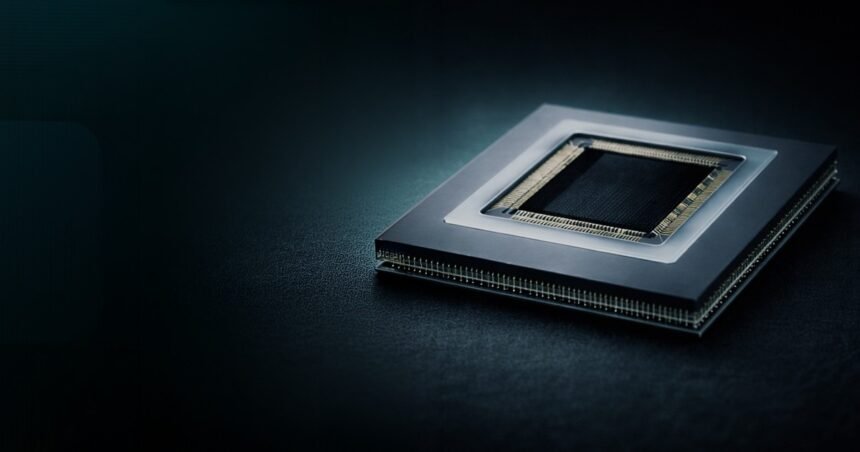
Every night-vision device, missile seeker and drone camera in India’s arsenal sees through a sensor India does not make. The company says India imports around $1 billion worth of these semiconductors every year for national-security needs alone. In September 2024, New Delhi and Washington announced the answer: a new fabrication plant called Shakti — one of the world’s first multi-material fabs dedicated to national security — built through a strategic technology partnership between Bharat Semi, its design arm 3rdiTech, and the US Space Force, with support from the India Semiconductor Mission.
Shakti will make the three compound-semiconductor families modern warfare runs on: infrared, gallium nitride and silicon carbide — the chips inside advanced sensing, communications and high-voltage power electronics, for national security, next-generation telecom and green energy. CNBC-TV18 reported the deal carries a 100% technology transfer from the US, with all enabling agreements in place. Reports at the time pointed to Jewar, Uttar Pradesh, next to the upcoming international airport, as the site. The company said it hoped to break ground in the first quarter of 2025 and begin manufacturing within three years, starting with 50,000 semiconductors a year in phase one — the first objective, the company says, is to plug the gaps in supply for the Indian Armed Forces, with exports to follow.
Two sides of the same coin
Bharat Semi and 3rdiTech are, in the founders’ own words, two sides of the same coin. The story began at IIT Delhi’s image sensor lab, where Vrinda Kapoor, Vinayak Dalmia and Mukul Sarkar met and conceived 3rdiTech in 2019. 3rdiTech designs; Bharat Semi, launched in 2023, is the manufacturing arm building India’s first homegrown integrated device manufacturer. The company’s low-light imaging sensors won the Army Design Bureau’s Award of Excellence, and 3rdiTech was one of the inaugural winners of the Ministry of Defence’s iDEX programme in 2018. The team went on to work with the US and UK defence departments, and in 2022 3rdiTech entered a strategic partnership with US defence major General Atomics Aeronautical Systems.
The sensors themselves are CMOS image sensors built for the hardest jobs in imaging: electro-optical sensing in the near-infrared and short-wave infrared, for surveillance, commercial UAVs, automotive vision and the machine-vision systems of physical AI. The company says its high-performance, high-reliability sensors are built for defence, surveillance, automotive and IoT — mil-grade durability for extended deployment cycles, with edge AI processing on the device.

From design to fabrication
The Shakti fab is the headline, but the build-out is already spreading. In May 2025, the Karnataka government approved a Bharat Semi Systems integrated design-and-manufacturing unit in Mysuru — a Rs 2,342 crore investment in compound semiconductors, silicon carbide and gallium nitride, creating more than 620 jobs. And at the Navy’s Swavlamban seminar in October 2024, an MoU was exchanged between Bharat Electronics, 3rdiTech and Bharat Semiconductors to develop niche semiconductor manufacturing together. The company said in September 2024 it had 85 people and aimed to grow to 250 by the end of 2025.
The timing is on the company’s side. In November 2026, the government opened applications under Semicon 2.0, the Rs 1,27,500 crore second phase of the India Semiconductor Mission — and at the CII Annual Business Summit in May 2025, Kapoor said India is the only country with enough skilled talent to rival China in semiconductors, with 20% of the world’s semiconductor design talent concentrated in Bengaluru, Hyderabad and Pune. The chips that let India see in the dark are, at last, being designed — and soon made — at home.
More Read

Keep reading: India’s First Quantum-Safe Algorithm: Inside Fortytwo Labs, the Pune Company Building Cryptography for the Quantum Age · The Rulebook for Defence Blockchain: Inside Zupple Labs, the Mangaluru Startup Securing India’s Records · More Industrial Automation & Technology stories
Like stories like this? Add Exceptional Technology as a preferred source on Google to see more of our reporting in your search results and Discover feed.







