


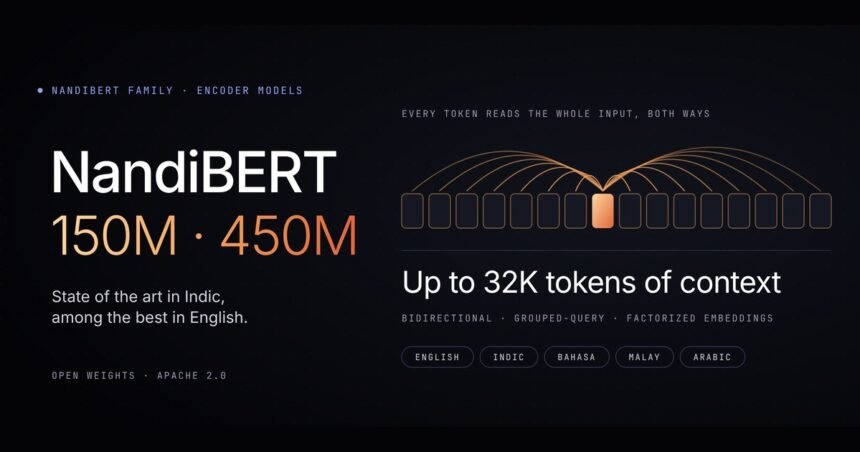
A search box in Hindi, a support ticket in Tamil, a contract in English — for most Indian teams, each of those needs a different AI model, or one model that understands one language well and the others barely at all. A small Bengaluru research lab thinks that trade-off should not exist. FrontiersMind, founded in 2026, has released NandiBERT, a family of open-weight text-understanding models that reads English and sixteen other languages — thirteen of them Indian — inside a single model, trained from scratch and free for anyone to download and use commercially.
The encoder that does the quiet work
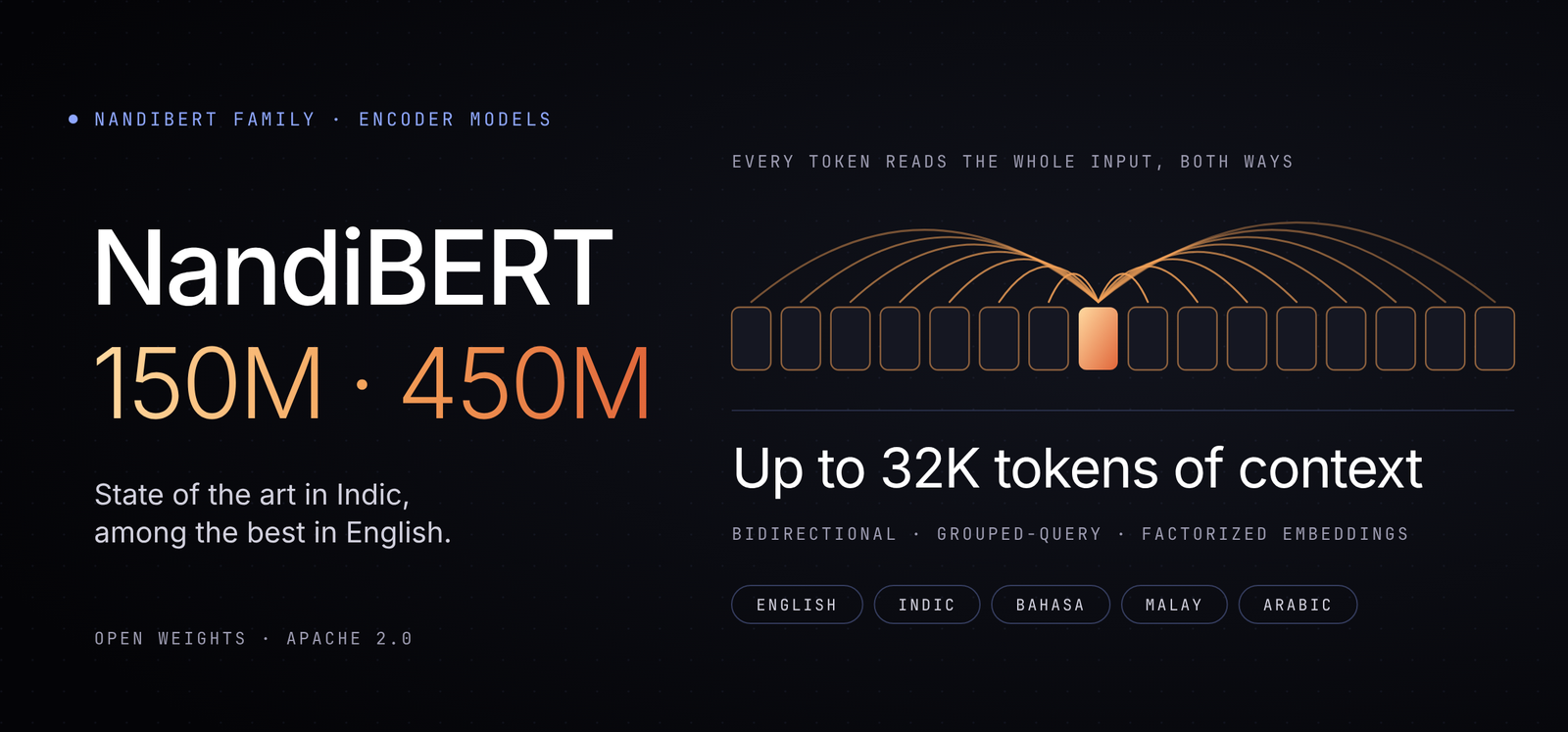
An encoder is the part of AI that reads text and turns it into numbers that capture meaning. It does not write anything back, which is what separates NandiBERT from the chat models most people have used. Once fine-tuned for a task, it can tell what category a document falls into, which names and places appear in it, or which of a million other documents say something similar. “Encoders do the quiet work behind search, classification, tagging and retrieval-augmented generation,” the lab writes in its launch post — and that quiet work runs on far smaller hardware than a chatbot needs. NandiBERT comes in two sizes. NandiBERT-150M has 146 million parameters in its encoder and reads up to 16,384 tokens at a time; NandiBERT-450M has 445 million and reads up to 32,768 tokens — four times the window of ModernBERT, the English encoder it is most often compared with. Both share one vocabulary of 100,352 tokens, and both are released under the Apache 2.0 licence, which allows free commercial use.
Trained from scratch, in a week of GPU time
The 450M model was pre-trained from scratch on 1.1 trillion tokens of text, and the 150M model was pruned and distilled from it. The company says pre-training took 168 hours on 16 NVIDIA B300 GPUs across two nodes — roughly 2,700 GPU hours for a model family that covers seventeen languages. Under the hood, both sizes share the same design: 28 layers, grouped-query attention that keeps memory low on long inputs, SwiGLU feed-forward layers and rotary positions tuned to stay distinct across 32,768 tokens. FrontiersMind was founded in 2026 by co-founder and chief executive Abhay Kumar, who has more than a decade of experience in AI, including work at AI labs in China and on the Falcon models at the Technology Innovation Institute in Abu Dhabi. The lab describes its goal as sovereign superintelligence for enterprises in regulated sectors — building its own architectures and pre-training its own models rather than fine-tuning someone else’s.
Seventeen languages, one vocabulary
NandiBERT’s single vocabulary covers English, thirteen Indian languages — Assamese, Bengali, Gujarati, Hindi, Kannada, Malayalam, Marathi, Nepali, Odia, Punjabi, Tamil, Telugu and Urdu — plus Bahasa Indonesia, Malay and Arabic, along with code and mathematics. Eleven of the Indian languages also work in romanised form, which matters because so much Indian text online is typed in the Roman alphabet rather than in Devanagari or Tamil script. The lab also put a second number next to accuracy: tokenizer fertility, the average number of tokens a model needs per word. Across eleven Indian languages, NandiBERT averages 1.93 tokens per word against 2.08 for Sarvam’s 105-billion-parameter model — about 7% fewer tokens, with the biggest gains on Assamese, at 38% fewer, and Kannada and Nepali at about 15% each. Fewer tokens per word means less compute for the same text, because cost scales with tokens.
The numbers it is measured by
The yardstick for Indian-language encoders has been IndicBERT v2, built by AI4Bharat at IIT Madras. FrontiersMind reports that NandiBERT-450M beats it on all seven Indic tasks the lab reports, averaging 73.23 against 65.93, and that the smaller 150M model beats it on average too — 67.37 against 66.57 — with 46% fewer parameters. In English, the company reports both models among the best in their size classes, ahead of ModernBERT and Ettin on a ten-benchmark average: 63.3 for the 450M against 61.0 for ModernBERT-large, and 61.0 for the 150M against 58.6 for ModernBERT-base. A second family built on top of NandiBERT, EmbeddingNandi, turns text into vectors for semantic search and retrieval. FrontiersMind reports that EmbeddingNandi-450M averaged 74.22 across three tests from MTEB, the Massive Text Embedding Benchmark, re-running every model itself with the same code — ahead of Google’s EmbeddingGemma 2 at 71.40 and Alibaba’s Qwen3-Embedding-0.6B at 69.69, and further ahead on Indian languages, at 76.62 against 68.39 and 64.10.
Why it matters
India’s AI story has mostly been told through chatbots and giant models that live in someone else’s cloud. NandiBERT is the other half of the stack: the small, open, efficient models that sit inside search boxes, support queues, moderation filters and document systems — the places where a bank, a hospital or a government department needs AI that runs on its own servers, in its own languages, on data it never hands over. “Enterprises should not have to hand their most sensitive data to someone else’s cloud to use AI. They need intelligence they can own and operate,” Abhay Kumar said at the launch. “We are building models that are efficient enough for every enterprise to own, and releasing them openly.” The models are live on Hugging Face now, and the lab — part of NVIDIA Inception, Google for Startups and AWS Activate — is already working on its next families: Lumma foundation models, Nandi models for edge devices, and a larger platform called Centauras. For a lab founded this year, that is a remarkably complete first act — and for every Indian team building in its own languages, the encoder they needed is now free to download.
More Read

Keep reading: The Screen That Sees the Room: Inside Cybernetyx’s EyeRIS, the Indian Vision AI in 80 Countries · The Box That Lets Traffic Cameras Think for Themselves: Inside Radiantech Systems’ RTE-300-R · More Industrial Automation & Technology stories
Like stories like this? Add Exceptional Technology as a preferred source on Google to see more of our reporting in your search results and Discover feed.







