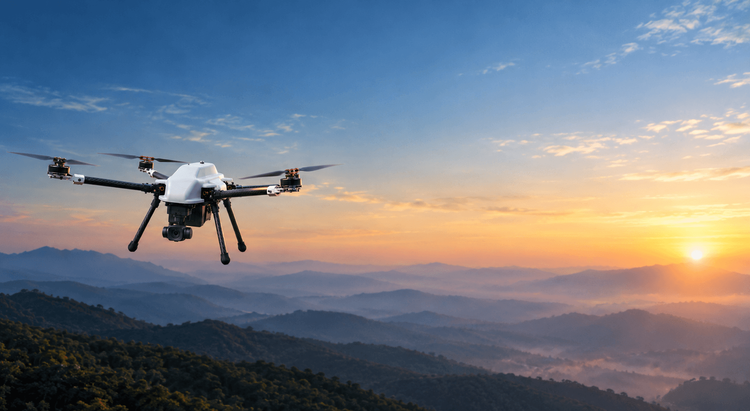
Image credit: axldrone — official company visual.
One end of the business builds long-range surveillance drones in joint development with the Indian Army, from an office in Kochi. The other end powers autonomous merchandise checkout stations for New York Knicks fans at Madison Square Garden. The common thread at AXL Systems is the hardware: the company says everything it builds is made in India.
The Army drone
Known in India as Axldrone Pvt Ltd, with AXL Systems as its international division, the company began around 2013 as a consulting outfit working for European and American software clients. It became a privately held company in 2015, and today employs over 150 people from its Kochi base, according to a 17 October 2026 feature in The Indian Express.
The move into hardware came through customers. Existing clients asked whether AXL could solve electronics problems, and the company concluded that different hardware would make its software better. Drones came from a simple observation: bridge inspections and area surveillance relied on fixed or two-dimensional viewpoints, and a three-dimensional approach would work better. The bigger engineering problem was longevity — off-the-shelf drones, the company’s CEO Joe Kuncharia told the paper, were often “collecting dust.”
On its defence work, Kuncharia was measured: he chose not to detail the firm’s growing relationship with the armed forces. But the outline is clear enough. AXL approached the Indian Army and learned about its unit requirements through public portals, and the result, per the company, is a long-range surveillance drone in joint development, carrying both AXL’s and the Army’s names. The company’s own site notes that the Indian Army required a reliable, indigenous UAV platform for long-range surveillance with extended flight endurance — and that its axl Peregrine drone was showcased in a briefing witnessed by the President of India and the Defence Minister.
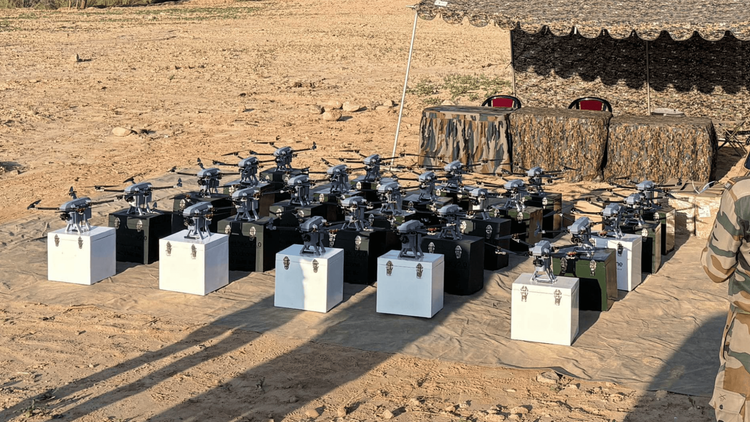
axldrone UAV systems in field deployment. Image credit: axldrone — official company visual.
More Read
Built, not bought
The most interesting engineering choice is the indigenisation push. Finding components that were not made in China was difficult, an AXL executive told The Indian Express — “but that was a good problem for us.” The company responded by building its own power distribution boards, GPS modules, flight controllers, remote controls and batteries.
That component stack is now a product line in its own right. The axl Orbit GNSS receiver, per the Kerala Startup Mission’s listing, offers positioning accuracy up to 1.5 metres across GPS, GLONASS, Galileo and BeiDou, with anti-spoofing and anti-jamming protection — designed and manufactured in India. The axl OneView remote controller runs a proprietary operating system the company calls axlDOS, with a 7-inch touchscreen and up to 10 km of control range. The flagship airframe, the axl Peregrine, is a lightweight, foldable carbon-fibre quadcopter built for industrial, surveillance and BVLOS work, with the company claiming up to 45 minutes of endurance, a 10 km operational range, a 4K three-axis gimbal camera with digital zoom, and integrated thermal imaging.
The Madison Square Garden business
The RFID line grew out of a roughly four-year US software partnership. According to Kuncharia, AXL’s proprietary RFID technology was deployed at Madison Square Garden in New York, powering autonomous merchandise checkout stations for Knicks fans — deployments he described as a first in the world.
The technical pitch is about speed and locality. AXL says its standard RFID setup can read up to 300 tags per second. Where many vendors send tag data to the cloud and wait for a response, AXL’s readers plug straight into the point-of-sale system over USB. “We increase that speed exponentially because of the local hardware technology,” Kuncharia said. The same technology guards the exit: if an alarm sounds on a shopper carrying 20 items, RFID can pinpoint which item triggered it. The company is piloting the system in India, where it says it is working against the notion that such technologies have failed before.
What to watch
The honest caveats: the Army relationship is deliberately opaque — the CEO declined to elaborate, and the joint-development claim rests on the company’s own account to The Indian Express. The 300-tags-per-second figure, the 45-minute endurance and the 10 km range are all company-reported and independently unverified. And drones that identify people, vehicles and objects across 300-kilometre stretches of forest have obvious dual-use dimensions, however civilian the stated applications — industrial safety, wildlife management, spotting illegal mining.
What stands out anyway is the method: a company that started borrowing someone else’s desk in Kerala chose the long road of building its own technology, with benefits visible only after four or five years, per Kuncharia. Fifteen years in, that patience has produced a rare combination — a defence drone programme developed with the Indian Army on one hand, and checkout technology deployed at the world’s most famous arena on the other. Both, the company insists, made entirely in India.