
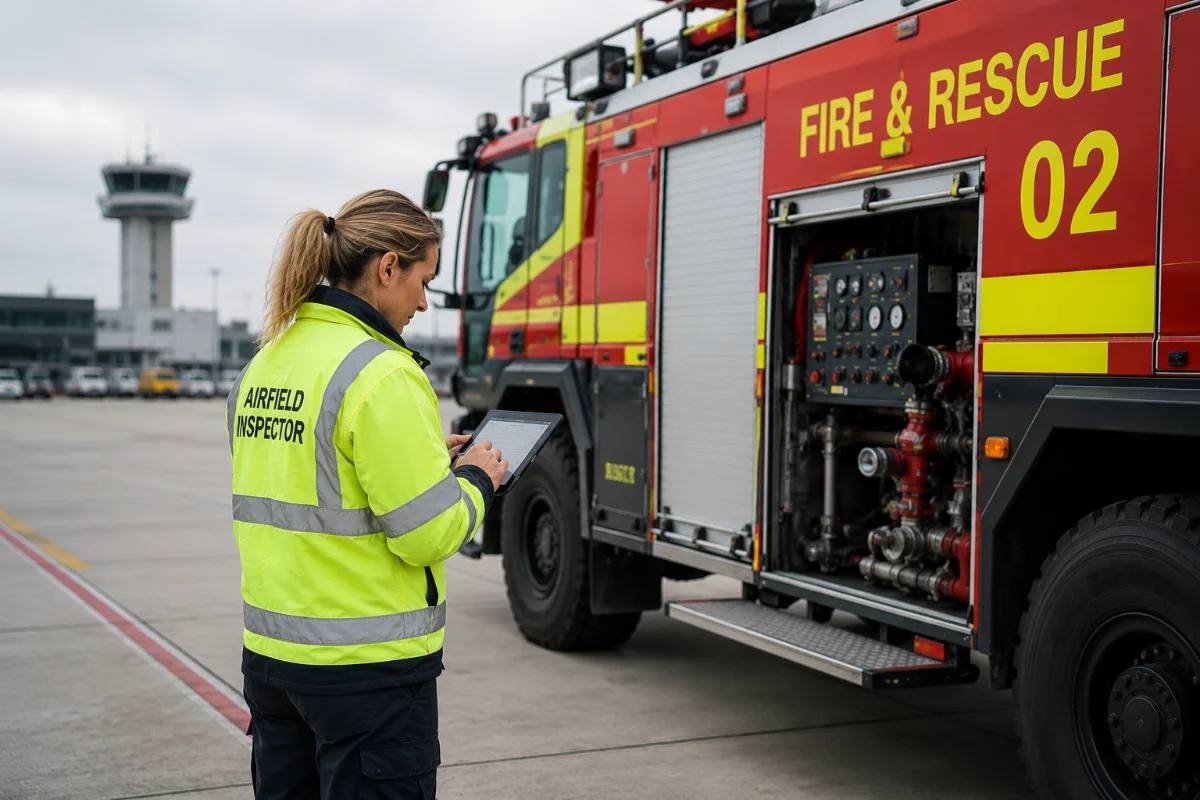
Image credit: Blunav. At Chennai International Airport, one of India’s busiest gateways, the people who keep flights moving are increasingly doing it on software built in Chennai. A small startup called Blunav has put its Aerios airport operating system into live operation at the airport under the Airports Authority of India’s Startup India initiative — replacing the patchwork of disconnected vendor systems and manual processes that most airports still run on with one connected platform, from flight schedules to airside safety alerts.
What Aerios actually does
Aerios is built in three suites on a single database, which is the whole point. The core platform, Aerios AMS, is the airport’s authoritative operational record: the Airport Operational Database (AODB), a Resource Management System (RMS) that allocates gates, stands, check-in counters and baggage belts with rule-based conflict detection, and the Flight Information Display System (FIDS) that drives every screen in the terminal. Aerios Orbis digitises the day-to-day work — asset management, airfield inspections with mobile forms, the operations log, lost and found, permit and badge management. Aerios Vecta tracks everything moving on the airfield: aircraft via ADS-B and surveillance feeds, vehicles via GNSS, all on one live airport map with geofencing, incursion and speed alerts, and 30-day airside replay.
The technical choices are worth noting. The central database is cloud-native so multiple airports can share one view, but each airport also gets an on-premise integration layer — AIDX messaging, AMQP over TLS — that keeps operations running through a connectivity drop and syncs when the link returns. Per the company, the platform follows ICAO and IATA operating standards, is CERT-In compliant, keeps per-airport data segregation, and speaks the industry protocols airports actually use: SSIM seasonal schedules, A-CDM, CUTE/CUSS, AFTN/AMHS and FIDS/PAVA integrations.
The numbers at Chennai
Blunav’s first major deployment is Chennai International Airport. In a release cited by The Hindu BusinessLine and The Times of India, the company said that after deployment, its Airside Management software enabled the airport to quantify a 22 per cent reduction in runway occupancy time — measured, the company says, across a 20-day study tracking more than 3,500 flights. Runway occupancy time is one of the hardest airport metrics to move: shaving even fractions of a minute off each movement compounds directly into capacity at a slot-constrained airport. That figure comes from the company and has not been independently verified — but it is, notably, the airport authority’s own operation supplying the measurement, not a lab demo.
The company behind the platform
Aerios is built by Blunav System Private Ltd, a deliberately small team based at the IIT Madras Research Park. Founded by Suseendar Marimuthu, the co-founder and chief executive, and Cherukuru Sridharan, the company describes its team’s background as nearly a quarter century of combined experience in AODB, RMS and FIDS work — airport operations and airport IT, not generic software services. In May 2026, Blunav raised $1 million in seed funding from Piper Serica to expand the team and scale deployments. The startup is squarely targeting the segment the industry’s giants underserve: small and mid-sized airports that still run on manual processes, while competing at the large-airport end against incumbents like SITA and Amadeus.
Why airports are the target
The timing is not accidental. India’s airport expansion — new terminals, privatised operations, regional connectivity growth — is creating greenfield demand for airport IT at exactly the moment when domestic procurement leans towards homegrown vendors. The company is also getting visible in the right rooms: co-founder and CEO Suseendar Marimuthu was among the startup founders who briefed Prime Minister Narendra Modi during the Chennai Metro’s inaugural ride on 11 October, presenting Blunav’s airport operations tools. Blunav’s stated ambition is a unified airport operating system built to global standards, made for underserved airports everywhere.
More Read

The caveats that matter
Two calibrations are important. First, the headline 22 per cent figure is the company’s reported measurement from its own study; no independent audit of the before-and-after data has been published. Second, one live deployment at one airport is a start, not a moat — the real test is whether Blunav can replicate Chennai’s results across the 12–24 month multi-airport rollout it is planning, against vendors like SITA and Amadeus that have been embedded in airport IT for decades. Airport technology is conservative for good reason: a failure in the operational database is not a bug report, it is a grounded flight.
Why this one is worth watching
Strip away the caveats and the achievement is concrete: an Indian startup, built at the IIT Madras Research Park, has put a vertically integrated airport operating system into live operation at an international airport — flight records, resource allocation, display systems, airside safety and maintenance workflows on one database, built to ICAO/IATA standards, with an on-premise layer that keeps the airfield running when the internet doesn’t. If Blunav can turn that into five or ten airports, it won’t just be selling software — it will be redefining who gets to run the digital layer of India’s airports.