Image credit: EtherealX
SpaceX made rocket boosters landing themselves look routine. The upper stage is a different story — every Falcon 9 still throws one away on re-entry. On 16 October 2026, a Bengaluru startup unveiled a 150-acre campus in Andhra Pradesh dedicated to solving the other half. Ethereal Exploration Guild — EtherealX, now going to market as The Guild — called the facility “The Anchorage”: a site in Space City, about 40 km from the Sriharikota spaceport, that will bring engine testing, manufacturing, stage qualification and refurbishment under one roof, according to the Economic Times. Everything there feeds one programme: the Razor Crest Mk-1 (RCM1), the company’s planned fully reusable medium-lift launch vehicle.
The industry’s unsolved half
The booster is the easy half of reuse. The upper stage comes home at orbital velocity — roughly 7.8 kilometres per second — arriving as a ball of plasma. No operational rocket has ever recovered one. EtherealX’s entire bet is that both stages can come back and fly again.
The company describes the Razor Crest Mk-1 as a roughly 71-metre vehicle that can fly expendable, partially reusable, or fully reusable: up to 24.8 tonnes to low Earth orbit in expendable mode, 22.8 tonnes partially reusable, and about 8 tonnes fully reusable, plus up to 10.8 tonnes to geostationary transfer orbit. A single flight could make up to 16 orbit insertions, the company says, enabling multi-customer missions without a third party for last-mile delivery. The targeted turnaround between flights is 72–96 hours, and the target economics are $350–$2,000 per kilogram depending on configuration and flight cadence — figures the company’s CEO, Manu J. Nair, disclosed to TechCrunch in January 2026.
Engines first: Stallion and Pegasus
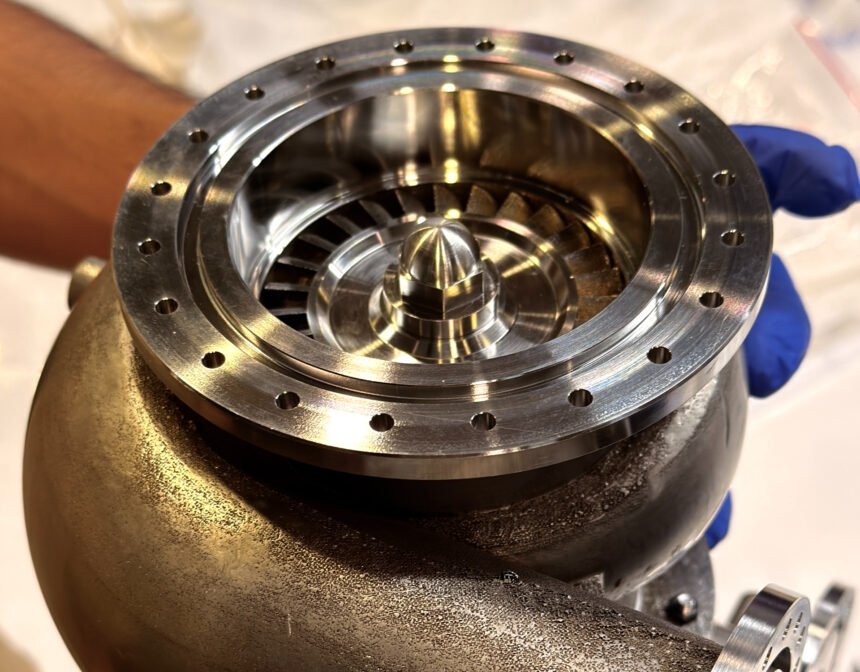
The hardware programme starts with propulsion. EtherealX has built two liquid engines in-house within about three and a half years, per the company: Stallion, a 1.2-meganewton gas-generator-cycle booster engine (306 seconds of sea-level specific impulse), with nine planned per booster; and Pegasus, the upper-stage engine (323 seconds of vacuum specific impulse) built around what the company calls a full-flow segregated cooling cycle, with 15 planned on the upper stage. Critical components such as turbopumps are additively manufactured in-house — the image above is the company’s own turbopump assembly, shared with TechCrunch.
The cleverest part of the design is how it handles re-entry. Instead of heavy, expensive heat shields, the company says it redirects re-entry heat through the propulsion system itself to slow the upper stage and bring it home. Nair has said EtherealX is deliberately skipping suborbital hop tests: the cooling system only produces meaningful data at true orbital velocity, so anything slower would be testing the wrong thing.
More Read
Two test bases and a deadline
EtherealX has been unusually serious about ground infrastructure for a startup its age. Base 001 in Cuddalore, Tamil Nadu — 700,000 square feet, which the company calls India’s largest privately owned rocket testing facility — already handles turbopump testing at more than 35,000 RPM and upper-stage engine qualification. The Anchorage in Andhra Pradesh’s Space City becomes the second leg: integrated manufacturing, assembly and full-stage testing, built with state government support.
The company’s stated timeline is tight: clustered engine hot-fire campaigns, a technology-demonstration flight in late 2027, and commercial missions from the end of 2028.
Money, contracts, and the honest fine print
The capital is real. EtherealX raised $20.5 million in a Series A round in January 2026, co-led by TDK Ventures and BIG Capital with Accel, Prosus, YourNest Venture Capital, BlueHill Capital, Campus Fund and Riceberg Ventures participating — at a post-money valuation of about $80.5 million (roughly ₹720 crore), nearly six times the ₹120-crore valuation at its $5-million seed round led by YourNest in August 2024. The company says it holds signed launch memoranda of understanding worth around $130 million from six customers, including Japan’s Space BD and Taiwan’s space agency TASA, and it was selected as a World Economic Forum 2026 Technology Pioneer.
The founders — Nair (CEO), Shubhayu Sardar (COO) and Prashanth Sharma (CTO) — bring experience from ISRO, satellite-propulsion startup Manastu Space and international aerospace research. Nair describes himself as a first-generation founder whose father served in the Indian Air Force; the company, he has said, began on money borrowed from his father.
The fine print matters too. The company was pre-revenue in FY2024-25, reporting a net loss of ₹4.2 crore. Memoranda of understanding are not firm orders. No Razor Crest has flown yet, and no one — SpaceX included — has ever recovered an upper stage from orbit. Regenerative kerosene cooling and a shield-less re-entry are brutally hard at this scale, and the gap between a compelling thermodynamic concept and flight-qualified hardware is measured in years and millions of dollars.
That is what makes the Anchorage worth watching. The next 18 months of testing — hot-fires at Cuddalore, and soon at a 150-acre campus in Andhra Pradesh — will say whether the full-flow cooling cycle is a genuine breakthrough or an ambitious idea the fire hasn’t yet validated. Either way, a Bengaluru startup just gave India its most serious shot at the hardest problem in launch.