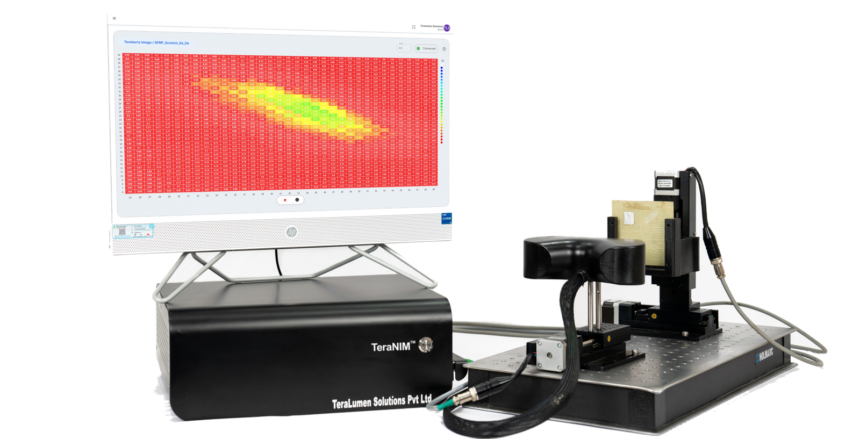
There is a band of the electromagnetic spectrum sitting between microwaves and infrared that can see through packaging, measure a car-paint coating without touching it, and spot defects inside aircraft composites — all without cutting, touching or irradiating anything. The instruments that work in this band have, for years, been bought from Germany and the US at roughly Rs 1.1 crore a unit. Now a 25-person company in Chennai says it has commercialised its own — and is selling them cheaper. TeraLumen Solutions, founded in 2019 by terahertz researcher Dr Jyotirmayee Dash, builds terahertz imaging systems for industrial inspection, research and medical use. Its flagship TeraNIM system does non-destructive testing for aerospace, automotive and oil-and-gas applications, the company says — and the founder claims its systems cost about 30% less than imported alternatives, per YourStory.
What TeraNIM does
Terahertz waves sit between microwave and infrared on the spectrum: they pass through dielectrics like plastics, composites and ceramics, but not metals. That makes them useful for seeing inside things that X-rays would over-penetrate and ultrasound cannot inspect without contact. TeraLumen’s TeraNIM is a turnkey industrial non-destructive-testing (NDT) system: a 1550 nm femtosecond laser THz source, a probe (handheld, scanner-mounted or robot/cobot-integrated), and onboard analysis software. The company’s published specifications put it at a 0.1–4 THz spectral range, over 70 dB of dynamic range, coating thickness measurement of 20 µm to 40 mm, and thickness accuracy of ±1 µm.
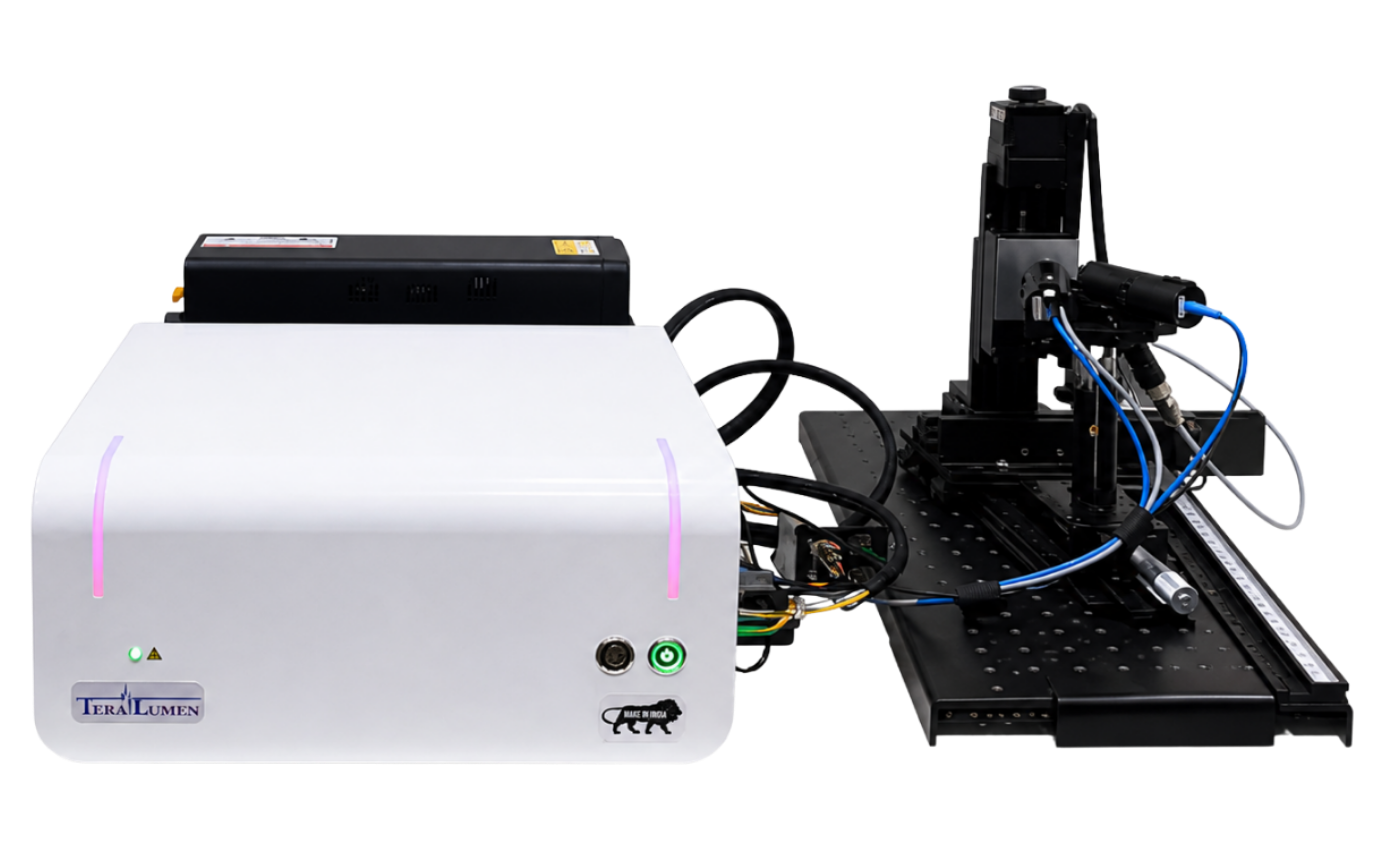
The applications are concrete rather than futuristic. In automotive paint shops, the system measures individual layers of multi-coat paint on metal, plastic and composite panels in 5–10 seconds per point, according to the company’s spec sheet. For aerospace, TeraLumen has published a case study on thickness measurement of EDPM polymer rubber components, where it says single-sided THz measurement matched micrometer references within 1% — useful where parts are bonded or installed and a micrometer cannot be used. The company also sells TeraXPLOR, a research and spectroscopy system for laboratories and universities, and is developing TeraMargin, a terahertz imaging device for identifying cancerous tissue margins during surgery, which is currently in clinical trials.
Why terahertz is a real gap
The honest part of TeraLumen’s story is the starting point: Dash’s own PhD equipment was imported. During her doctorate she says she used terahertz devices imported from Germany and the US costing close to Rs 1.1 crore — an expense that puts the technology out of reach of most Indian labs and factories. Building the instruments domestically is what turns terahertz from a laboratory curiosity into a usable inspection tool: an NDT system that detects delamination in carbon fibre or measures coating thickness has to live on a production floor, not in a physics department.
The company has real hardware to show for it. TeraXPLOR and TeraNIM were commercialised in 2024, and the company holds four patents including, per its site, a terahertz imaging system, a breast-cancer margin detection device, and a contact-less testing system. Dash told YourStory the company has raised around Rs 10 crore, generated close to Rs 7 crore in revenue over the last two years, and has seven customers, most of them B2B. It also says it has won support from DST’s NIDHI-PRAYAS, DBT’s BIRAC-BIG, and the VISA innovation programme — and it was named to YourStory’s Tech30 2026 cohort.
The people behind the machine
TeraLumen is the brainchild of Dr Jyotirmayee Dash, who earned her PhD in photonics from CSIR CECRI Chennai, where she helped set up what the company describes as India’s first dedicated terahertz lab. She has filed multiple patents and published over 30 papers, and before founding the company she was an assistant professor at SRM University in Chennai, where she spent years saving money and writing the business plan. The company is headquartered at the Golden Jubilee Biotech Park for Women at Siruseri SIPCOT, Chennai.
The hard part is still ahead
Honesty requires the caveat: a claim of “about 30% cheaper than imports” and “performance comparable with global suppliers” comes from the founder, and YourStory-level reporting is not independent metrology. Terahertz NDT is still an emerging inspection modality globally — most factories inspect coatings with eddy current, ultrasound or beta gauges, and displacing entrenched methods takes years of validation, standards work and customer education. TeraMargin, the medical device, faces the long road of clinical trials and regulatory clearance. And seven customers is a customer list, not yet a market.
What is genuinely exceptional here is the vertical integration: TeraLumen manufactures its own hardware and writes its own signal-processing software, a rare combination for deep-tech hardware in India. Terahertz sat in research labs for decades because the instruments were too expensive to touch; if a Chennai-built instrument can put this capability onto Indian factory floors and into Indian labs at a fraction of the import price, that is the kind of quiet infrastructure shift this site exists to document. The milestones to watch: scale of TeraNIM deployments beyond the first handful of customers, progress of the TeraMargin clinical trials, and whether Indian industry starts writing terahertz inspection into its quality standards.