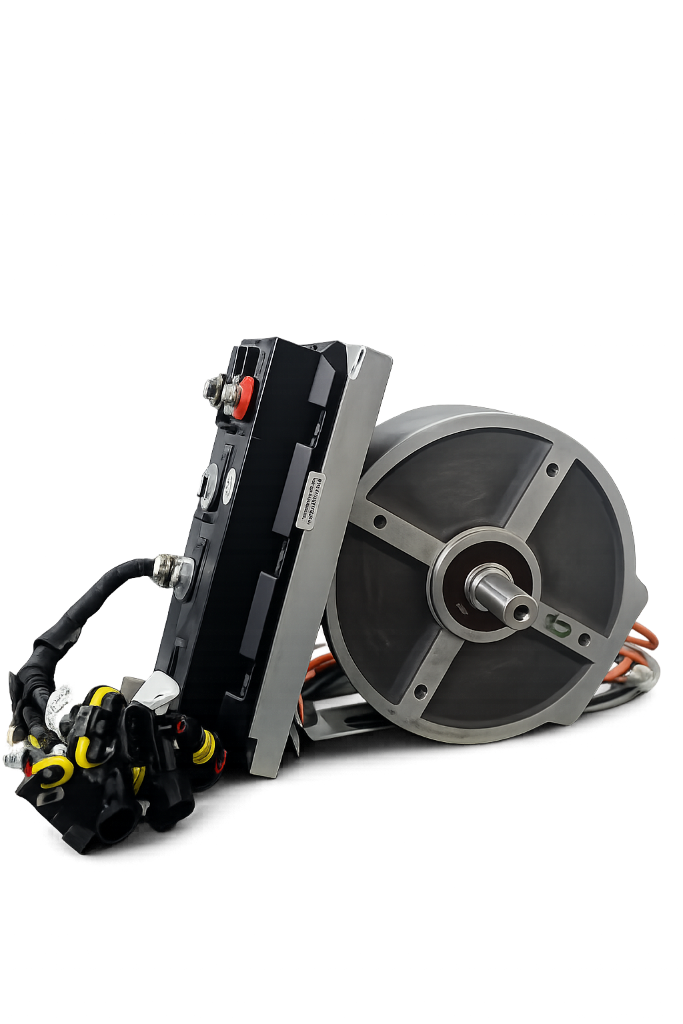
Most electric motors are shaped like cans — magnetic flux flows radially, along the radius, and the motor ends up long, heavy and hard to package. Flip the geometry so the flux runs parallel to the shaft, and the motor flattens into a disc: shorter, denser and far more powerful for its size. These are axial flux motors — the architecture Mercedes-Benz bet on when it bought YASA — and a Chennai startup has spent seven years making one in India. Torus Motion designs and builds proprietary axial flux motors and controllers that it describes as India’s first production-ready axial flux powertrain.
A disc instead of a can
In an axial flux motor the stator and rotor sit face to face, so the magnetic field crosses a much larger working area in a fraction of the axial length. The company’s V1 series — aimed at two-wheelers, golf carts and automated guided vehicles — runs at 48, 60 or 72 volts with up to 10 kW of peak power and 40 Nm of torque, in air-cooled or liquid-cooled versions. The heavier V2 series, built for L5-category three-wheelers, forklifts and tow tugs, pushes up to 20 kW and 60 Nm. Across the range the company quotes peak efficiencies up to 95 percent, IP67 sealing and packaging roughly 50 percent more compact than an equivalent radial motor.
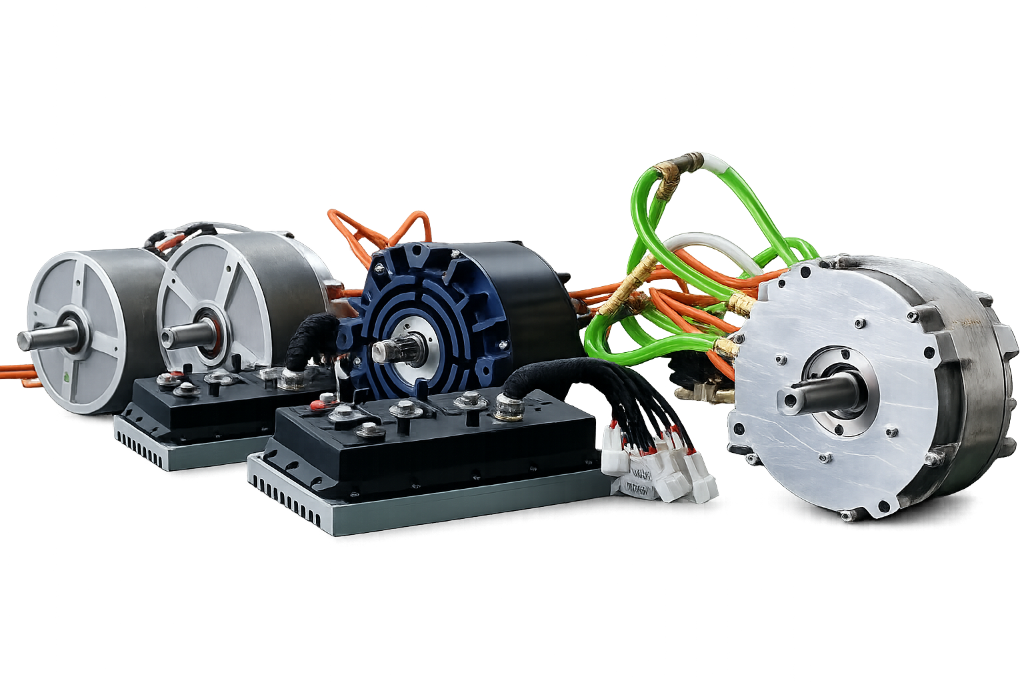
The motor is only half the product. Torus also builds its own TESC Gen 5 controllers — 100, 300, 500 and 700 series — with its ICSC control algorithm, automotive-grade CAN communication, over-the-air updates and compatibility with BLDC, PMSM, IPM and axial flux motors alike, sold as integrated powertrain packages for L3/L5 vehicles, AGVs, UGVs and industrial equipment.
Why it matters
Sixty to seventy percent of what it costs to build an EV in India sits in three largely imported buckets — motors, controllers and batteries — which is exactly where EV affordability stalls. Torus’s pitch is to take the motor bucket home: a lighter, more efficient, domestically designed powertrain that drops straight into the two- and three-wheelers India actually buys. Beyond EVs, the same compact motors are aimed at generators, agricultural machinery, robotics, pumps, HVAC and marine applications — anywhere weight and space are constraints.
The company behind the motor
Torus Motion was founded in 2019 — originally as Torus Robotics — by three SRM University mechatronics engineers: Vignesh M, Vibhakar Senthil and Abbhi Vignesh K. They started out building unmanned electric defence systems and kept hitting the same wall: months spent importing the right motors. So they pivoted to building the motors themselves. The company raised a $470,000 seed round led by the Tamil Nadu Infrastructure Fund Management Corporation under the TN Emerging Sector Seed Fund, with Forge Innovation & Ventures and IIT Bombay’s SINE participating, and counts MeitY Startup Hub, StartupTN, UNIDO and the Department of Science and Technology among its backers.
More Read
The launch that put the company on the map came in July 2026, when it introduced the production-ready V1 and V2 series for sub-100 V applications. The test to watch now is adoption: whether Indian two- and three-wheeler makers pick an indigenous disc over an imported can. If they do, one more link in the EV supply chain stops being a shipment and starts being a domestic product.