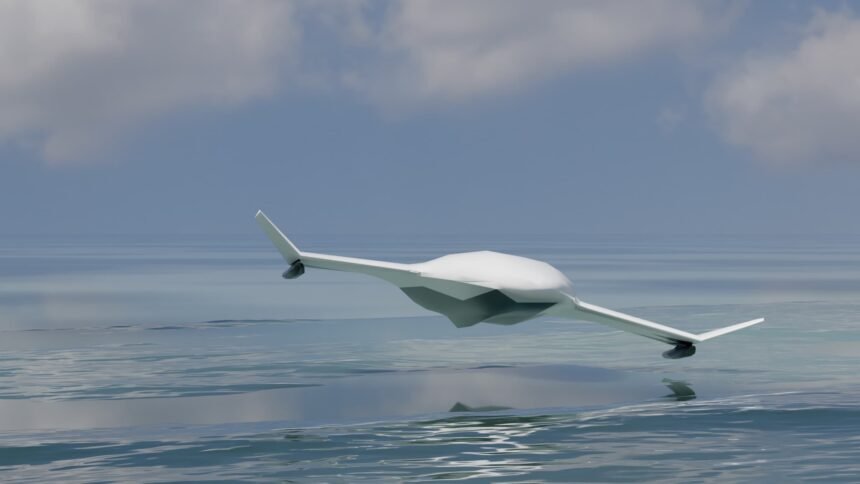
Image credit: Waterfly Technologies — concept render of the company’s SEN-1X wing-in-ground demonstrator.
A runway is one of the most expensive pieces of infrastructure a transport system needs. Waterfly Technologies says its aircraft does not need one at all — because its runway is the ocean. On 11 October 2026, the Chennai startup unveiled Hummingbird, an electric Wing-in-Ground (WIG) craft that takes off from water and cruises a couple of metres above the waves, riding a cushion of air. The unveiling in Chennai took place in the presence of Prime Minister Narendra Modi, who congratulated the team and, according to co-founder Keshav Kumar Choudhary, said he hoped the craft would soon be flying over the ocean.
A wing the size of the ocean it flies over
Waterfly is building what it calls ground-effect aircraft: a blended-wing-body craft that skims the surface. The physics is the ground effect — within a wingspan of the water, a wing rides on a cushion of its own air. Drag collapses and efficiency soars, which is why the company pitches the craft as moving cargo “at the speed of an aircraft and the cost of a ship”. Battery packs in the body and wings drive ten electric motors, according to the company’s own site. The payoff is infrastructure freedom: no airport, no port, no terminal — the company says every coastline, island and river mouth becomes a node in a network.
From 30 kg to 300 kg — and then the sea
Waterfly spent around six months developing and testing a 30-kg prototype to understand how the craft could take off from water and transition into flight, and then another six months scaling the design to a 300-kg craft. The larger prototype was tested at Kaveripakkam Lake in Tamil Nadu’s Ranipet district, flying at an altitude of approximately 1.5 metres above the water to study the ground effect. The next step is the hard one: the first ocean trial, planned between Chennai and Puducherry by December 2026, to assess how the craft handles real marine conditions — moving, gusty open water at speed. That trial, the company says, will feed directly into commercialisation.
The company behind the craft
Waterfly Technologies began operations in 2025 under founders Harish Rajesh, Keshav Kumar Choudhary and Harshin N, and is incubated at IIT Madras. It is manufacturing its technology in-house at a facility in Sriperumbudur, Tamil Nadu, and says it is in discussions with classification and certification agencies including Bureau Veritas to define the requirements for commercial cargo operations. The company has said it is targeting certification from the Indian Register of Shipping under the International Maritime Organisation framework.
Cargo first, containers next
The initial market is coastal and island cargo, including logistics support for offshore oil fields. Beyond that, Waterfly is exploring a larger version capable of carrying a standard 20-foot shipping container, with Southeast Asia among its initial target markets. Reported design targets for the SEN-1X include a payload of up to four tons, a top speed of 250 knots (around 463 km/h) and a design range of around 1,500 km — figures that represent intended design targets, not demonstrated flight performance. CEO Harish Rajesh has sketched the longer-term ambition in vivid terms: the 1,600-km Kolkata–Chennai run in around three hours at roughly Rs 600 a seat, cheaper than an AC three-tier train ticket. That is a vision, not a specification — but the sequence behind it, a tested 300-kg prototype leading to ocean trials, is how ambitious hardware companies earn the right to dream aloud. One to watch closely as the December trial approaches.