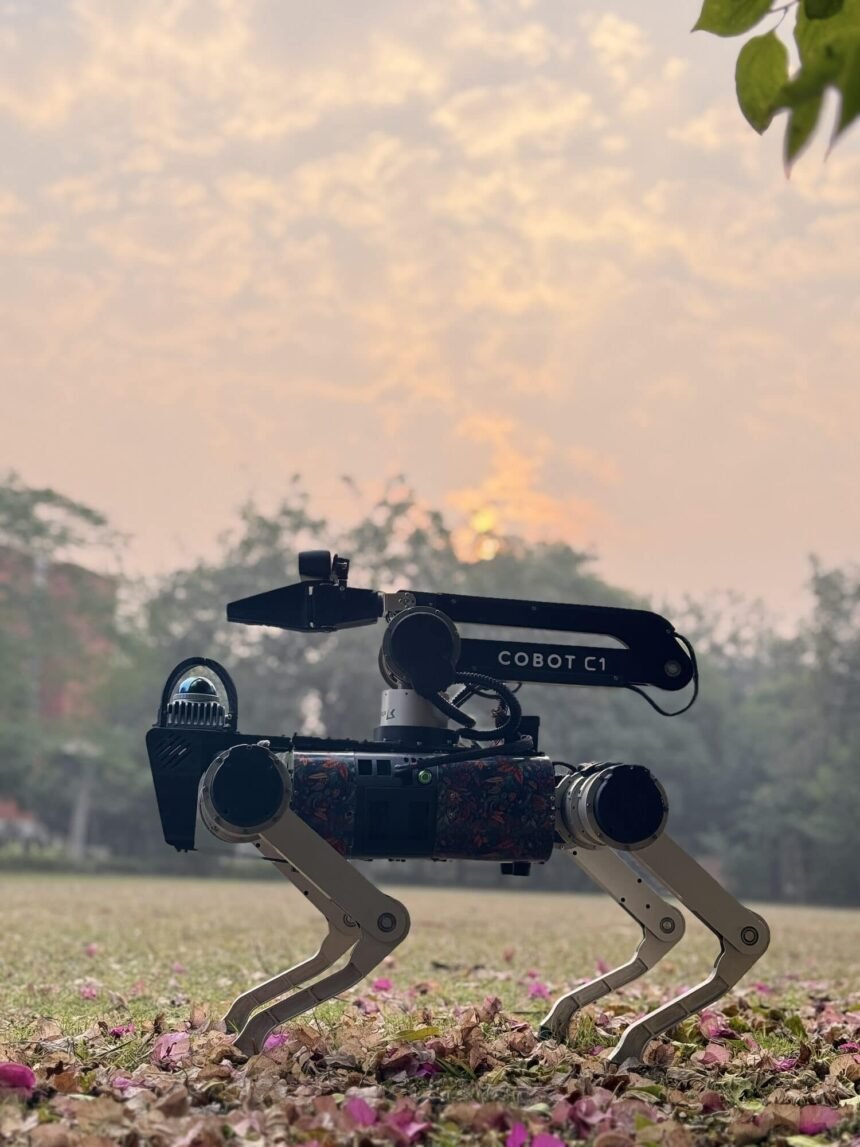
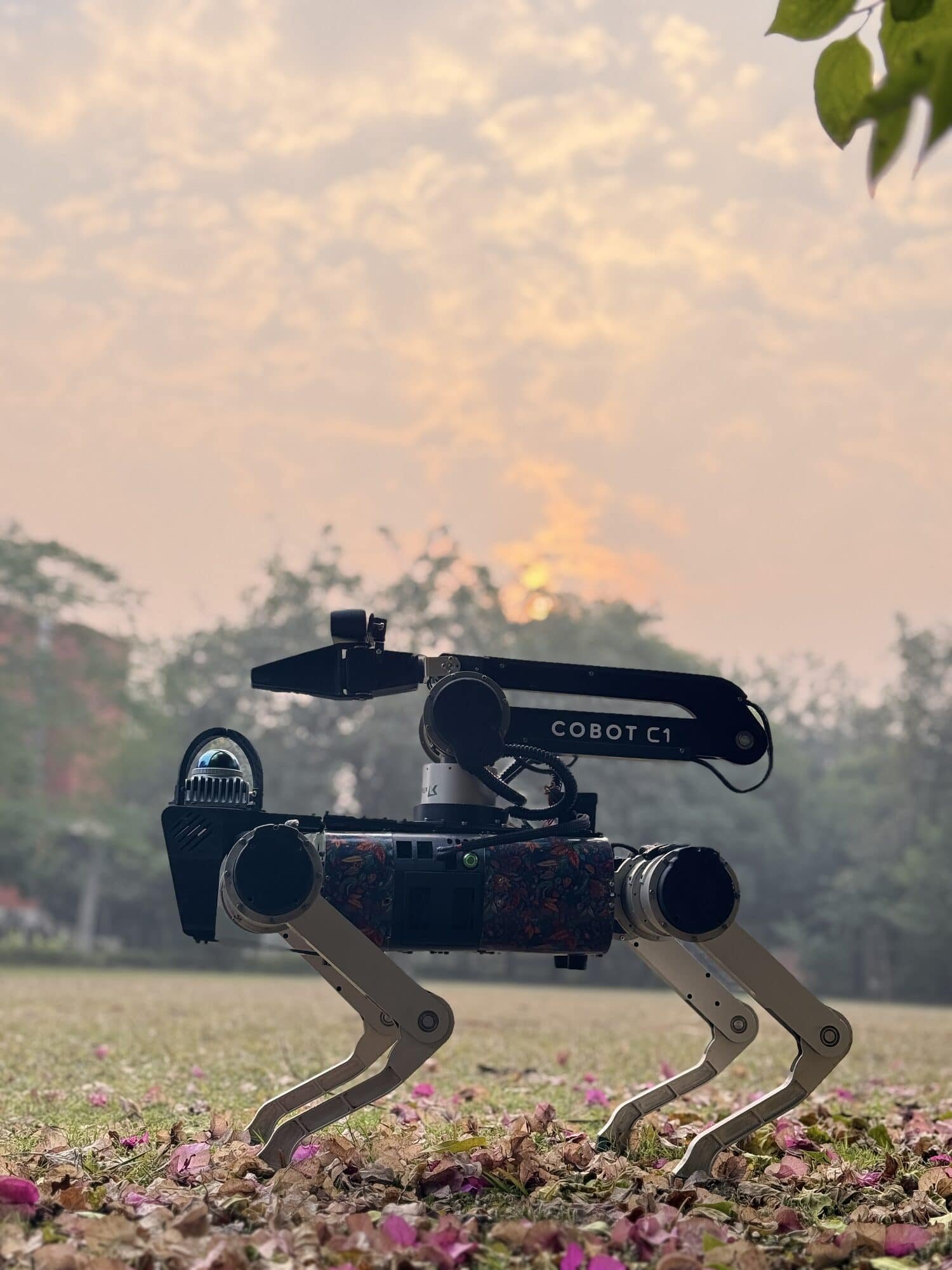
India has built several four-legged robots that can walk, climb and inspect. What it had not built, until this year, was a four-legged robot that can also lend a hand. In January 2026, a Kanpur deep-tech startup unveiled SCORP — short for Four-legged Collaborative Robotic Platform — which the company describes as India’s first legged mobile manipulator: a quadruped robot with a robotic arm mounted on its back, able to walk into dangerous places and physically interact with what it finds there.
The company behind it is xTerra Robotics, founded in 2023 at the Startup Incubation and Innovation Centre of IIT Kanpur by four of the institute’s own graduates — Amritanshu Manu, Avinash Bhashkar, Nimesh Khandelwal and Aditya Rajawat. The startup has spent its life doing one hard thing: making legged robots in India instead of importing them. SCORP was developed with support from IIT Kanpur’s Technology Innovation Hub and uses locally designed actuators and control systems, according to the company and independent coverage of the unveiling.
More than a robot dog with an arm bolted on
The technical leap is in the integration. A legged manipulator must keep its balance while its arm reaches, lifts and pushes — two control problems that fight each other. SCORP pairs quadruped locomotion with what the company calls an integrated robotic arm, running its control on real-time motion planning over the ROS robotics middleware, with operation in autonomous or teleoperated mode over WiFi or Ethernet. The platform is rated for uneven and outdoor surfaces — gravel, stairs, slopes, rubble — terrain where wheels and tracks fail and where most industrial work that needs doing is hard to reach.
That combination turns inspection into intervention. Instead of merely filming a pipeline, the robot can probe it up close; instead of just mapping a disaster site, it can pick up objects, move debris or inspect valves and fire-extinguisher pressure in places too dangerous for people. The company lists industrial inspection, close-range pipeline checks, vehicle underside inspections, automated waste collection in campuses and smart cities, fire-safety patrols and autonomous patrolling among the jobs it targets.
From India’s first commercial quadruped to this
SCORP did not come out of nowhere. xTerra’s earlier SVAN M2 is recognised as India’s first commercial quadruped robot — a 12-kilogram machine with a 5-kilogram payload, quasi-direct-drive actuators and the company’s own Orion AI V2.0 control stack, priced around Rs 20 lakh. That track record is real: IIT Bombay acquired SVAN M2 units to strengthen its robotics research, and the robot was a crowd-puller at the AI Impact Summit in New Delhi in February 2026. The company is now building even its own precision actuators in-house — its new DHAV autonomous quadruped platform has been opened for pre-sales — which is the sort of vertical integration that decides whether an Indian robotics company survives against cheaper Chinese imports.
More Read

Early days for the platform
SCORP is young — unveiled less than a year ago — and the company has not disclosed pricing, customers or deployment numbers for it. Whether it becomes a working machine in refineries, mines and disaster-response fleets, or remains a promising prototype, will depend on the grinding work of sales and service that follows every hardware launch. But the engineering achievement stands: a legged manipulator designed, actuated and controlled in Kanpur, in a field where India previously had to buy foreign. If SCORP earns its keep in the field, India will have a new category of robot to call its own — one that doesn’t just go where people can’t, but does something once it gets there.