Every drone carries the same single point of failure: gravity. A snapped arm, a dead battery, a severed radio link — and an aircraft that took months to design becomes a very expensive hole in the ground. As India’s drone industry scales from defence trials to delivery corridors and commercial surveying, every new flight multiplies that risk. A Bengaluru startup called Saubha Aerial Systems looked at the problem and built the industry’s least glamorous insurance policy: parachutes engineered specifically for drones.
Saubha Aerial Systems Private Limited, founded in 2025 by Ksheeraj Krishna K V and Ruturaj Yellurkar, describes itself as a builder of aerospace-grade emergency safety systems for unmanned aircraft. The pitch is aimed at drone makers and test teams: with a reliable last-resort recovery system onboard, customers can test new airframes without worrying about range or adverse weather conditions. Inc42 named the company one of its 30 startups to watch in August 2026.
Canopies sized for the job — the Para range
The product line starts with the canopy. The Para range spans payloads from 4 kg to 25 kg, all tuned for a descent velocity of about 5 m/s — slow enough to save the airframe and its payload on impact. The ultralight Para 4k is the smallest of the line; the Para 8k is the industry-standard canopy, weighing 170 grams and supporting an 8 kg maximum payload at 5 m/s descent; the Para 15k is the medium-capacity system; and the Para 25k is the high-capacity payload parachute.
Three ways to fire it — Springshot, Airlaunch, Pyrolaunch
A parachute you cannot deploy fast enough is decoration. Saubha sells three ejection mechanisms matched to different mission profiles: Springshot, a spring-powered mechanical ejection system for smaller drones; Airlaunch, a pneumatic compressed-air system — 475 grams, compatible with the Para 15k, using 12 g CO₂ cartridges for rapid deployment; and Pyrolaunch, a pyrotechnic deployment system for mission-critical applications.
The trigger matters more than the canopy
The subtle engineering sits in the trigger. Most of the failure modes that kill a drone — a dead flight controller, a browned-out power bus, a severed command link — would also kill a recovery system wired through those same electronics. Saubha’s answer is Mayday, an autonomous flight trigger that uses multi-sensor monitoring to detect emergencies on its own: it bypasses the main electronics, instantly detects a rapid, uncontrolled fall, and deploys the parachute automatically. Lifeline is the manual counterpart — a pilot-controlled trigger for moments when a human makes the call. A trigger that watches the aircraft independently means the failure that kills the drone’s brain does not kill the rescue.
From recovery to interception — the netgun
Parachutes protect your drone; the other half of Saubha’s portfolio protects your airspace from everyone else’s. The company is developing a net deployment system that lets an interceptor drone capture hostile UAVs mid-air. The current range is 10–15 metres, with a capsule-based deployment planned for 100–150 metres, compatible with vehicle-based turrets, drones and handheld use — and the net can be paired with a parachute so the captured drone is lowered safely to the ground for collection.
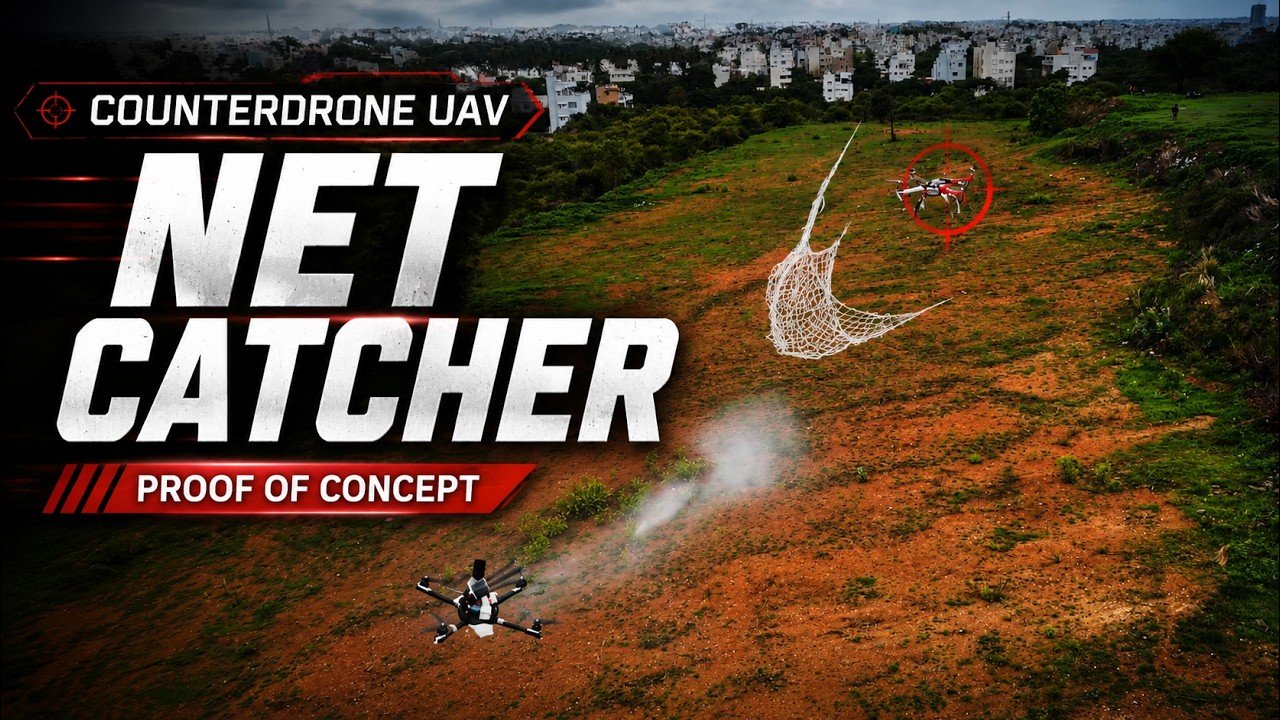
In July 2026, Indian Defence News reported the successful test of the company’s indigenous Drone Netgun, noting that physical capture brings rogue drones down intact — valuable for forensics and for avoiding collateral damage from falling debris in urban or sensitive environments. It is a natural second act for a company that started by thinking about what goes wrong in the air.
Key takeaway
Key takeaway: Saubha is not competing in the crowded business of building drones — it is building the safety layer the whole industry stands on. Parachutes that fire when the flight controller is dead, triggers that watch the aircraft independently, and now a netgun for the rogues: every product assumes the worst day of a drone’s life and plans for it. As drones move from novelty to infrastructure, that pessimism is the product.