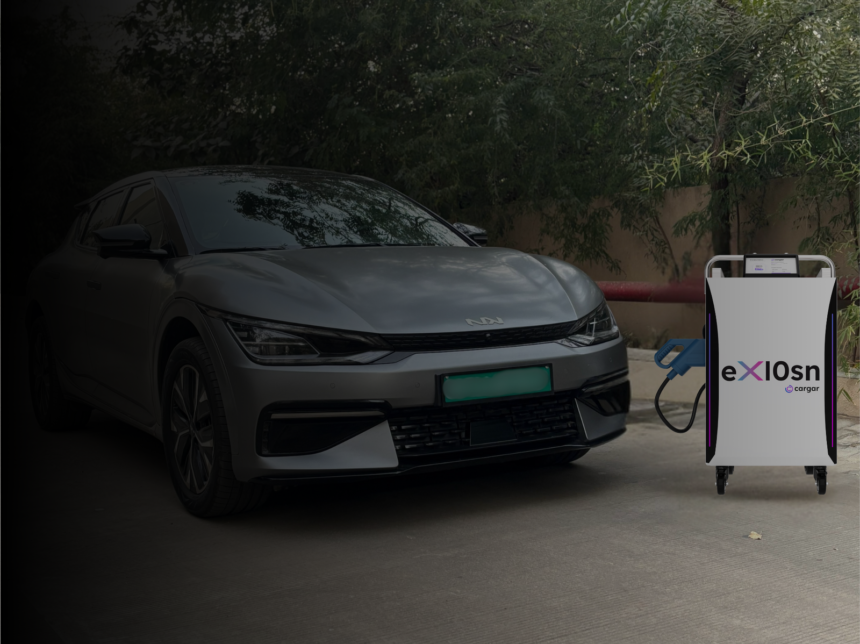
Most fast chargers in India are bolted to a single parking spot. The moment a car plugs in, that expensive piece of hardware is off-limits to every other car in the building — and the building still had to find the electrical capacity, the heavy cabling, the protection equipment and the parking bay to host it. An Ahmedabad-based climate-tech startup called Cargar looked at that equation and asked a simpler question: what if the charger could walk to the cars?
The answer is eX10sn, a portable DC fast charger that the company describes as India’s first of its kind. It is an on-grid unit — it still needs a compatible three-phase power supply — but it draws from that single point through a long input cable, so an operator can wheel the charger from car to car across a 10–20 metre radius. For an apartment complex, an office or a fleet depot, a handful of eX10sn units can serve a whole parking row without a single trench being dug.
One charger, many parking spaces
The insight is about utilisation, not just hardware. A fixed charger serves the car parked in front of it and nobody else; Cargar’s pitch is that operators can serve the same charging demand with far fewer assets, simply by moving the charger to whichever car needs it next. The company says eX10sn needs zero civil work and a lower utility upgrade than a conventional installation — and because it is designed and developed 100% in India, it is built for the parking realities of Indian metros rather than adapted from abroad.
The engineering behind the portability
The hardware itself is a compact, trolley-mounted unit with an all-weather enclosure, a lightweight aluminium frame, a DC gun with CCS2-compatible connector and a status/payment display on top. The company’s published specifications put output at 20–30 kW with voltage up to 1000 V on a CCS T2 Combo protocol — the charging standard used by most mainstream electric cars sold in India, so one unit can serve almost anything in the car park.
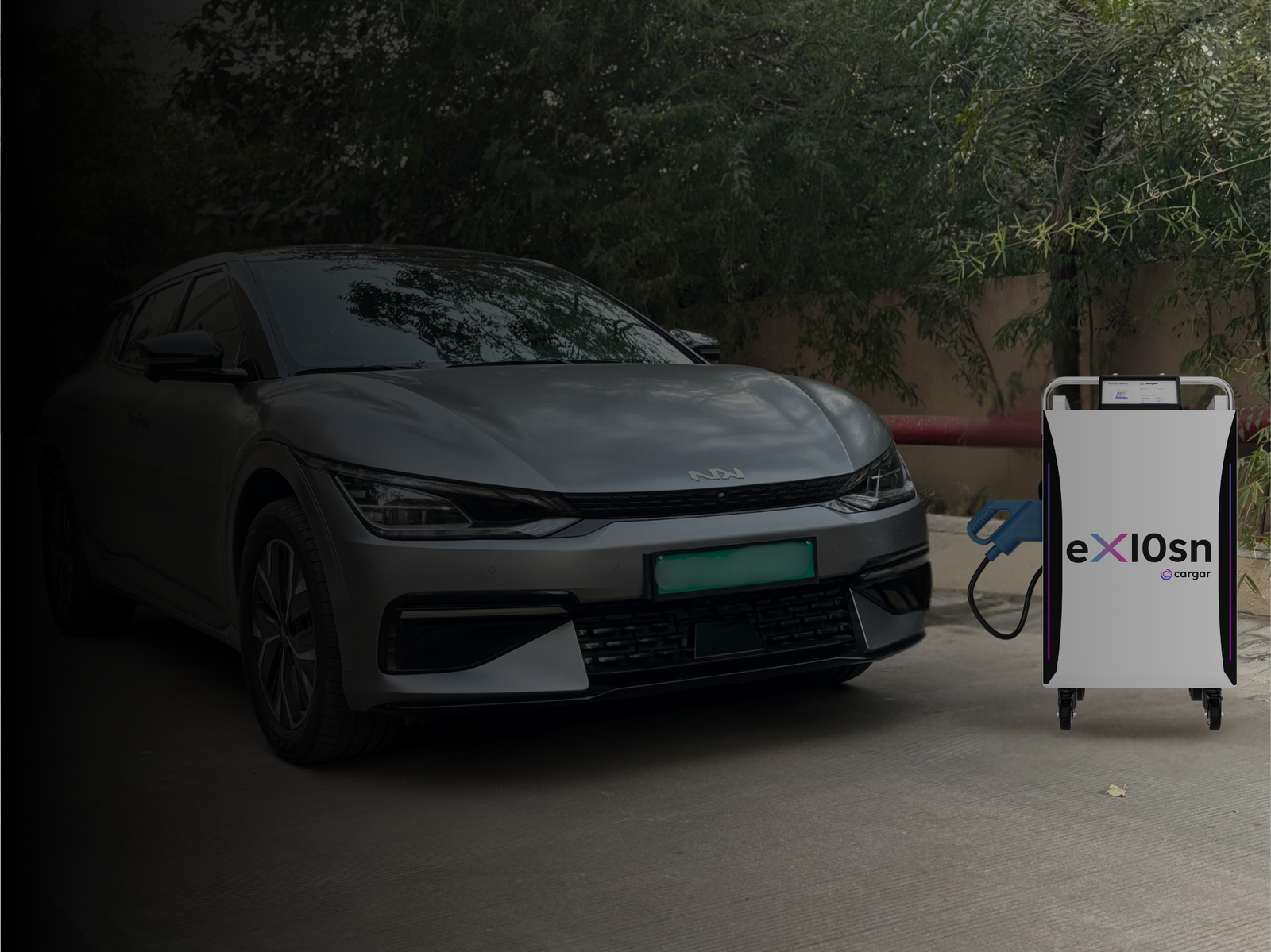
This is not a concept render. MCS Cargar Private Limited, based at GIDC Naroda in Ahmedabad, has demonstrated eX10sn with its Cargar.pay payment flow at a NEXA showroom in Ahmedabad, and the company reports over 1,000 charging sessions and 2,00,000+ green kilometres delivered to date — company-reported figures, but the deployments they describe are the ordinary kind: showrooms, service centres, residential and corporate parking.
Beyond eX10sn: solar and off-grid
Cargar’s ambitions run wider than one portable unit. The same platform thinking shows up in SOLe, which the company calls India’s first solar-integrated EV charger — a 7.4 kW AC unit that synchronises with rooftop solar — and in electron, described as the world’s first 100% off-grid super-fast EV charger, a mobile energy-delivery device that can be hailed or scheduled to a doorstep. Both are company claims rather than independently verified firsts, but they underline the through-line: Cargar treats charging as an energy-delivery problem, not a construction problem.
More Read
Key takeaway
Key takeaway: Cargar is not interesting because it built another charger — it is interesting because it attacked the utilisation problem instead of the charger problem. Move the hardware, share one power point, serve the whole car park. The eX10sn is a real, deployed product doing exactly that, and the parking-row economics are what make it an exceptional-technology story rather than an infrastructure story.
What is Cargar’s eX10sn?
The eX10sn is a portable, on-grid DC fast charger built by Ahmedabad-based MCS Cargar. Mounted on a trolley, it can be moved across a 10–20 metre radius from a single three-phase power point, serving multiple parked cars with one unit. The company describes it as India’s first portable EV fast charger.
How is a portable fast charger different from a fixed one?
A fixed charger serves only the car parked in its designated spot and needs civil work, dedicated cabling and utility upgrades to install. The eX10sn needs no civil work and can be wheeled between cars, so one unit can cover many parking spaces — improving utilisation of both the hardware and the electrical capacity feeding it.
Where does the eX10sn work best?
Anywhere cars sit parked for hours but fixed infrastructure is hard to install: apartment basements, residential and corporate parking, fleet depots, showrooms and service centres. Cargar has demonstrated the unit with its app-free Cargar.pay UPI payment flow at a NEXA showroom in Ahmedabad.
Who makes the eX10sn?
MCS Cargar Private Limited, an Ahmedabad-based climate-tech company. The company says the eX10sn is designed and developed 100% in India, and its wider platform includes the SOLe solar-integrated charger and electron, a 100% off-grid mobile fast charger.
Sources & further reading
- Cargar official website — eX10sn product specifications: 20–30 kW output, up to 1000 V, CCS T2 Combo, 10–20 m radius, zero civil work, UPI payments
- Cargar: eX10sn portable DC fast charger (official video) — The unit in operation, from the company’s official YouTube presence
- MCS Cargar Private Limited, Ahmedabad (IndiaMART profile) — Company details and product listings