Michael Spencer spent four years at Tesla — scaling Model 3 and Model Y production lines, helping deploy the Supercharger network, and leading parts of the company’s energy business. In 2022 he left to build something Tesla would never build: a motorcycle designed for the world’s toughest commuter roads. His company, Zeno, operates out of Bengaluru and San Francisco, and its first product, the Emara, is — the company says — India’s first “Sport Utility Electric Motorcycle”: a 100 km-range e-bike engineered to carry 250 kilograms up 30-degree slopes.
The Emara is not a lifestyle product. It was conceived for bodaboda riders in Nairobi and Kampala, delivery workers, and Indian commuters who routinely overload 100 cc motorcycles far past their design limits. Zeno first rolled it out in Kenya, with India — starting with Bengaluru — to follow in 2026, betting that the same rugged, low-cost machine serves both markets.
Engineered like farm equipment, priced like a commuter
The Emara’s numbers read like a utility vehicle’s spec sheet. An 8 kW-peak electric motor drives a claimed top speed of 90 km/h and a 0–60 km/h sprint of 7.8 seconds — roughly 150 cc performance. Two swappable 2 kWh lithium-iron-phosphate battery packs give a combined 4 kWh, good for about 100 km of real-world range, and each pack is rated for over 3,000 charge cycles, the company says.
What sets it apart is the load rating. The Emara is built to carry 250 kg — rider, passenger and cargo — with 190 mm of ground clearance, dual disc brakes, and 30-degree gradeability, meaning it can climb steep inclines fully loaded. The company credits an industry-first “tractor mode,” one of four ride modes, which trades speed for maximum low-end torque when hauling. Up to 150 litres of lockable storage can be added via accessories, from a 100-litre rear box to luggage panniers, and a 6.3-inch digital display handles ride information.
Three ways to keep moving
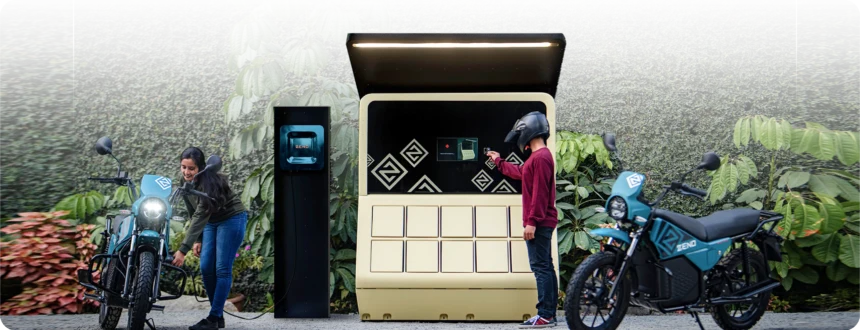
Zeno calls the Emara’s charging system “multi-modal”: charge at home with the bundled portable charger, fast-charge at public Type 6 chargers, or swap depleted packs at Zeno’s own battery-swap stations. The company has been building that swap infrastructure alongside the bike — more than 150 charging locations were live across four cities in Kenya and Uganda by early 2026, TechCrunch reported — because for a bodaboda rider who earns by the trip, downtime is the enemy.
The ownership model is as engineered as the bike. In India the Emara was unveiled at ₹1.19 lakh ex-showroom (₹1 lakh for the first 5,000 bookings), or under a battery-as-a-service plan that drops the upfront price to ₹64,000 with subscriptions starting at ₹1,500 per month. In East Africa it sells for about $1,300 without a battery and $2,000 with one. Zeno says the result is roughly 50% lower operating costs than a petrol bike — the number that matters to a rider doing 100 km a day.
More Read
From 800 bikes to 25,000 waiting
The bet appears to be landing. After a $9.5-million seed round led by Lowercarbon Ventures and Toyota Ventures in late 2024, Zeno closed a $25-million Series A in March 2026, led by Congruent Ventures, to expand production and the swap network. By that point the company had built more than 800 Emaras, was producing 70–80 bikes a week, and — by its own account — had more than 25,000 retail and fleet customers waiting for one, TechCrunch reported.
Spencer has said the manufacturing footprint stays Indian: the bike is designed and developed across Zeno’s R&D centres in San Francisco and Bengaluru, and is produced at a facility in Manesar, Haryana, with capacity of around 600–1,000 bikes a month that can scale as demand grows. A follow-up model, the Emara ADV, adds 10 kW of peak power, a 19-inch front wheel, onboard navigation and room for two spare batteries for up to 200 km of range — the company’s answer to riders who want to go further off the paved road.
Strip away the marketing and the Emara is a lesson in designing for reality instead of the showroom: most of the world’s two-wheeler kilometres are ridden overloaded, on bad roads, by people whose livelihood depends on the machine starting every morning. Spencer’s thesis is that Tesla-grade systems thinking — batteries as a managed fleet asset, energy as a subscription, torque over top speed — wins harder there than anywhere else. India’s roads are about to find out.