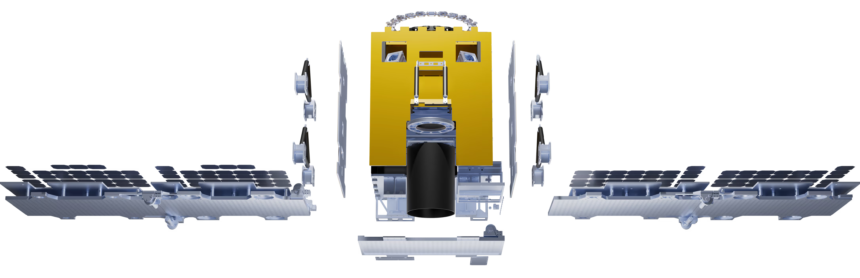
On May 3, 2026, a Falcon 9 lifted off from Vandenberg, California, carrying a 190-kg satellite built by five IIT Madras engineers. Mission Drishti, from Bengaluru startup GalaxEye, was — the company says — the world’s first commercial satellite to carry a synthetic aperture radar and a seven-band multispectral imager on a single platform, fusing both data streams in orbit with onboard AI. Prime Minister Narendra Modi called it a major achievement in India’s space journey.
Two months later, it was gone. In the final stage of its early-orbit phase, Drishti was hit by a geomagnetic solar storm; communication went intermittent and was eventually lost, the company announced on July 7. Recovery efforts continued, but GalaxEye acknowledged the likelihood of recovery “currently appears low.” What follows is the story of the engineering that flew — and of the storm that took it — with every design claim clearly attributed to GalaxEye, because the fused imagery itself was never demonstrated in orbit.
Why optical and radar were never on one bus
Optical cameras make intuitive, colourful images — but fail under cloud cover, smoke or darkness. SAR sees through weather and darkness using radar pulses, but its images are grainy and hard to interpret. Until Drishti, satellites carried one or the other; anyone wanting both had to merge data from separate satellites, aligned after the fact — a process the company describes as slow and error-prone. Drishti’s bet was to co-locate both sensors on one platform and fuse the streams at the source, producing an inherently aligned, analysis-ready product in a single pass.
SyncFused OptoSAR: what the company claims
All specifications below are GalaxEye’s design figures, not demonstrated performance. The SAR sensor operates in X-band with VV polarization, imaging in stripmap and spotlight modes with up to 0.9-metre resolution in spotlight; the seven-band multispectral imager (including coastal blue, red edge and near-infrared bands) has a native resolution of about 3.6 metres at nadir; and the fused OptoSAR product is quoted at 1.8 metres. Swath widths are about 30 km for SAR and 10 km for the imager. An NVIDIA Jetson Orin computer handles onboard AI processing — the “SyncFusion” stack that aligns and fuses the two streams before downlink. The satellite targeted a sun-synchronous orbit around 500 km with a four-day revisit. The company describes Drishti as India’s largest privately built Earth observation satellite, and at 190 kg it is remarkably light: comparable combined-sensor satellites internationally weigh on the order of 2,800 kg.
Five years from a rail rig to orbit
GalaxEye was founded in May 2021 by Suyash Singh, Denil Chawda, Kishan Thakkar, Pranit Mehta and Rakshit Bhatt — engineers from IIT Madras’s Avishkar Hyperloop team — to answer one question: can radar and optical sensing work as a single instrument? Early work was deliberately scrappy: a proof-of-concept radar tested on a rail-mounted rig in 2022 (moving a radar along a track is the cheapest way to create a synthetic aperture), then a miniaturised 4-kg radar tested from drones. The company raised a $3.5-million seed round in December 2022, closed a $10-million Series A in late 2024 led by MountTech Growth Fund-Kavachh with Infosys’s first space-tech investment, and added a roughly $4.8-million Series A extension in March 2026 — about $14 million raised in total. Its first hardware reached orbit on December 30, 2024, when the GLX-SQ payload flew on ISRO’s PSLV-C60 POEM-4 platform; the company says it tested onboard processing over the radiation-heavy South Atlantic Anomaly.
Then the solar storm
On July 7, GalaxEye announced that in the final stage of the Launch and Early Orbit Phase, the maiden spacecraft had encountered an anomaly following a geomagnetic solar storm. The company’s initial root-cause analysis pointed to radiation effects from the event likely damaging a critical onboard system. Before the loss, the company said, Drishti had established communication, completed most of its planned LEOP, executed critical deployment and attitude-control activities, and operated its onboard computing and communications systems through its Mission Control Centre in Bengaluru — which it described as a demonstration of its fully in-house mission operations capability. But the record is clear about what did not happen: no imagery from Drishti was ever demonstrated in orbit. The 0.9-metre SAR, the seven-band multispectral and the fused 1.8-metre product remain design claims, and this post presents them only as such.
More Read
What’s next
GalaxEye says the mission provided engineering insights that will directly strengthen future satellites, and that it is accelerating the move to bring more of its supply chain, manufacturing and satellite development in-house. The company plans to launch two new OptoSAR satellites within the next 24 months, scaling toward a constellation of about 10 satellites by 2030 aimed at defence, agriculture, disaster response, maritime surveillance and infrastructure monitoring. Drishti’s loss is a setback, not a verdict — but the verdict will come from orbit, when the next satellite survives long enough to send back a fused image.