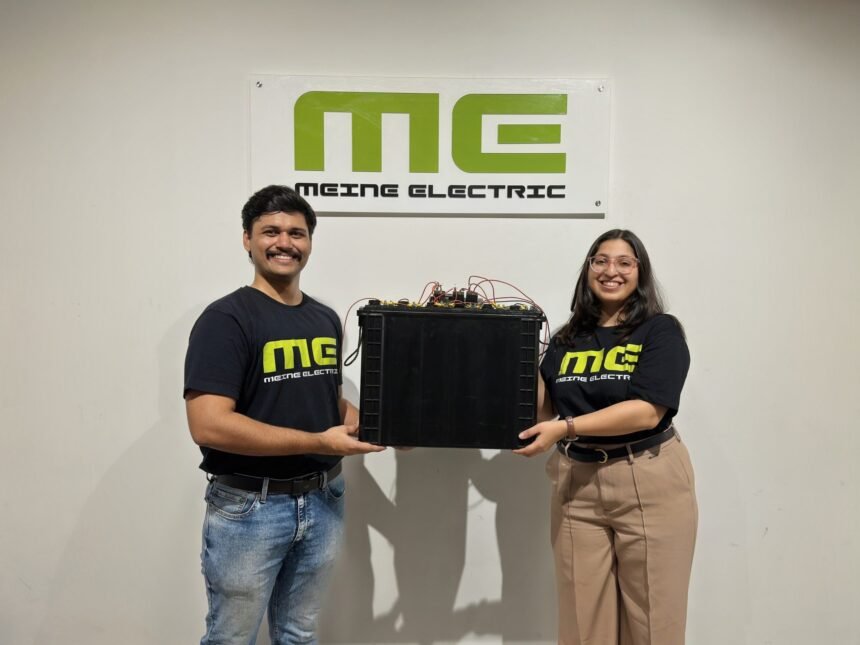
At NTPC’s Simhadri Thermal Power Station in Andhra Pradesh, a battery made of rust, air and water is about to work its first real shift. Chennai-based Meine Electric will deploy its first pilot iron-air battery system at the plant — a “multi hundred” kilowatt-hour installation expected to be completed by early 2027. The stated objective: demonstrate “thermal flexibilisation” — using long-duration batteries to flex thermal power plants instead of relying on gas peaker plants.
The company, founded in 2023 by Priyansh Mohan (CEO) and Stuti Kakkar (COO), is building iron-air batteries for long-duration energy storage (LDES). The chemistry runs on a process engineers usually treat as a flaw: reversible rusting. During discharge, iron reacts with oxygen to form rust, releasing electricity; charging reverses the reaction to regenerate metallic iron. Mohan has said the idea was to make iron oxidise into a stable, microscopic structure that stays anchored to the electrode instead of flaking away and losing capacity.
The six-hour charge
What sets Meine Electric apart, the company says, is its proprietary Fast Charge Long Discharge (FCLD) technology: a full charge in six hours, then a discharge stretching over 18 hours. That matters because the established iron-air approaches — including systems from Form Energy in the US and Ore Energy in Europe — have been designed around multi-day storage cycles of up to 100 hours, which Meine Electric says makes them a poor fit for daily renewable balancing. FCLD is engineered for the solar rhythm: soak up excess daytime generation, release it through the evening and night.
The independent stamp
In July 2026, the FCLD system cleared independent validation by Customized Energy Solutions (CES), the US-based energy services and technology company that is the parent organisation of the India Energy Storage Alliance (IESA). The CES Battery Laboratory tested two iron-air electrochemical cells under a structured protocol covering electrochemical performance, capacity retention and operational stability — including the asymmetric six-hour-charge, 18-hour-discharge duty cycle. It is the kind of third-party credibility that separates a lab claim from a grid-ready technology.
Meine Electric says it is the first company in APAC — and the third globally — developing iron-air long-duration storage, and puts the technology’s levelised cost of storage below $0.05/kWh (about ₹5/kWh). The startup has won the National Startup Award 2026 and the Nasscom Emerge 50, and raised a $750,000 pre-seed round backed by Antler, Rebalance, Venture Catalysts, gradCapital and the AIC-Anna University incubation foundation.
What is not known yet
The company has not disclosed the exact capacity of the NTPC pilot beyond “multi hundred” kWh, citing confidentiality agreements with NTPC. Cycle-life figures, commercial pricing and a firm delivery date for its containerised systems — which the company aims to deliver by 2027 — have not been made public, and the sub-$0.05/kWh levelised-cost figure is a company claim awaiting real-world confirmation at scale.
More Read
Sources: The Hindu BusinessLine, ess-news, Autocar Professional, The Times of India; company statements attributed to Meine Electric.