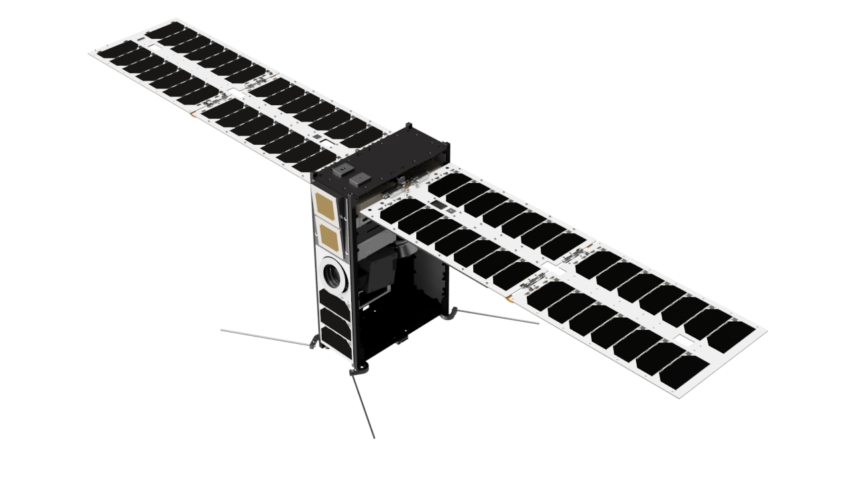
An Earth-observation satellite can collect far more data in a single pass than it can ever transmit. Ground-station passes are short, the downlink pipe is narrow, and most of what the camera captures waits hours to come down — or is discarded outright. A Hyderabad startup wants to remove the pipe from the equation entirely: process the data in orbit, and send down only the answer.
TakeMe2Space, founded in 2024 by Ronak Kumar Samantray, describes itself as building India’s first data centre in space. The logic is simple — an agriculture customer doesn’t need every pixel of a farmland pass, only the map of where crops are stressed; a mining customer needs only what changed. Analyse on board, and the satellite can transmit a small, useful result instead of a raw feed. The company says its OrbitLab platform lets customers upload containerised AI models to the satellite, run them as it passes overhead, and pay only for the satellite time they use.
A GPU in a 14-kilogram box
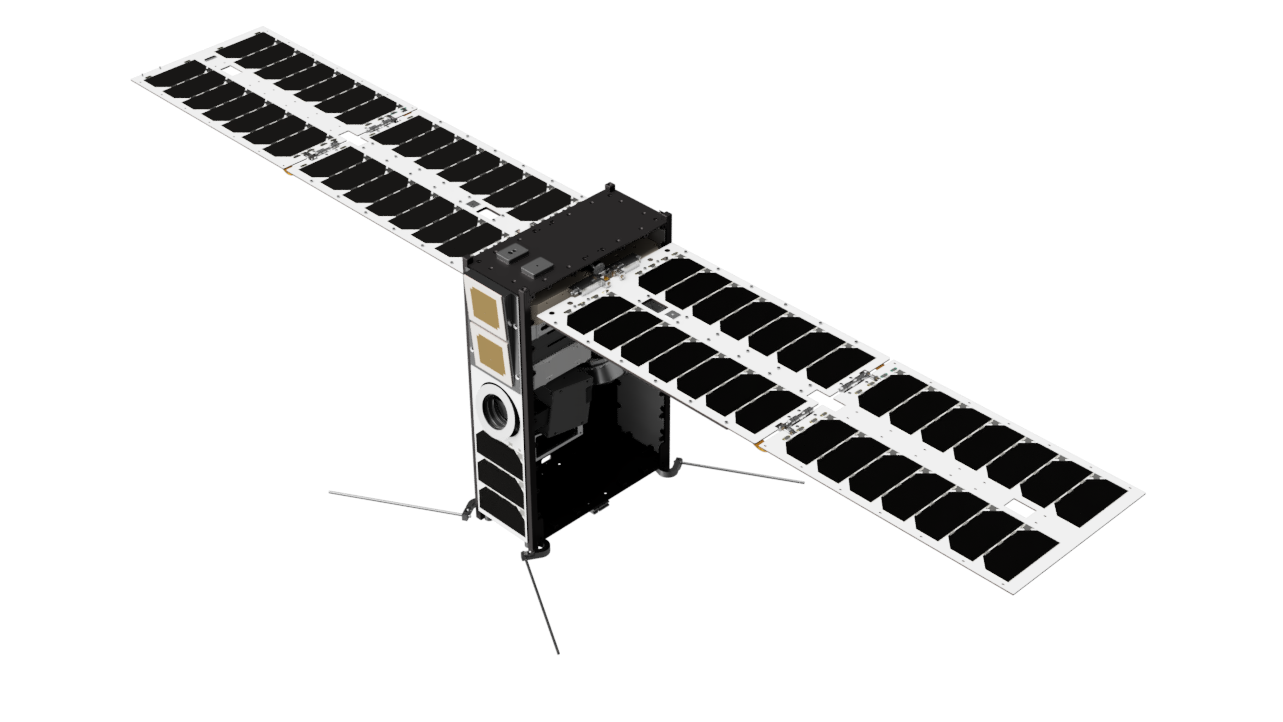
The company’s first commercial orbital-compute node, MOI-1A, is built around an Nvidia Jetson Orin NX edge-computing processor. The company lists 117 TOPS of compute with 16 GB of RAM and 2 TB of storage, alongside a 9-band multispectral optical imager for real-time AI processing. The spacecraft weighs roughly 14 kilograms with about 120 to 150 watts of power for the payload — the company lists 120 watts of payload allocation; Reuters reported about 150 watts overall. That makes it an edge-computing satellite rather than a data centre in the terrestrial sense: closer to a cloudlet in orbit than a server farm.
It has already worked in orbit
The approach isn’t only theory. In December 2024, the company’s MOI-TD demonstrator flew aboard an ISRO PSLV-C60 mission from Sriharikota and executed more than 20 experiments in low Earth orbit — on-orbit AI inference, sensor fusion and high-speed data handling — completing a 14-day demonstration mission in January 2025. The flight also validated RadShield, the company’s proprietary radiation-hardening coating, which TakeMe2Space says survived multiple solar flares in orbit and extends the mission life of protected electronics tenfold over standard alternatives.
A successor satellite, MOI-1, was lost in January 2026 when the PSLV-C62 launch vehicle suffered a third-stage anomaly during ascent — the company says the satellite’s systems were nominal at the moment of loss. MOI-1A is the follow-on; the company lists it as its next mission with a tentative October 2026 launch from California.
Customers are already buying in
Reuters reported that TakeMe2Space has signed 23 customers for the orbital-computing service — geographic-information-system companies, educational institutions and firms including the US-based space-data analytics company Little Place Labs — with applications targeted at agriculture, mining, supply-chain management and insurance. The pitch, as founder Samantray put it to Reuters: the money customers save by not downloading raw data offsets the premium they pay for computing in orbit.
More Read
The funding is following too. The company says it closed a Series A round led by Chiratae Ventures to build a six-satellite constellation that would deliver complete daily global coverage with orbital compute by the fourth quarter of 2027. YourStory reported the company has also received support from IN-SPACe’s Technology Adoption Fund, and it has signed a launch-services agreement with French firm RIDE! for two further spacecraft.
The real data-centre test comes in 2028
Business Standard has reported the company’s most ambitious milestone yet: two larger satellites scheduled to fly on a SpaceX Falcon 9 in 2028, each generating about 1.5 kilowatts of power, carrying 10 Nvidia Thor GPUs and 100 terabytes of storage, linked by optical inter-satellite connections so the pair can share workloads and data. That would be India’s first mission designed to network computing capabilities across multiple spacecraft — the closest thing yet to an actual data centre in orbit.
What is not known yet
The company has not publicly confirmed a launch vehicle or date for MOI-1A since earlier reports placed it on a 2026 rideshare; its own site still lists the mission as upcoming. The tenfold RadShield mission-life claim, the up-to-85% transmission-cost saving, and the unit economics of orbital computing are company claims that the constellation itself will have to prove. And a six-satellite, daily-coverage constellation by Q4 2027 is an aggressive timeline for a company that has flown one technology demonstrator so far.
Sources: Reuters, Business Standard, YourStory, and company statements on the TakeMe2Space website (tm2.space).