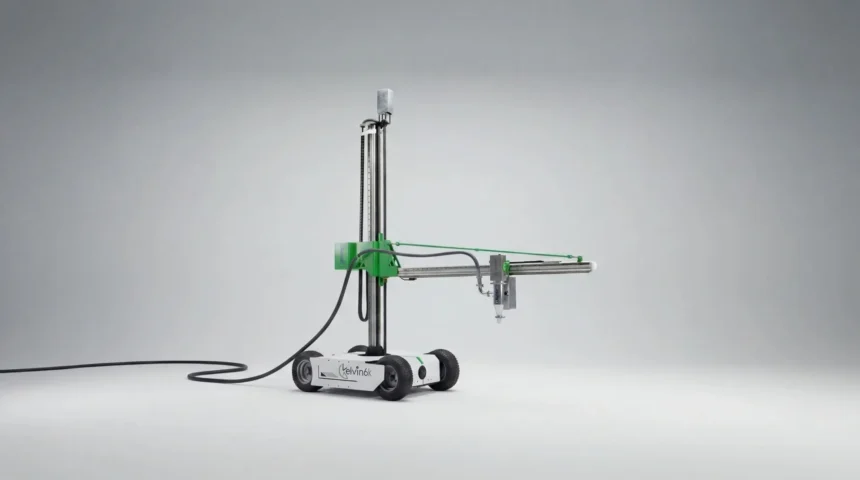
In Chennai, a pair of PhDs are teaching robots to print buildings. Kelvin6k Technologies, a deep-tech startup from the city’s industrial belt, builds mobile robotic arms that 3D-print walls and structures directly on site — using a cement-free geopolymer ink the company says cuts carbon emissions by up to 90% compared to conventional cement.
It is a serious engineering bet on one of the world’s most polluting industries: cement production alone accounts for roughly 8% of global CO2 emissions. Kelvin6k’s answer is to replace the cement — and much of the manual labour — with robots and industrial waste.
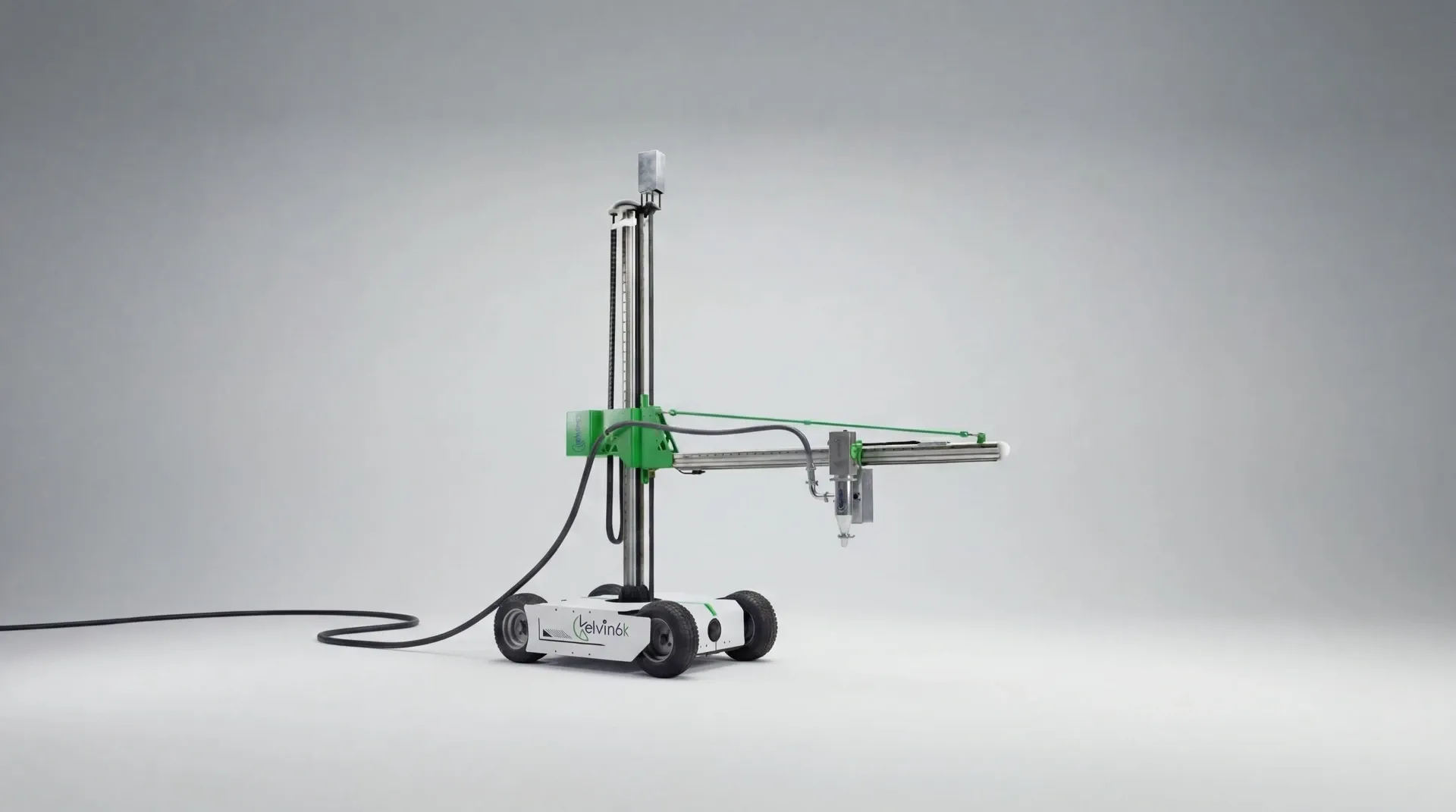
The printer that goes to the building
Most 3D-printed construction elsewhere happens partly off-site: components are printed in a factory and assembled where the building stands. Kelvin6k’s differentiator is that its machines print on site. The ATOM arm rolls into position and extrudes its “ink” along programmed paths, stacking layers until walls form. The company says a pillar can be printed in 10 to 20 minutes, and that a 2,500 sq ft home could be built in under a month — roughly 60% faster and 30% cheaper than conventional construction.
The hardware is entirely designed and fabricated around Chennai, in industrial hubs such as Ambattur and Guindy, and the company says it holds a patent for its construction robotic 3D printer — the first of its kind in the country, and among only a few in the world.
Printing without cement
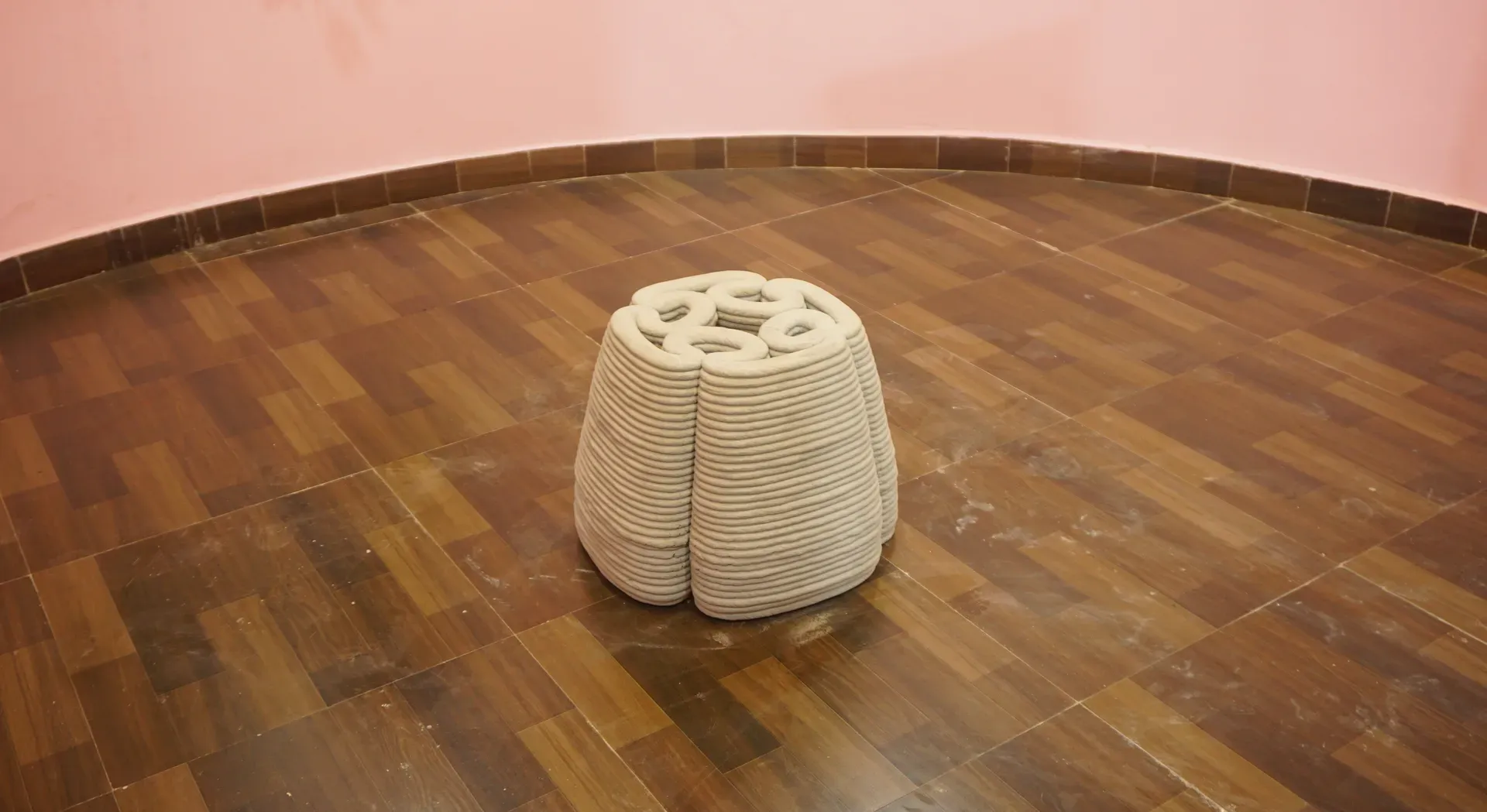
Kelvin6k’s materials innovation is as important as its robotics. Instead of Portland cement, its geopolymer “ink” is derived from industrial waste such as fly ash. According to the company, the material sets fast, reaches structural strength, and slashes the carbon footprint of the build. The approach earned the startup Asia’s first geopolymer-based 3D-printed home — built for Zoho founder Sridhar Vembu — and the company claims India’s first on-site 3D-printed building.
Defence, cities and Shark Tank
The technology has already moved beyond demos. With Military Engineer Services at Tambaram, Chennai, Kelvin6k built India’s first commercial on-site 3D-printed building — a guard room and sentry post printed with a domestically produced SCARA robotic printer, inaugurated by Air Commodore Ratish Kumar VM in July 2026. It has also completed commercial projects for the Greater Chennai Corporation and the Indian Air Force, and a 3D-printed building constructed entirely without cement for a private client.
More Read
Earlier in 2026, the founders — Dr. Pradeepkumar Sundarraj (CEO, PhD in mechanical engineering, formerly at the German aerospace centre DLR), Dr. Ravi Kant Upadhyay (CSO, PhD in chemistry) and Deepiga Sugumar (CHO) — pitched on Shark Tank India 5 and walked away with a ₹1 crore deal from Ritesh Agarwal. The company has raised ₹2 crore from IHFC of IIT Delhi, Crescent Innovation and Incubation Council and Ivy League Ventures, and is incubated at CIIC.
The Moon shot
The founders make no secret of the long game: 3D printing habitats on the Moon and Mars by 2030, using locally available materials and solar energy. Sundarraj’s interest traces back to his time at the German aerospace centre, where he worked alongside a team melting lunar regolith for extra-terrestrial habitats. Closer to earth, the plan is to scale a construction-as-a-service fleet and target markets from affordable housing under PM Awas Yojana to real-estate developers.
Watch: Kelvin6k’s timelapse of its 3D-printed guard post for MES Tambaram.
Sundarraj founded Kelvin6k — named for the surface temperature of the Sun — in January 2023. Three years on, its robots are already printing buildings for the Indian military, Indian cities and one of India’s best-known tech founders.