Cement is the most-consumed manufactured material on earth, and one of the hardest climate problems to solve. Making it accounts for roughly 8% of global CO2 emissions, and in India — the world’s second-largest cement producer — there has been no affordable substitute that works at construction scale. A Bengaluru startup says the way forward is to delete cement from the recipe entirely.
Ecopath, founded in 2024 by Sourabh Kumar and Abhishek Chhazed, makes EcoConcrete: a construction material the company says contains zero cement. Instead of Portland cement, it binds ground granulated blast-furnace slag (GGBS) — a by-product of steel manufacturing — with proprietary admixtures, and its process needs no water-based curing. The company claims 75–80% lower CO2 emissions than conventional concrete, 30% water savings in production, and double the road lifespan of cement-based roads.
The chemistry: steel waste as the binder
The engineering idea is not entirely new — geopolymer-style binders have been researched for decades — but commercial deployment at scale has stayed elusive. Ecopath’s move is to industrialise it: take GGBS, a steel-industry waste stream India generates in abundance, activate it with the company’s own binder chemistry, and manufacture the everyday building blocks of construction: ready-mix concrete, pavers, kerbstones, bricks and blocks, and precast solutions, plus full carbon-negative road projects. Its block plant in Bengaluru has a stated production capacity of 50,000 blocks a day, and the company says its blocks carry at least 70% recycled content.
The water story may matter as much as the carbon one. Cement concrete needs to be cured with water for days to gain strength; Ecopath says its zero-energy curing process skips that step entirely. For a country where construction sites routinely compete with households for water, that is a serious second selling point.
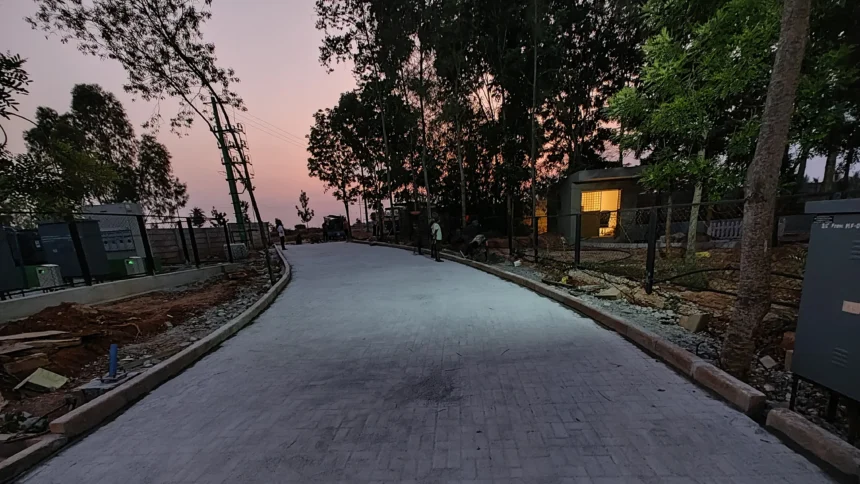
Proof on the ground: India’s first cement-free road
The claim that turns heads is a delivered one. In April 2026, the company announced what it describes as India’s first cement-free cast-in-situ concrete road, built at the Army School in Bengaluru: 100% cement-free concrete reinforced with fibreglass composite rebars instead of conventional steel, saving an estimated 34 tonnes of CO2. More than a year on, the company says the road continues to perform. A second milestone followed: India’s first carbon-negative bituminous road at American Air Filters in Bengaluru, with a claimed net footprint of roughly minus 3 tonnes of CO2.
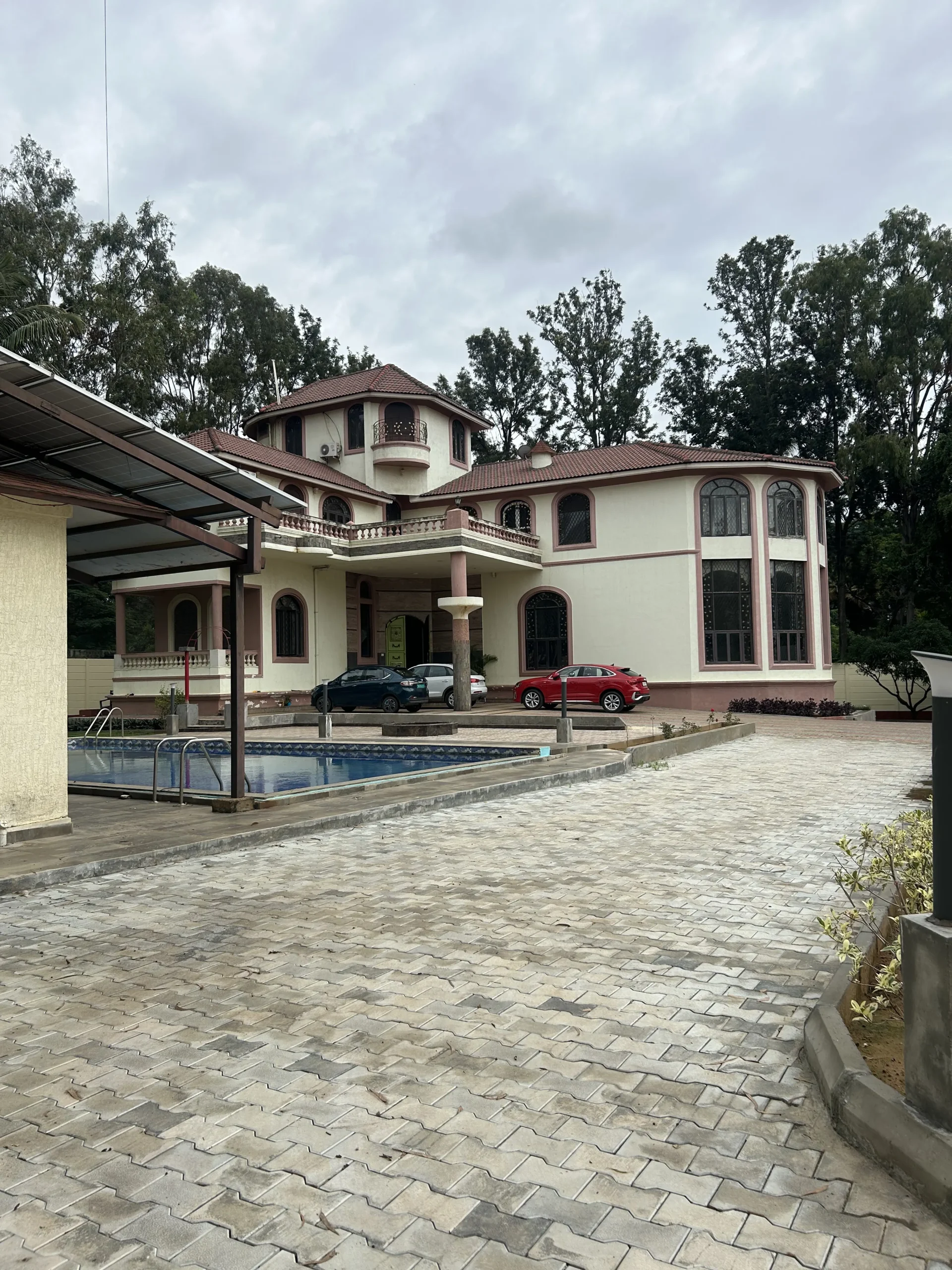
Commercial deployments have followed the pilots. At Nesta Ira Estates, Ecopath delivered the entire road infrastructure using its EcoConcrete — 3,000 kg of cement eliminated, 1,000 tonnes of water saved, and a 20% cost reduction versus conventional construction, per the company. A second estate project, at CoEvolve Estates in Whitefield, cut 500 kg of cement and saved 100 tonnes of water, also at about 20% lower cost. The cost claim is the one that could make the technology travel: green construction usually costs more, and here the company says it costs less.
More Read
The business behind it
Ecopath has moved past pilot stage into real revenue. Co-founder Sourabh Kumar told YourStory the company has generated nearly Rs 12 crore in cumulative revenue and expects to cross Rs 50 crore by the end of the current financial year. The company has filed six patent applications with five more in the pipeline, employs a 20-person team, and currently operates in Bengaluru, Pune, Mumbai and Hyderabad, with plans to reach at least 20 Indian cities and interest from the Middle East and Africa. It was named to TiE’s TiE50 2026 list of top global startups and to YourStory’s Tech30 2026 cohort. The company says it has reused more than 10,000 tonnes of industrial waste to date.
The caveats
As with any materials startup, the headline figures — 80% CO2 reduction, carbon-negative roads — are the company’s own, and independent third-party lifecycle verification has not been published. The “firsts” also sit in a busy field: India’s geopolymer researchers and peers like MiCoB’s industrial 3D concrete printing and Kelvin6k’s robotic construction printers are attacking the same cement problem from different directions. What sets Ecopath apart is not the lab result but the delivered roads — physical infrastructure, carrying traffic, that can be inspected.
Why it matters
Cement’s emissions are baked into chemistry, not just fuel: roughly half come from the limestone calcination itself, which is why efficiency gains alone can’t fix it. The only real levers are less cement per structure, or no cement at all. Ecopath is betting on the second, and doing it with waste India already has too much of — steel slag — at a price the company claims undercuts the conventional alternative. If the delivered roads hold up and the cost curve keeps pointing down, the cement bag may turn out to be optional after all.