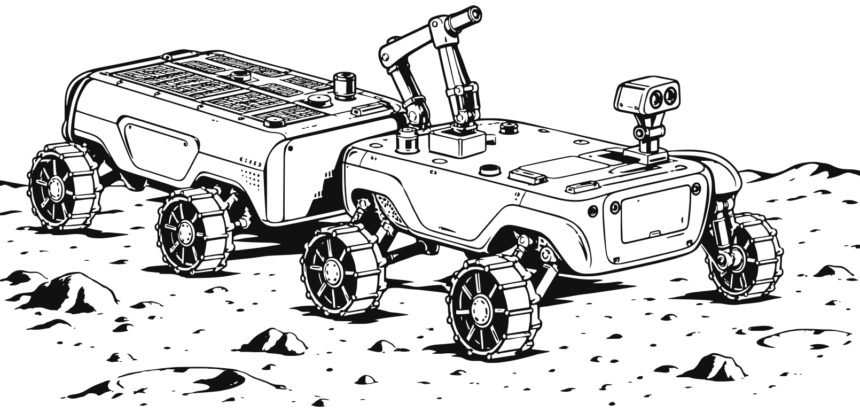
Every mission to the Moon today carries its own bespoke way of getting around once it lands — one-off engineering, rebuilt for every payload. An Ahmedabad startup founded this year thinks the return to the Moon needs better infrastructure: Cosmochute is building what it calls lunar infrastructure systems — a standardised rover-and-trailer platform that can carry anybody’s equipment across the lunar surface. The company has just raised a $1.5 million pre-seed round led by Accel and Prosus Ventures through their Atoms X programme to build it, per Indian Startup News and Entrackr.
What LEAP is
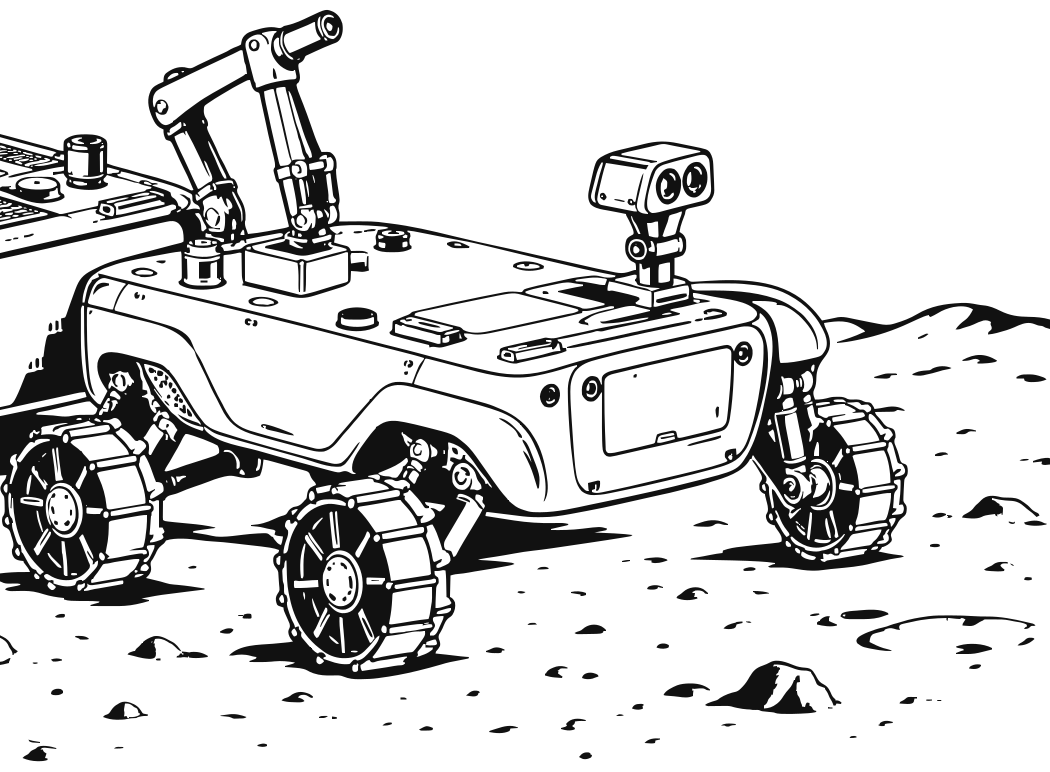
Cosmochute’s first programme is LEAP — a modular lunar mobility platform that pairs a rover with a trailer, both fitted with standard payload bays so multiple instruments, experiments and commercial hardware can be integrated into a common mission architecture. The pitch is simple: today’s lunar missions require mission-specific engineering to transport and deploy equipment, which keeps cost and complexity high. A standardised, reusable transport system — the company says — would make lunar surface operations repeatable instead of reinvented every time. Beyond LEAP, the company lists four offering pillars on its official website: lunar environment shielding, payload power and downlink, payload hosting designed for operations in permanently shadowed regions, and science and regolith access.
Why lunar logistics is the bet
The timing argument comes from co-founder Janhavi Gore: “Space 1.0 was ISRO proving India could reach orbit. Space 2.0 made orbit commercial: cheaper, more frequent, and open to private capital,” she told Indian Startup News. “With sustainable access now secured, we believe it’s the moment for Space 3.0, what happens after you make the in-space economy operable and extend it to the surface of the Moon.”
The shift she is pointing at is real: lunar exploration is moving from purely government-led science missions toward a commercial era, with private landers already flying paid payloads and space agencies planning sustained surface presence. India has a home-market heritage to draw on — Chandrayaan-3’s 2023 soft landing made India the fourth nation to land on the Moon.
The people behind the machine
Cosmochute was founded in 2026 by Janhavi Gore, Amit Chowdhary and Dhruv Alok Sangal, and is setting up its lunar laboratories at IIMA Ventures’ incubation facility in Ahmedabad. The scientific team is reported, by Indian Startup News, to include Mylswamy Annadurai — India’s “Moon Man”, the project director of Chandrayaan-1 — as chief scientist. Cosmochute is one of seven startups in the inaugural Atoms X cohort; the round also drew IIMA Ventures’ Deeptech and Aerospace Acceleration Fund, Operators Studio and Chinmayi Muthyala, and the company says it will use the funds for product development, engineering expansion and its commercial roadmap. Its backers page also lists NVIDIA Inception.
More Read

The hard part is still ahead
Honesty requires the caveat: Cosmochute is months old, LEAP is a programme in development rather than flight hardware, and the commercial lunar economy it is betting on does not exist yet. Nothing about the Moon is standardised — abrasive regolith dust, radiation and two-week nights will test every engineering choice the team makes. The milestones to watch: the engineering build-out, first hardware from the IIMA labs, and whether payload customers sign on to standard bays ahead of the commercial lunar landings of the decade.