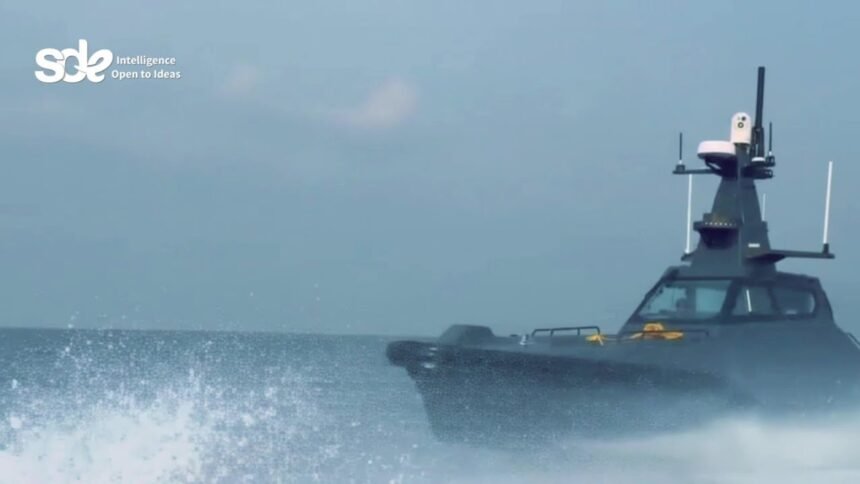
On 29 October 2024, a 13-metre boat set off from Mumbai with nobody aboard — no captain, no crew, no one at the wheel. Days later it arrived in Thoothukudi, Tamil Nadu, some 1,500 kilometres down the coast, after making the entire voyage on its own. No human touched the controls at any point. The vessel had navigated open ocean, recognised other shipping, and avoided collisions, all by itself.
The vessel was Matangi, and its builders are Sagar Defence Engineering, a Pune company that spent a decade building unmanned maritime systems before its industry — and the Indian Navy — started to take notice. Founded in 2015 by former merchant navy officer Captain Nikunj Parashar with co-founder Mridul Babbar, the company develops unmanned surface vessels, aerial systems and underwater platforms, together with the autonomy software that runs them.
The machine: Matangi and the GENISYS autonomy stack
Matangi is the flagship of Sagar Defence’s unmanned surface vessel line. Under the Indian Navy’s Swavlamban initiative and with Navy support through the Naval Innovation and Indigenisation Organisation, the vessel sailed Mumbai to Thoothukudi — about 850 nautical miles — using indigenous navigation and collision-avoidance software. Cameras, radar and other sensors feed an onboard autonomy system that follows mission waypoints, tracks surrounding traffic and alters course on its own.
The company calls its autonomy architecture GENISYS, which it describes as its patented technology for autonomous maritime systems. The same autonomy stack can also be retrofitted onto existing manned boats, so the company does not always need to sell a new hull to put autonomy on the water. The company has said its vessels can be operated as a coordinated swarm from a single control station.
The business: from boats to certified warships
The voyage was proof; the contracts are the business. Sagar Defence has been supplying unmanned systems to the Indian Navy and the Coast Guard for years — the Navy gave approval of necessity for 12 autonomous weaponised boat swarms developed by the company, intended for coastal surveillance and for Army operations at Pangong Lake in Ladakh. The weaponised fast interceptor craft pair autonomy with armament, including a remotely operated 12.7 mm gun.
Then came the milestones that changed the company’s category. In December 2025 it opened a Pune plant with Boeing subsidiary Liquid Robotics to co-produce the Wave Glider autonomous surface vessel. In September 2026 it secured an industrial licence to design, build, integrate and supply military surface and underwater vessels for the Navy and Coast Guard — placing a decade-old startup among the small group of private Indian firms authorised to build naval platforms. And in October 2026 it signed a memorandum of understanding with Lloyd’s Register, the classification society, to develop practical routes to certification for autonomous and remotely operated vessels — addressing what is arguably the biggest barrier to deploying unmanned ships at scale.
More Read
The economics are catching up with the engineering. The company reported revenue of about ₹108 crore for the financial year ended March 2025, and it is building a 30-acre autonomous maritime shipbuilding and systems centre at Juvvaladinne Fishing Harbour in Andhra Pradesh’s Nellore district, with trial production expected from October 2026 — alongside a larger defence manufacturing facility in the state announced in the presence of the Defence Minister.
The deeper bet is that the ocean — India has over 7,500 kilometres of coastline — will run on unmanned systems the way warehouses now run on robots. A vessel that needs no crew needs no food, no rest and no life-support; it can stay out longer and cost a fraction of a manned equivalent. Sagar Defence started that decade ago from a 150-square-foot apartment. It now has the Navy’s contracts, a warship-building licence and a global classification society helping certify its boats. The crewless ship, it turns out, was the easy part.