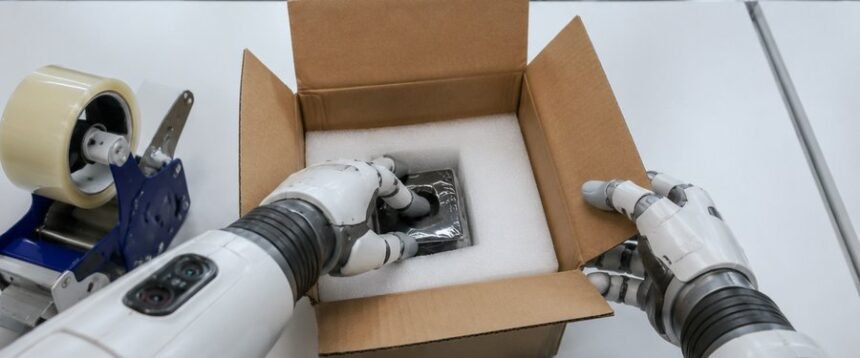
For a decade, a Mumbai company taught robots to talk safely to children. This month, it is teaching every other kind of machine — industrial arms, humanoids, drones, even CCTV systems — to act safely around people. In early October 2026, Inner Sky Labs, the company behind the Miko companion robot, unveiled a full stack of foundation models for what it calls physical AI: models that let machines perceive their surroundings, decide what to do, and — the part that matters most — stop themselves from doing anything unsafe.
The bet is a horizontal one. Instead of selling one more robot, Inner Sky Labs wants to sell the intelligence that goes into everyone else’s robots. Co-founder and CEO Sneh Vaswani has argued that building foundation models is becoming too expensive for individual machine makers, especially at modest production volumes; a common provider lets multiple manufacturers adopt the technology without each training their own models from scratch. The company says its models are developed in-house — not fine-tuned on open-source models — and trained on nearly a decade of physical-world data collected from factories, the Miko manufacturing ecosystem and other environments.
The machine: perception, action, and a safety layer with its own vote
The stack comes in three classes of model, each independently versioned and licensable, each able to run as a cloud API or inside the device’s own control loop.
Perception is the Drishti series of vision models, the Shruti series of audio models and the Sparsh touch models. Together they are meant to give a machine a human-like read of a scene: what it sees, what it hears — a spoken instruction, the crash of something falling — and how hard it is gripping, so a robotic hand can tell the difference between holding an egg and holding a wrench.
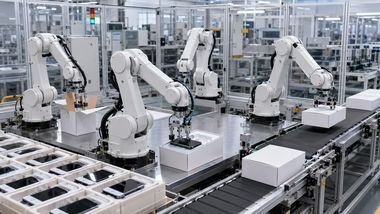
Action is where the engineering gets ambitious. Kriya is a family of vision-language-action policies for contact-rich manipulation, Karma is a world model that predicts how objects, people and other agents will respond before the machine acts, and Prana is the flagship omni-conditioned foundation model with what the company describes as a dual-brain architecture — one model family that perceives, anticipates and acts across any embodiment. The published roadmap scales Kriya, Karma and Prana from 4, 4 and 9 billion parameters to 12, 16 and 37 billion respectively. The first generation, Kriya and Karma, is already running in industrial single-arm cells, the company says, distinguishing conditions that look alike but feel different — a successful insertion versus a jam, a stable contact versus a collision.
Kavach: the brain whose only job is to say no
The most distinctive piece is Kavach, Sanskrit for “shield”. It is designed as an independent safety layer that checks every action a machine is about to take — before execution — and can block it regardless of what the rest of the stack decided. A robotic arm about to swing across a factory floor gets three questions first: is the space clear of people, is the speed safe for the area, is the movement inside its authorised zone. If any answer is no, the arm does not move. Not slowed down, not flagged for review later. Blocked before it starts. The company says Kavach ships with more than 20 such guardrails, and that end customers or authorities can write their own safety rules in their own operational and legal language.
More Read
The company’s own benchmarks claim a lot for Kavach v2 — 1.00 prompt safety and 0.91 response safety against flagship commercial models, improving further under multi-turn escalation — but these are company-published numbers, not independent results, and the platform itself is new: access is currently by invitation to qualified partners, with cloud, on-premises and fully offline on-device deployments. The trust track record it leans on is older and more concrete. Miko, the children’s robot whose conversational safety thinking seeded this platform, has shipped half a million units across more than 140 countries, according to the company — and in an independent evaluation by BDO’s cybersecurity practice, cited in the launch material, Miko’s safety system caught every unsafe prompt across seven public AI-safety benchmarks, ahead of four widely used commercial models.
The business: from one robot to every robot
Inner Sky Labs is an IIT Bombay alumni-founded company with more than US$80 million raised behind it, from investors including Chiratae Ventures, IvyCap Ventures, YourNest Venture Capital and 360 ONE, according to Express Computer. Alongside the launch, the company said it is closing a roughly ₹300 crore round involving existing backer YourNest and Keshav R. Murugesh with new global investors, earmarked for real-world data collection, compute and model training.
The question that will decide whether this becomes infrastructure is the one independent analysts are already asking: whether capabilities proven around one companion robot transfer reliably to industrial arms with very different precision, control and safety requirements. The company’s answer is its data flywheel — an ISL Data Lab running instrumented factory stations, household capture rigs and simulated twins, with reinforcement learning against audited outcomes from the fleet’s own experience. A decade spent earning a parent’s trust with a robot for their child, the company argues, is now the foundation for earning a factory’s, a hospital’s and a government’s trust with machines that move.