On the night of September 27-28, 2026, a stream of single photons crossed 5.56 kilometres of open air between two campuses in Gandhinagar, Gujarat — and carried a secret. In a field trial by Bengaluru’s QNu Labs, the Bhaskaracharya National Institute for Space Applications and Geo-informatics (BISAG-N) and IIT Gandhinagar established India’s first free-space quantum key distribution (QKD) link at the 5 km scale. The link held a quantum bit error rate below 5 per cent and generated secure keys at 230 to 260 bits per second — roughly one fresh 256-bit symmetric key every second — which were then used to encrypt and decrypt test messages end to end. The Ministry of Electronics and Information Technology announced the demonstration in a release in early October; ANI reported it on October 15.
Why it matters: conventional QKD runs through fibre, which limits reach. Free-space QKD transmits quantum signals through the atmosphere itself, and the atmospheric segment is exactly the part a satellite-to-ground quantum link must traverse. A stable multi-kilometre link over open air is the terrestrial dress rehearsal for satellite-based quantum communication — secure government, defence and critical-infrastructure networks that future quantum computers cannot silently break.
The hard part: keeping a photon stream on target
Sending single-photon-level signals through the atmosphere means fighting beam wander, atmospheric turbulence and background light for every microsecond of the transmission. The hero of the trial was QNu Labs’ Pointing, Acquisition and Tracking (PAT) system, which kept the 1550 nm quantum channel aligned between the two sites. As detailed in the Quantum Computing Report’s account of the trial, the PAT combined gimbal-based coarse pointing at about 5 microradian accuracy with fast fine steering at a 100 Hz tracking bandwidth — good to roughly 0.1 microradian — to stabilise the beam against turbulence.
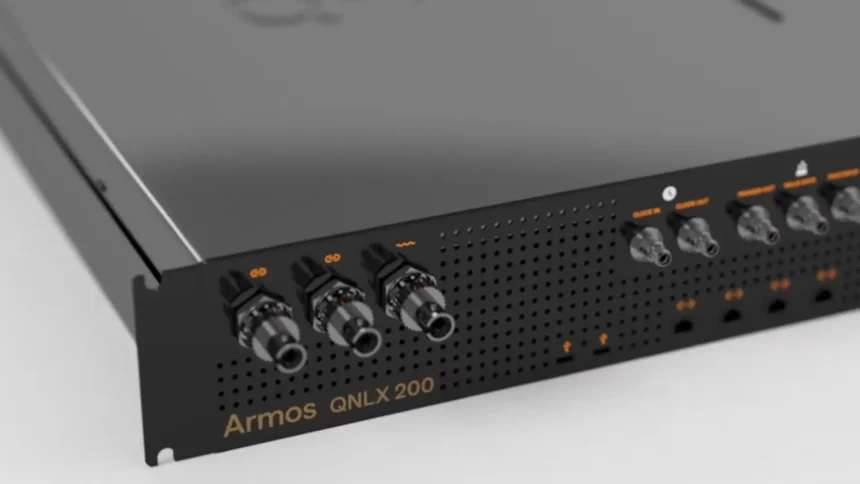
The link ran on the differential-phase-shift (DPS)-Decoy QKD protocol through the company’s Armos hardware, the same QKD family the company has deployed with the Indian Navy, defence PSU BEL and the Indian Army, according to industry reports. The generated keys were delivered through the ETSI GS QKD 014 standard interface, which let them slot directly into BISAG-N’s software stack rather than living as a laboratory curiosity.
Two layers, one failure-tolerant design
The trial was deliberately built as a hybrid. QNu Labs’ hardware-based QKD supplied keys over the free-space optical channel; BISAG-N’s Vedic Kavach platform supplied a software layer of post-quantum cryptography with quantum random number generation. The integration was designed so the application stays protected even if the physical quantum channel is temporarily unavailable — a pragmatic admission that weather and misalignment are real-world conditions, not edge cases.
Co-founder and CEO Sunil Gupta said the demonstration shows QKD supported by precise optical pointing and tracking can be deployed over a multi-kilometre free-space link and integrated with a post-quantum security layer — an important step, in his framing, towards longer-distance quantum-secure networks and architectures that can eventually support multiple nodes and satellite-based quantum communication. BISAG-N Director General Dr Vinay Thakur called the integration of Vedic Kavach with QNu’s QKD technology a significant step towards practical quantum-resilient communication systems.
More Read
The company behind the beam
QNu Labs was founded in 2016 by Sunil Gupta, Srinivasa Rao Aluri and fellow technologists, and was incubated at IIT Madras. The company claims the distinction of being India’s first firm to build commercial cybersecurity products on quantum physics, and its portfolio now spans quantum key distribution (Armos), quantum random number generation (Tropos), post-quantum cryptography and the QShield quantum-security platform — with deployments in government, critical infrastructure and banking, financial services and insurance, according to YourStory. It also runs a US subsidiary, QNu Labs Inc, set up in Massachusetts in 2019.
The momentum behind the trial is financial as well as technical. In September 2026 the company raised Rs 200 crore in a Series A1 round co-led by the state-backed National Quantum Mission and Speciale Invest, with Sony Innovation Fund, Gaja Capital and Artha Ventures participating — taking total capital raised to Rs 375 crore. The company says it is moving from technology development into what it calls a “proof-of-scale” phase, expanding into quantum sensing, AI, and security solutions for drones and satellites aimed at the defence sector. Under the National Quantum Mission, it is also working on the technology backbone for longer-distance quantum-secure networks.
The 5.56 km link is not a product launch; it is a field validation. But it is the kind that matters: indigenous hardware, academic research and real-world testing, run overnight through real atmosphere, and announced by the government. The next distances to beat — longer terrestrial hops, then the far harder jump to orbit — now have a working baseline to build from.