Image credit: CraftifAI
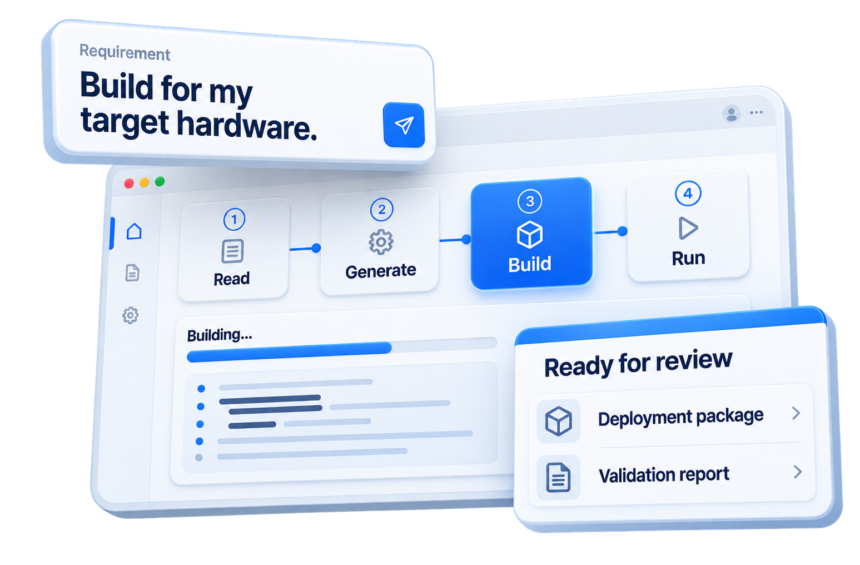
A payment speaker that announces a transaction, a drone navigating a warehouse, a camera watching a factory floor — each runs on software that must work intimately with the chip underneath it. But writing that software takes months: engineers rebuild applications for every new piece of silicon, and every hardware swap means starting large parts of the work over. A Bengaluru startup says the fix is to let AI do the rebuilding — not generic code generation, but agents that take a plain-English requirement, inspect the actual target hardware, generate the code, then compile and run it to prove it works before handing it over.
The company is CraftifAI, founded by Pratik Sharda and Yashwant Dagar. The founding story is the pain point itself: Sharda led the hardware portfolio at PhonePe, where he watched software development delay the deployment of sound boxes, point-of-sale terminals and dynamic QR systems; Dagar built applications for semiconductor customers, where moving between chips meant substantial rework. Their platform, CraftifAI Orbit, is aimed squarely at the gap between AI models and physical devices — what the industry now calls physical AI.
Orbit: three agentic lifecycles for hardware teams
Orbit is not one product but a suite of agentic-AI tools for hardware engineering teams, covering three lifecycles. PipeGen handles edge-AI perception and vision-AI pipelines — the company describes the output as a trained model turned into a deployed pipeline on one platform, with a TensorRT engine, a containerised deployment package and a benchmark report. FirmGen handles the firmware lifecycle: production firmware for the customer’s exact board, delivered as a native SDK project (ESP-IDF or STM32Cube) that compiles clean. AgentIQ handles the FPGA design lifecycle, producing FPGA designs and deployable bitstreams for the target device with timing closed.
The differentiator the company stresses is proof on hardware: each agent generates code and then compiles and runs it to demonstrate the result — an important claim, because embedded software that compiles but fails on the board is exactly the failure mode that makes hardware teams distrust AI-generated code. The platform supports multiple chipsets, development environments and frameworks including GStreamer, ROS2 and Android, and is offered as SaaS or on-premise. The headline numbers are the company’s own: shipping enterprise-grade software five times faster, more than 80% faster time to market per project, and 30 to 60 minutes from requirement to embedded software running on the device.
Proof it works
The platform went live in 2026. According to the company, by September it was in use at more than 15 companies and enterprises, with over 500 users — a credible early base for a B2B developer tool launched the same year. Earlier pilots ran with several Indian original equipment manufacturers across robotics, drones, IoT and AI cameras, alongside a US-listed semiconductor company, and the company says engagements with major customers have moved from proofs of concept to full-year contracts. The team is around 40 people, more than 85% of them in R&D — unusually high even for deep tech, and consistent with a product still being hardened. The company is headquartered in Bengaluru with a satellite office in San Francisco, and is targeting enterprise adoption in India, the US and Germany. In February 2026 it raised a $3 million seed round led by Ankur Capital, with IvyCap Ventures, Capital-A and Antler participating. In October 2026 it was named to YourStory’s Tech30 cohort, and it was earlier selected for Google’s India Startup Accelerator 2026 cohort.
More Read
The bigger bet: hardware without the handcuffs
CraftifAI’s thesis is that physical-AI development should be modular: software that adapts across hardware architectures instead of being rebuilt for each one. The immediate commercial bet is on vendor lock-in — the company says its hardware-agnostic approach lets teams switch chipsets without proprietary constraints, which matters in an Indian embedded software market that Inc42 pegs at growing from about $488 million in 2024 to roughly $911 million by 2030. The target industries are the ones where this pain is sharpest: robotics, drones, industrial IoT, automotive and consumer electronics, where product cycles are set by silicon, not software.
What would make this real
The honest caveats matter. The speed figures — 30 to 60 minutes, 80%+ faster, five times faster — are the company’s own marketing claims, not independent measurements. And the core risk is reliability: embedded code that runs must run deterministically on the board, and Sharda himself told YourStory that the next challenge is turning early enterprise interest into sustained adoption “while ensuring that AI-generated software works reliably on physical devices” — which is as close to the company naming its own hardest problem as you get. The company has not disclosed revenue figures.
Still, the pedigree is hard to fake: founders who have shipped hardware at scale, a founding team of embedded engineers, and an R&D-heavy headcount building for a market that is only getting bigger as connected devices multiply. If the agents really can generate, compile and run production-grade firmware for any board from a plain-English requirement, the bottleneck in physical AI shifts from writing code to knowing what to build. For a country trying to build its own electronics supply chain, that is infrastructure worth watching.