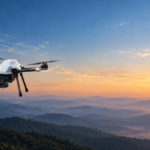
Image credit: ShepHertz (AgentAnywhere) — official company visual.
In the mountains where the mobile signal dies, the drone still has to decide. In a hospital operating under Indian data law, the diagnostic agent still has to stay inside the building. In a bank where a hallucinated number becomes a regulatory event, the model still has to answer. Most of today’s AI solves these problems by calling home — a data centre in another country, a jurisdiction nobody chose. ShepHertz Technologies, a Gurugram applied-AI company founded in 2010, is betting that India’s machines should carry their intelligence with them, offline, and own it outright.

AgentAnywhere, ShepHertz’s sovereign AI platform. Image: ShepHertz.
The sovereignty bet
ShepHertz is not new to AI — the company says it put its first commercial AI platform into production in 2012, that its deployments reach more than 150 countries, and that its operations are SOC 2 and ISO 27001 certified, with HIPAA and GDPR readiness independently assessed. But on 15 August 2026 it launched something new: AgentAnywhere, a sovereign agentic-AI platform whose premise is that models, agents and governance should all run inside the customer’s own infrastructure — on their cloud, in their jurisdiction, under their encryption keys, region-pinned or fully air-gapped.
At its core is an enforced trust layer the company says is already operational, not a roadmap item: Aavaran masks and de-identifies personal, financial and regulated data before any model sees it; Kavach acts as an inline security shield, screening every request and response for prompt injection, jailbreaks and leaked secrets; and every call closes with a signed Trust Receipt — a record of what was masked, what was screened, which model ran and under which policy — that an auditor can verify offline. “India cannot be sovereign in AI by renting its intelligence from abroad,” founder and CEO Siddhartha Chandurkar said at the launch. “The machines that watch our borders, fly our skies and orbit above us must think in India.”
More Read
Tatva, Sanjaya and Drashta
In early October 2026, at Drone Expo 2026, the company unveiled three new India-built AI model families, designed for the machines that cannot phone home — from satellites to smart rings:
Tatva (“essence”) is for on-device command: it turns an operator’s plain words in English, Hinglish or Indian languages into exactly one command a machine understands — or into no action at all. It runs on the device itself, from Raspberry-Pi-class boards to laptops and servers, in Edge, Nano, Micro and Indic variants sized from wearables to ground stations. Tatva Edge entered private preview through a waitlist at agentanywhere.ai.
Sanjaya — named after the Mahabharata’s narrator who could see the whole battlefield — gives mission control one live picture across fleets of drones, satellites and vehicles, and keeps a fleet coordinated when links fail or its leader drops out.
Drashta (“the seer”) is for machine vision: it reads satellite and aerial imagery offline and maps objects of interest for analysts to review, serving defence and strategic users inside air-gapped perimeters — the company is explicit that it is never placed in a weapons-release chain, with a named officer in command of every consequential step.
All three follow one rule, per the company: the model proposes, a policy outside the model checks, and a person approves anything that matters. The customer defines the machine’s command vocabulary; anything outside it is refused.
Built from scratch, in India
The company’s defining claim is the provenance: the models are trained from scratch in India on openly licensed, licence-recorded data, with the training corpus built and receipted using Shuddhi — the data-factory tool ShepHertz has open-sourced under the Apache 2.0 licence, which issues a hash-chained receipt proving exactly what went into a corpus and what was filtered out. More of the trust toolchain — Model Hub, the Agent Universal Gateway, the Annotator and Nabhika OS, the node layer that installs AI on a machine — is slated to follow as open source.
AgentAnywhere is now a family of seven model families, per the company: Taksha (sovereign AI-engineering and coding, generally available), Manthan (reasoning), Kuber (BFSI), Seva (service operations), Tatva (on-device and edge), Astra (defence) and Sanjaya (critical telemetry) — each shipped only after passing an execution-graded testing battery, a bar the company says rejected two candidate models for failing the gates. The company even runs its own business on the platform: marketing lead-generation, enterprise RFP responses, contract review and cloud-cost optimisation all run on its own agents.
What to watch
The honest caveat: everything announced in October is company-reported, and the eye-catching expo demonstrations — a 500-drone swarm electing a new leader on board when its leader is lost, a humanoid robot taking tasks in plain language and refusing unsafe ones, border reconnaissance, farm watch, rooftop solar inspection, flood search-and-rescue — were simulations, though the company says every Tatva output shown in them was real recorded model output. The next test is performance in partner deployments: command accuracy on real hardware, memory and power budgets on constrained boards, and behaviour over months in the field.
But the direction is unmistakable. India’s AI conversation has been dominated by models that live in someone else’s cloud; ShepHertz is trying to build the alternative rung by rung — small models that think on the machine, a trust layer that can prove what they did, and an open receipt book so nobody has to take the company’s word for it. That is a genuinely different theory of sovereign AI, and it is being built, tested and shipped from Gurugram.