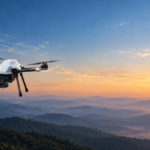
Image credit: NewSpace Research & Technologies — official company visual.
Most strike drones need a runway, a catapult or at least a long, clear stretch of road to get airborne. NewSpace Research & Technologies wants to delete that requirement entirely. On 15 October 2026, the Bengaluru aerospace and defence startup announced that its GryphonWorks team had successfully test-fired a rocket-assisted take-off (RATO) booster on the Sheshnaag-150, its long-range one-way-attack drone — a first, the company says, for an indigenously designed, developed and manufactured (IDDM) long-range strike asset.
The drone
The Sheshnaag-150 sits in the 150-kg class and is the headline act of NewSpace’s wider Sheshnaag programme, a family of one-way-attack UAVs the company is developing with strike ranges from 15 km out to 1,000 km. Unveiled at the World Defence Show 2026 in Riyadh in February, the 150 is pitched as a theatre-level loitering munition: the company claims a range beyond 1,000 km, endurance of roughly five hours, and a warhead class of 25 to 40 kg.
The engineering choices are deliberate. The airframe is a compact, low-aspect delta wing with a central dorsal fin and a rear propulsion section — a configuration defence analysts note prioritises straightforward manufacturing, generous internal fuel volume and stable long-range cruise. Power comes from a four-cylinder, air-cooled boxer piston engine, a setup borrowed from larger tactical UAVs: the opposing pistons cancel vibration for reliability on multi-hour missions, and with no liquid cooling loop there is nothing to freeze at Himalayan altitudes. NewSpace also claims GPS-denied operability and, most distinctively, collaborative autonomy — self-healing swarms, dynamic re-tasking and mesh networking that let multiple aircraft coordinate a saturation attack rather than simply flying identical routes.
What the RATO booster changes
Until now the Sheshnaag-150 launched from vehicles or mobile highway setups. A RATO booster is a bolt-on rocket motor that delivers a short, high-thrust burn — enough to hurl the munition out of a canister up to flying speed and a safe climb angle — then burns out and separates while the wings open and the sustainer engine takes over for the loiter phase. The payoff is a launch footprint roughly the size of the munition itself: no runway, no catapult, no prepared strip. The company has not disclosed the test location, the booster’s specifications or how many trials have been conducted, but it frames the capability as the thing that lets the system deploy from confined, unprepared forward locations.
Tested, not just rendered
Unlike many paper concepts in this category, the Sheshnaag-150 has a flight record. Open-source accounts put its first flight in February 2025 from the Chitradurga Aeronautical Test Range, and in April 2026 the aircraft reportedly flew a roughly 720-km waypoint course at Pokhran before engaging its target — without a live warhead. The same accounts say development was fast-tracked after Operation Sindoor, when the startup’s leadership was summoned by the military. None of the performance figures have been independently verified, and NewSpace has published no test imagery beyond its announcement — but the programme is visibly moving from brochure to range.
More Read
The company behind it
NewSpace Research & Technologies was founded in 2017 by former Indian Air Force officer Sameer Joshi and Julius Amrit, and has spent nearly a decade on unmanned aerospace systems. It raised $21 million in a 2022 round led by Pavestone Technology Fund, signed a Ministry of Defence deal the same year to develop a high-altitude pseudo-satellite, and has won Indian Air Force swarm-drone competitions — the pedigree behind the company’s claim that it builds “intelligent cyber-physical systems” rather than airframes alone.
What to watch
The honest caveats: every headline figure — the 1,000-km range, the five-hour endurance, the warhead class — is company-reported and independently unverified. The RATO announcement discloses no test location or trial count. And while the Sheshnaag-150’s claimed profile maps remarkably well onto the Indian Army’s Long Range Loiter Munition Make-II requirement (a 1,000-km, 25-kg-minimum, GPS-denied system, approved in principle in July 2025), there is no public evidence it has been selected — and one reported gap to close: the Army is said to want 400 km/h, against published Sheshnaag cruise figures closer to 300 km/h.
What stands out anyway is the trajectory: a Bengaluru startup that began with swarm-drone research is now flight-testing a 1,000-km-class strike system with canister launch — hardware India’s private sector simply did not build a decade ago.