Image credit: SS Innovations — official company visual. In the first week of October 2026, SS Innovations International answered the US Food and Drug Administration’s outstanding questions on its SSi Mantra surgical robotic system — the regulatory step that could put the first Indian-designed surgical robot into American operating theatres. The company expects the FDA to complete its review of the 510(k) submission in the first quarter of 2027. If it clears, a machine designed and built in Gurugram will compete with systems that have dominated surgical robotics for two decades.
The surgeon behind the robot
SS Innovations was founded by Dr. Sudhir Srivastava, a robotic cardiac surgeon who serves as the company’s founder, chairman and CEO. The company says he holds the record for the most robotic beating-heart totally endoscopic coronary artery bypass (TECAB) surgeries — a procedure performed entirely through small incisions on a beating heart, without stopping it. His stated vision for the SSi Mantra was to “decentralise excellence”: take the capabilities of elite robotic surgery out of a handful of rich-country hospitals and into the operating rooms that serve everyone else.
SS Innovations International is listed on Nasdaq (ticker: SSII) and describes itself as an American company headquartered in India, with its operating base in Gurugram, Haryana. Its manufacturing carries India’s CDSCO licence (MFG/MD/2024/000827) and EN ISO 13485:2016 certification.
The machine: modular arms, an open console
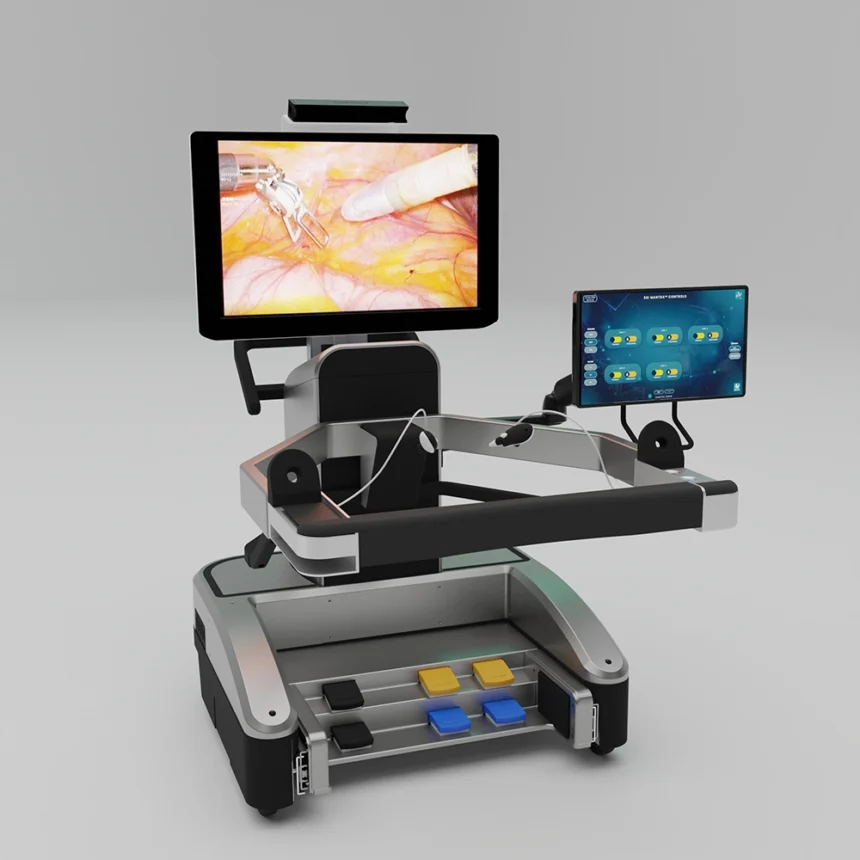
The SSi Mantra is a modular, multi-arm system. Three to five robotic arm carts dock independently around the patient — the modularity lets surgeons use fewer arms for small procedures and the full five for complex ones, and keeps the carts from colliding mid-operation. The surgeon works at an open-faced ergonomic command center with a 32-inch 3D 4K monitor, a 23-inch 2D touch panel for patient information, and a virtual real-time image of the arm carts. The system can superimpose 3D models built from the patient’s own diagnostic scans onto the surgical view — the plan and the patient, in one picture.
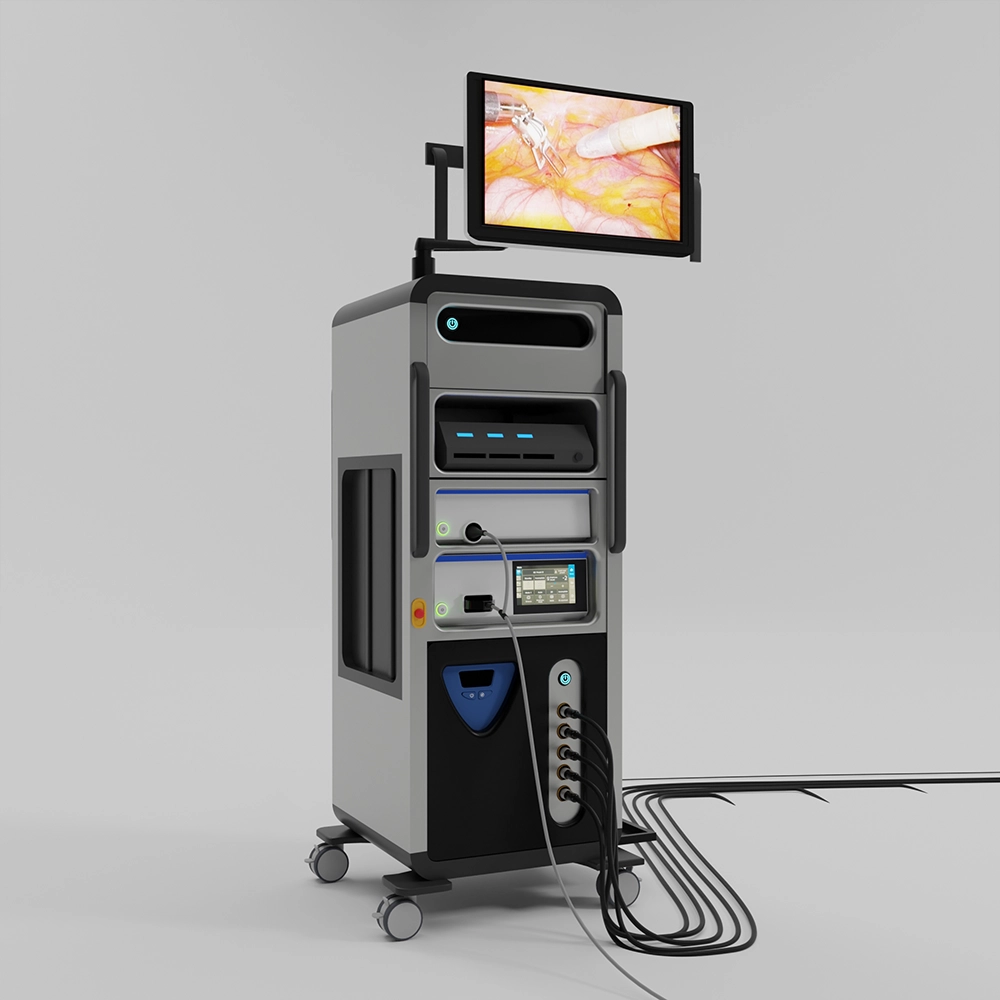
The SSi Mantra 3 vision cart. Image: SS Innovations.
More Read
A separate vision cart gives the whole operating-room team the same magnified 3D 4K view the surgeon sees. The system uses more than 40 types of robotic endo-surgical instruments, including 5 mm instruments for pediatric and ENT work. The company says the Mantra has been clinically validated in India across more than 190 types of surgical procedures — from urology and gynecology to cardiac and thoracic surgery.
Telesurgery: the record book
Where SSi Mantra has genuinely led is surgery over distance. In January 2025 the company performed what it calls the world’s first two robotic cardiac telesurgeries: a surgeon in Gurgaon operated a console while the patients — undergoing coronary artery bypass grafts — lay in Jaipur, 286 km away, with the surgeon’s movements transmitted at 35–40 milliseconds of latency. It has since reported the world’s first robotic bariatric telesurgeries, performed remotely from Gurugram on patients in Indore, some 900 km away.
In July 2026 the company set its longest-distance record yet with a telesurgery between Colombia and India, and by the end of August 2026 it reported 188 cumulative telesurgeries. India’s drug regulator has approved the SSi Mantra 3 for telesurgery and tele-proctoring, and the company has unveiled the SSi MantrAsana — a portable, compact tele-surgeon console — and MantraM, a mobile tele-surgical unit designed to take robotic surgery to remote regions.
The scale — attributed
The company’s September 2026 operational update puts numbers to the trajectory: 238 installed systems across 12 countries, up 42% since the end of 2025, and 14,103 multi-specialty procedures, up 79%. Pediatric work includes a kidney procedure on a 45-day-old infant in August 2026 — 258 pediatric surgeries in all by that month’s end. On a single day, 15 August 2026, one hospital in Indore completed 50 robot-assisted surgeries using five SSi Mantra systems.
The system is approved for marketing in India, Nepal, Ecuador, Guatemala, the Philippines, Indonesia and Ukraine. These are company-reported figures — the independently verifiable core is the regulatory record (CDSCO, the FDA 510(k) process) and the peer-reviewed work, including a November 2024 Springer publication on dual-console telesurgery with the system.
The scrutiny
Two things deserve keeping straight. First, 5 October was a response to the FDA’s questions, not a clearance — the first-quarter-2027 timeline is the company’s stated expectation, not a regulatory promise, and the submission currently covers only cholecystectomy, or gallbladder removal. Second, the scale numbers above come from the company’s own investor communications, not independent audits. TipRanks’ AI analyst is Neutral on the stock, citing ongoing losses and cash burn despite the revenue growth — a reminder that clinical momentum and financial health are different things. The “world-first” telesurgery claims are the company’s; peer-reviewed validation of the long-distance outcomes will be the real test.
What comes next
The immediate test is the FDA’s decision in early 2027. Clearance for the first indication would open the US market and likely accelerate the EU’s CE-marking pathway — together, the two regulatory stamps that decide whether the SSi Mantra stays a developing-world story or becomes a global one. Behind it, SS Innovations is building a wider platform: SSi Operion single-arm assist carts for endoscopy and ultrasound (in early clinical validation), the SSi Mudra instrument suite, and training and streaming systems. The SSi Mantra proved an Indian team could build a credible surgical robot; the next three years will show whether it can scale one like an incumbent.