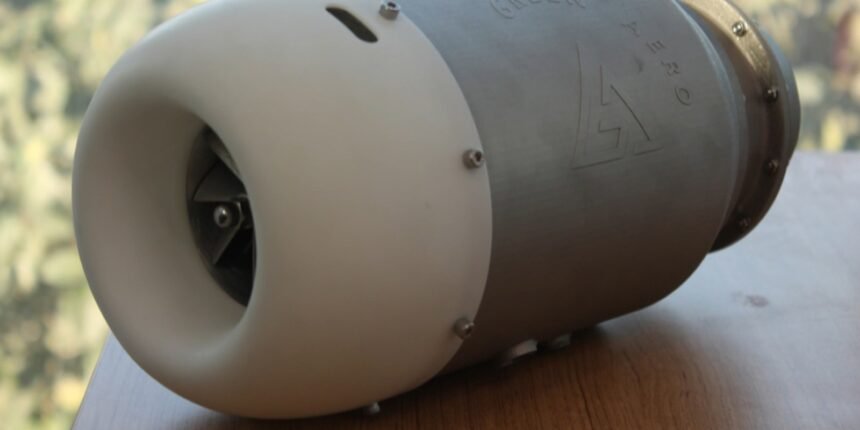
Image credit: Green Aero — official company visual. On 14 October 2026, an investor profile of Green Aero put a number to a quiet three-year grind: the Bengaluru deep-tech startup has hot-fired its supercritical carbon-dioxide turbines more than 700 times — and signed L&T Defence to license the technology and supply engines for India’s military drones. Green Aero is attempting what India’s Kaveri programme never finished: building a jet engine at home. Its most visible result so far is the Blue Dragon, a hydrogen-powered aero engine core the company describes as the first of its kind built in India, test-fired in May 2025.
The founder who came home to build engines
Green Aero Propulsion Private Limited was founded in 2023 by Dr Prithwish Kundu, a propulsion scientist with a PhD in aerospace engineering from North Carolina State University. Kundu previously worked as a research scientist at the US Department of Energy’s Argonne National Laboratory, where his work covered computational fluid dynamics and advanced combustion systems, and he has been part of propulsion programmes with NASA and the US Army. After returning to India, he ran battery and thermal systems at Euler Motors and led computational studies at AgniKul Cosmos before starting Green Aero.
The company was incubated at IIT Delhi, associated with its Foundation for Innovation and Technology Transfer (FITT) at the Research & Innovation Park, and now operates from Bengaluru’s HiTech Defence & Aerospace Park. It raised a $1.6 million seed round in July 2025 led by pi Ventures with Antler participating, following an earlier ~$240,000 round led by Rebalance and a grant from Boeing — taking total funding to roughly $1.8–2 million. A 2026 startup-showcase listing also refers to signed long-term contracts worth about $3 million.
Two bets: hydrogen cores and supercritical turbines
Green Aero is building on two tracks. The first is the Blue Dragon, its hydrogen-powered aero engine core, which the company test-fired in May 2025 and calls India’s first such core. The company says the core achieves nearly 99% combustion efficiency and is designed to run on both conventional jet fuel and green hydrogen. Hydrogen is attractive because burning it produces water vapour rather than carbon dioxide — but it burns hotter and faster than kerosene and is far harder to store, which is why the combustor design is where most of the difficulty sits.
The second track is a compact supercritical CO₂-based waste-heat-recovery unit. Conventional propulsion systems waste more than half of their energy as heat; Green Aero’s approach recycles that heat at high pressures and temperatures. The company claims the system delivers nearly twice the efficiency of the current global state of the art, and its investor Antler reports the turbines are about 50% more efficient than conventional ones at a fraction of the size. The 700-plus hot-fires are the evidence the company points to that the architecture survives contact with reality.
The drone engine: sub-kilonewton, multi-fuel, 3D-printed
The nearer-term product is a sub-kilonewton liquid-fuelled aero engine for drones. In a test firing reported on 5 March 2026, the company demonstrated the engine in a long-endurance run, taking it from idle up to higher thrust. The test, the company said, validated the turbomachinery, fuel injection, ignition systems, rotor dynamics, lubrication and metallurgy.
More Read
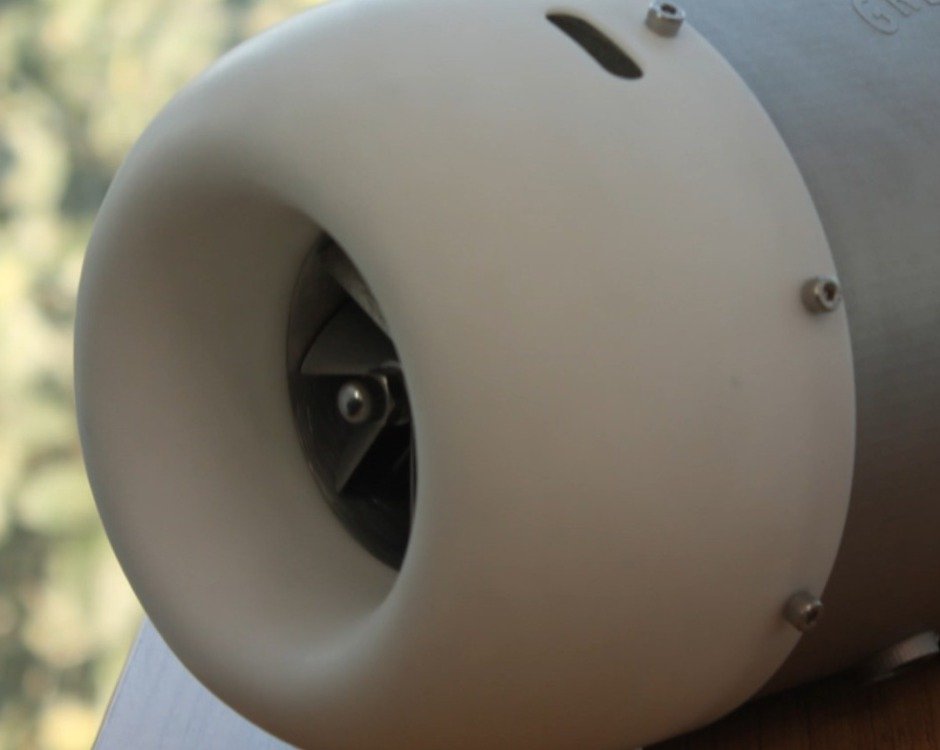
A close look at the Blue Dragon’s intake. Image: Green Aero.
The engine incorporates airblast atomisers that use high-velocity air to atomise fuel, enabling stable combustion across fuels — the company describes it as the world’s first airblast atomiser for engines this small. It runs on multiple fuels, including jet fuel and diesel, and features an electric start. The compressor and diffuser were developed in-house, and the combustor uses an effusion-cooled liner with microscopic perforations that form a thin cooling film over the engine materials. The unit is manufactured with metal additive manufacturing in superalloys, which the company says cuts part counts by nearly 70% compared with traditional machining. The thrust class targets the 20 to 100 kilogram-force segment — aimed at high-speed drones, collaborative combat aircraft, loitering munitions and standoff systems.
The L&T deal and a transonic drone waiting to fly
In July 2025, Green Aero entered a partnership with Larsen & Toubro to co-develop micro turbojet engines for military drones, with L&T planning to integrate the Indian-made engines into its own range of tactical UAVs. Antler’s October 2026 profile goes further, reporting that L&T Defence has signed to license Green Aero’s technology and to be supplied with engines for military drones.
The company has also built a transonic drone airframe — called AgniPankh in its hiring posts — powered by its Blue Dragon engines, which is built and awaiting its first flight. The company says it is establishing a dedicated propulsion test cell capable of simulating high-altitude operating conditions and is hiring engineers across turbomachinery design, computational fluid dynamics, combustion modelling and embedded systems.
The scrutiny
Two things deserve keeping straight. First, the headline numbers — 99% combustion efficiency, roughly double the efficiency of the global state of the art, the “first” and “world’s first” labels — are the company’s claims, reported by its investors and the trade press, not independently verified test data. Second, Green Aero has yet to launch commercial operations or earn revenue; as one industry profile noted, the aerospace game takes years and enormous capital to go from a hot-fire to a flying, certified product. Hydrogen aviation in particular remains years from commercial deployment across the industry. The March 2026 firing was a ground test, not a flight — the transonic drone’s first flight is the milestone that would move the story from the test cell to the sky.
What comes next
The company says it is gearing up to commercialise a 100kW-class engine while laying the foundation for its supercritical systems on larger defence and clean-aviation platforms — and it is already talking about supersonic propulsion. The immediate tests are the high-altitude test cell, the first flight of the transonic drone, and converting the L&T relationship into production engines on Indian military UAVs. India has imported its turbine engines for decades; if Green Aero’s hot-fires turn into hardware on Indian drones, it will have closed one of the country’s oldest technology gaps.