Image credit: Photo by Krishna Singh / Picraft Technology (via Defence Blog). On 17 October 2026, reports from Indian defence media carried a striking announcement out of Dehradun: Picraft Technology, a young defence startup, had completed high-altitude trials of its indigenous swarm drone technology at roughly 16,500 feet in Ladakh. Multiple small unmanned aircraft, flying as a coordinated group rather than as individual machines, evaluated together in the thin, freezing air of the Himalayas — exactly the environment where India’s armed forces need such capabilities most.
Swarm drones are a different beast from the single camera-drone you might see at a wedding. The idea is that several unmanned aerial vehicles share information, maintain formation and distribute tasks among themselves, supervised by a small number of operators instead of one pilot per aircraft. That kind of coordination is hard enough on a calm day at sea level. At 16,500 feet, where air density is roughly half of what it is at the coast, propellers generate far less lift, batteries lose efficiency in the cold, and mountain winds punish any weakness in the flight-control software.
The Dehradun startup behind the trials
Picraft Technology Pvt. Ltd. is a Dehradun-based company building artificial intelligence-enabled drone platforms for defence applications, led by founder and lead research and development engineer Krishna Singh. The company is small, young and quiet — it has no public-facing website of its own, and its announcements have surfaced through its own social channels and the defence press.
But its recent record is worth noting. According to the company’s announcement reported on 17 October 2026, the Ladakh demonstration focused on coordinated navigation, communication and control of multiple unmanned platforms under high-altitude conditions — the kind of environment where reduced atmospheric density, low temperatures and difficult terrain test every assumption a drone was designed around.
A spring rehearsal with the Army
The swarm trials were not the company’s first encounter with military validation. In April 2026, Picraft announced pilot testing of an AI-powered autonomous first-person-view (FPV) kamikaze drone system in collaboration with the Indian Army’s Dogra Regiment. According to the company, the demonstration evaluated autonomous target acquisition and precision terminal engagement — in plain terms, a drone that finds its own target and flies itself into it, without a pilot guiding every move.
That matters because the FPV drone has become the signature weapon of the current era of warfare, from Ukraine to the Middle East, and India has been racing to indigenise its own versions. The Economic Times and The Times of India have both reported in recent weeks on the Indian Army’s growing appetite for high-altitude FPV systems, including competitive trials above 17,000 feet that led to a 225-drone order from AeroDrone Robotics. Picraft’s work sits in the same current — autonomy pushed to the extreme edge of where machines can fly.
More Read
The other half of the business: killing drones
Swarm drones are only half of Picraft’s story. The company has also developed the Harpy Eagle, an AI-powered anti-drone interceptor — essentially a weapon designed to kill other drones. The system takes the form of a portable, gun-shaped launcher that fires its own miniature drone, which uses computer vision to detect, track and physically intercept hostile unmanned aircraft.
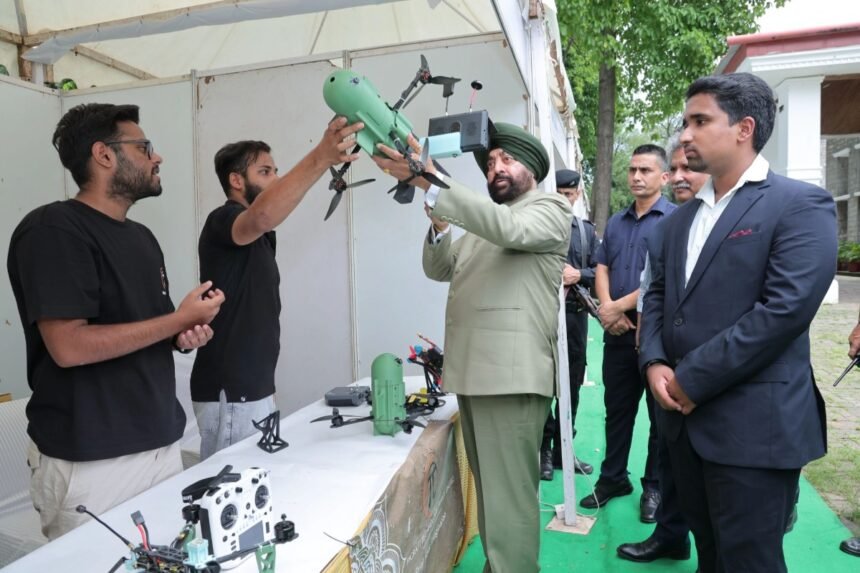
Harpy Eagle made its public debut at a showcase held under the Aarohi AI Incubator, a state-backed programme at Raj Bhavan in Dehradun, where Uttarakhand Governor Lt. Gen. Gurmit Singh visited the company’s exhibition stall — a moment Singh described as a milestone for the young firm. The concept mirrors a class of counter-drone weapons that has emerged out of battlefield necessity, where cheap, hard-to-detect FPV drones have made traditional air-defence systems poorly suited to stopping swarms of small, low-flying aircraft.
As with most early-stage defence hardware, the details are thin. Picraft has not publicly disclosed performance specifications for Harpy Eagle — no range, interception speed or unit cost — and it remains unclear whether the Indian military has evaluated the system beyond its public debut. The same caution applies to the swarm trials: the details come from the company’s own announcement as reported on 17 October 2026, and independent confirmation from the Army or DRDO has not surfaced yet.
Why this trial matters
Still, there is a real engineering achievement underneath the caveats. High-altitude swarm flight is genuinely rare. The Indian Army began inducting its first swarm drone sets for surveillance back in 2022 — procured from Bengaluru’s NewSpace Research and Technology and Noida’s Raphe mPhibr — and has since been pushing autonomous systems further into Himalayan conditions. A homegrown startup demonstrating coordinated multi-aircraft operations at 16,500 feet adds to that momentum at exactly the frontier where India’s security concerns are sharpest: the Line of Actual Control, where troops operate between 12,000 and 18,000 feet.
Picraft is still at the beginning of its journey. It has no reported institutional funding, no manufacturing scale-up to point to, and its biggest claims await independent validation. But in a country trying to build a private defence-industrial base from scratch, a team that can fly coordinated autonomous drones in the Himalayas and is already iterating with the Army deserves to be watched. The swarms above Ladakh are the signal; the validation will come next.