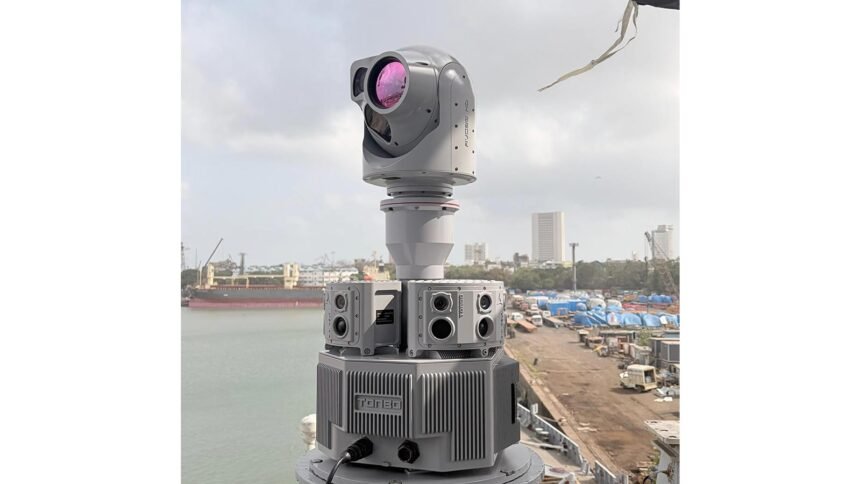
Image credit: Tonbo Imaging. This week, a Bengaluru defence-electronics company opened an ₹852-crore initial public offering that is unusual in one quiet but decisive respect: the company going public sells the “eyes” of modern military equipment, and it owns every piece of the technology behind them. Tonbo Imaging India Limited opened its IPO on 15 October 2026 at a price band of ₹665–700 per share, closing on 19 October, with a tentative listing on the BSE and NSE on 23 October. The offer is entirely an Offer for Sale — existing shareholders are selling, and no new capital flows into the company — but the engineering story underneath the listing stands entirely on its own: indigenous thermal imaging, deliberately free of US export restrictions, deployed on more than 28,000 systems across 24 countries.
The eyes of modern military equipment
Every modern weapon system that fights at night — a soldier’s thermal weapon sight, a helicopter’s targeting gimbal, a missile’s seeker — depends on electro-optics and infrared engineering. Tonbo’s portfolio covers the full spectrum: thermal imaging cores, weapon sights, handheld thermal imaging binoculars, targeting systems, missile seekers, fire-control systems and missile-guidance systems, sold through its Tactical Systems and Platform Systems verticals.
Take the BloodHound, one of its handheld thermal binoculars: a 640×480 microbolometer array on a 17-micron pitch, shutterless, with integrated GPS, compass, optional laser rangefinder and target geo-referencing — able, per the company’s specifications, to detect a NATO-sized target at up to 3 kilometres. At the other end of the scale, the company is developing directed-energy systems to counter drone swarms, with its Vault counter-UAS product showcased in the company’s own demonstration videos.
As of 30 June 2026, the company says it had deployed over 28,000 systems across 24 countries. A Frost & Sullivan report cited in the company’s draft red herring prospectus — reported by the Economic Times — describes Tonbo as India’s largest manufacturer of thermal imaging systems supplied to government and defence agencies by sales value during FY24–FY26, and puts its share of India’s thermal imaging exports at 94.3 per cent by units over the same period. Those figures come from a company-commissioned industry report, so they should be read as the company’s documented market position rather than independent fact — but the underlying scale of deployment is not in dispute.
Why “ITAR-free” is the real engineering bet
The phrase that matters most in Tonbo’s story is “ITAR-free”. US International Traffic in Arms Regulations control the export of American-origin defence technology, which means many countries simply cannot buy American electro-optics at all — or can buy them only under restrictive end-use agreements. Tonbo’s entire product line is indigenously designed, and its electro-optic and infrared products sit free of US ITAR export controls. That single engineering choice — building from Indian designs rather than integrating foreign-controlled technology — is what opens those 24 export markets.
The company states it owns 100 per cent of its intellectual property, from optics to embedded software and electronics. That ownership dates to March 2024, when Tonbo bought out the remaining stake in its technology from CEAQ Singapore under agreements dated 11 March 2024, severing dependence on any outside technology partner. It also fits neatly into India’s procurement architecture: Tonbo qualifies as an IDDM — Indigenously Designed, Developed and Manufactured — supplier, a category that requires Indian control and design with foreign content capped at 50 per cent of contract value, giving it an edge in winning Indian defence orders.
More Read
Asset-light by design
Notably, Tonbo does not run its own factories. The model is asset-light: design, IP and R&D stay in-house — 130 engineers, about 38 per cent of the workforce, work at the Bengaluru R&D centre as of 30 June 2026 — while manufacturing is outsourced to certified electronics-manufacturing-services partners including Kaynes Technology India and Avalon Technologies.
It is a model that has produced healthy margins: analysts note gross margins above 50 per cent and EBITDA margins near 29 per cent, with almost nothing tied up in fixed assets. The company’s confirmed order book stood at ₹314.2 crore as of 30 June 2026, with ₹231.87 crore of it domestic. Investors on the register include Qualcomm Ventures, Artiman, Celesta, Edelweiss Value & Growth, HBL Engineering, Tenacity Ventures, Exim Bank of India and Florintree, which with Tenacity and Exim Bank also backed the ₹175-crore Series D pre-IPO round.
The Bengaluru team behind the optics
Tonbo Imaging India Limited was incorporated in 2003 and pivoted to defence product manufacturing in 2012, after a promoter buyout of the erstwhile parent company. Its promoters are Arvind Kondangi Lakshmikumar, the managing director and CEO, Ankit Kumar and Cecilia D’Souza. Per the Economic Times, the founding technologists previously worked with the US Department of Defense and Sarnoff Corporation — the Princeton research lab that pioneered much of modern imaging technology — before bringing that expertise home to Bengaluru.
That lineage shows up in the programmes the company is running. Per IPO filings summarised by BharatShakti, Tonbo is developing a high-performance electro-optic/infrared gimbal airborne system for an Indian defence R&D organisation, a multi-spectral infrared seeker with a command launcher unit for a defence manufacturer, and a free-space optical communication system for terrestrial and naval use — genuinely hard engineering problems, not brochure technology.
What the CEO says comes next
In an interview this week with CNBC-TV18, CEO Arvind Lakshmikumar named three growth drivers: thermal weapon sights, missile seekers and high-power microwave (HPM) counter-drone systems. On weapon sights, he claims roughly 65 per cent of the Indian market, saying about 20,000 of the roughly 30,000 thermal sights deployed in India are Tonbo’s. On missile seekers, he describes the company as a sole-source supplier to a couple of missile manufacturers. And on directed energy, he points to minimum-order-quantity agreements and letters of intent from the Indian Navy and European customers for about 11 systems — at roughly ₹200 crore per system in India (US$25 million internationally), a ₹2,500-crore opportunity as framed by the company. These are the chief executive’s statements, not audited figures, and the HPM systems remain in development — revenue is expected only around 2029–30.
The caveats that matter
Three calibrations are important. First, the headline market-share numbers — 94.3 per cent of exports, 65 per cent of India’s thermal sights — come from a company-commissioned report and the chief executive’s own mouth respectively. They are the company’s documented claims, not independently verified facts.
Second, defence revenue is lumpy. Tonbo’s FY26 net profit was ₹50.88 crore, down from ₹72.76 crore in FY25 on delayed international order execution — procurement cycles are tender-driven, and a quarter can slip on a single delayed contract. The asset-light model keeps margins healthy, but it also means growth comes in steps, not slopes.
Third, an IPO that is entirely an Offer for Sale puts no new money into the company’s R&D. This listing is a liquidity event for existing investors, not a fundraising for the directed-energy programme. The HPM systems and the ₹2,500-crore opportunity are pipeline, not product: they should be judged when hardware is delivered, not when order intent is announced.
Why this one is worth watching
Strip away the caveats and the engineering achievement is real and rare: a Bengaluru company that designs its own thermal imaging cores, weapon sights and missile seekers end-to-end, owns its IP outright, manufactures through Indian EMS partners, qualifies as an IDDM supplier, and has put 28,000 systems into the field across two dozen countries — all without depending on US-controlled technology. In a world where electro-optics are a strategic choke point, India having a domestic house that can design, own and export them matters far beyond one IPO week.
The milestones to watch are concrete: delivery on the ₹314.2-crore order book, the move from missile-seeker sole-source claims to named programmes, and the first real revenue from the high-power microwave counter-drone systems towards the end of the decade. Tonbo goes public not as a promise of what India might build, but as evidence of what one Bengaluru company already has.