Image credit: Astrogate Labs. There were over 11,700 active satellites in orbit by the middle of 2025, and the number keeps climbing as constellations expand. Every one of them needs to talk — to the ground and to each other — and the radio spectrum they have used since the 1950s has changed little in decades. That infrastructure now faces spectrum congestion and hard bandwidth limits, even as a single modern satellite can generate over 1–2 TB of data per day. The industry’s answer has been to take the links off radio entirely: satellites talking to each other with laser beams. SpaceX has proven the architecture at scale — its 2025 progress report describes more than 13,000 bidirectional laser links operating as an optical mesh in orbit. A Bengaluru startup founded in 2017 has spent nine years building India’s answer to that shift, and this September it unveiled what it describes as the country’s first indigenous optical inter-satellite link terminal.
The terminal Astrogate is building
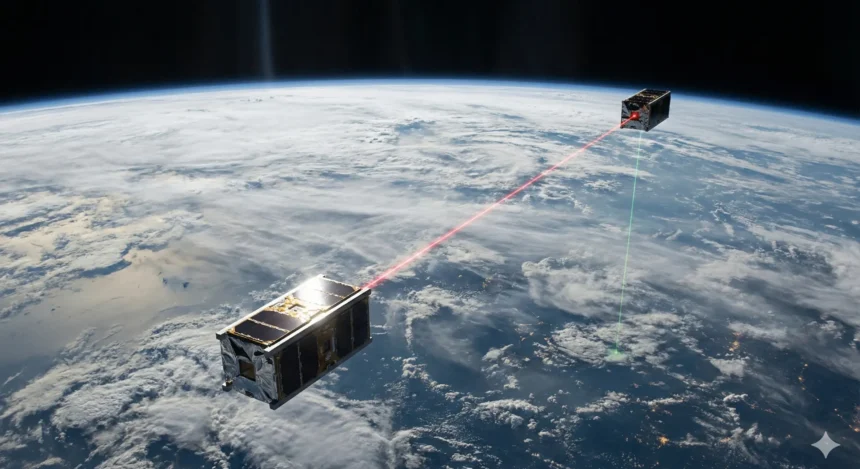
At Bengaluru Space Expo 2026, held 7–9 September at the Bangalore International Exhibition Centre, Astrogate Labs unveiled its Optical Inter-Satellite Link (OISL) capability, with flight readiness targeted for 2027. OISL terminals let satellites exchange large volumes of data directly through laser beams instead of routing every transmission through a ground station — secure, high-speed, low-latency connectivity, mirroring the optical mesh architecture that constellations like Starlink run on.
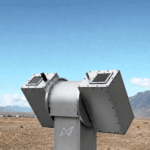
The terminal’s core building blocks, according to the company, are a high-precision Pointing, Acquisition and Tracking (PAT) system, an optical modem, stabilized coarse-tracking gimbals and system-level integration — all developed in-house and validated on Astrogate’s space-to-ground terminals. “The core building blocks of our OISL terminal — the Pointing, Acquisition and Tracking system, the optical modem, stabilized coarse tracking gimbals and system-level integration — were developed and validated for Astrogate’s space-to-ground terminals, and carry over to inter-satellite links. That inheritance is what puts flight readiness within reach by 2027,” said Jayaraman Yogeshwaran, the company’s co-founder and chief technology officer.
AstroLink Micro: 10 gigabits over light
Alongside the OISL unveiling, the company demonstrated AstroLink Micro, its 10 Gbps space-to-ground laser communication terminal — the two programmes share technology but are distinct systems. The numbers put the leap in perspective: co-founder Subhajit Chakraborty has said that on the CubeSat-class form factors Astrogate works with, radio-frequency terminals manage around 200 Mbps — “ballpark” — while Astrogate’s terminals are at 10 Gbps. The company’s official specification sheet claims its laser-comm terminals deliver over 100x the bandwidth of conventional radio-frequency systems, with high-throughput links ranging from 10 Gbps to over 1 Tbps, operating on unlicensed optical spectrum.
The security argument is physical, not cryptographic: laser beams are extremely narrow, making interception or interference impractical — a property that matters for defence and strategic communication, which Astrogate names as a core market alongside commercial satellite backhaul and orbital compute.
The ISRO relationship and TRL 8
The company’s claim to have earned its place is concrete hardware. Astrogate says it has supplied an indigenously developed satellite-to-ground lasercomm terminal to ISRO — describing itself as the only Indian company to have delivered this strategic technology to the national space agency, a characterisation that should be read as the company’s own. Its space-to-ground laser communication terminals, the company says, have reached Technology Readiness Level 8 — complete and qualified for flight.
More Read
There is international validation of a different kind: Astrogate has completed cross-compatibility testing with the University of Western Australia’s TeraNet mobile optical ground station, confirming its terminals can interoperate with international ground infrastructure. The company’s official site lists ISRO, DRDO and WESEE among its working partners, with the TeraNet and Durham University logos alongside — consistent with its second office in Durham, England.
“Some time back, laser communication from India was a research question. Today it is a product we deliver, with ISRO as a customer. OISL is the harder problem, and it is the one that decides who builds the connectivity layer for future LEO constellations. We are building it, with technology owned end to end in India,” said Nitish K. Singh, founder and chief executive officer of Astrogate Labs.
The company behind the lasers
Astrogate Labs was founded in 2017 by Nitish Singh (CEO), Yogeshwaran J (CTO) and Subhajit Chakraborty — engineers who took the problem statement from lived experience of how radio-frequency bottlenecks capped what satellites could actually send home. The funding arc is modest by spacetech standards but tells its own story: the company has raised close to $2 million so far, including a $1.3 million pre-Series A round led by Piper Serica Angel Fund, with backing from Speciale Invest, SatSure and Anicut Capital — a strategic-investor roster drawn from the Indian space ecosystem itself.
The landscape it plays in is real but early. Pune-based Olee Space works on free-space optical communication for defence and terrestrial networks, and Bengaluru’s own QOSMIC builds optical ground stations — but the inter-satellite terminal, the hardest piece of the stack, is where Astrogate says it is placing its bet. The three markets it targets are telling: satellite backhaul for constellation operators, sovereign defence constellations, and orbital compute — the emerging architecture where satellites process data in orbit rather than dumping it all to the ground.
The caveats that matter
Three calibrations are essential. First, the OISL terminal is a development programme, not flight hardware: flight readiness in 2027 is the company’s target, and the terminal has not yet flown — the hardest problems in OISL, acquiring and holding a laser lock between two satellites moving at kilometres per second, can only be proven in orbit. Second, the headline claims — “India’s first indigenous OISL terminal,” the only Indian company to have delivered lasercomm hardware to ISRO, TRL 8 status — are the company’s own characterisations, reported by business press via its announcements but not independently verified; no separate ISRO announcement of the hardware supply could be located. Third, the financing is still light for what it wants to build: close to $2 million raised puts the company well behind the capital intensity typical of flight-hardware programmes, and the 2027 target assumes the funding pipeline keeps pace with the engineering.
Why this one is worth watching
Chakraborty made the measured point himself: laser will not replace radio — “laser is actually the future of space communication… but it is a complement to RF because RF cannot be totally ruled out.” The honest version of the story is that RF remains the reliable workhorse while optical is the frontier. But it is a frontier that decides who owns the connectivity layer of the orbital economy. If Astrogate’s 2027 flight-readiness target holds — and if an Indian terminal, designed and manufactured end to end in India, starts linking satellites by laser — the company will have moved India from importing the optical layer of future constellations to building it. In a decade where constellations are the strategic high ground, that is not a communications story. It is a sovereignty story.