Image credit: Digantara. Roughly 40,000 objects large enough to track are circling the Earth — working satellites, dead ones, spent rocket stages and fragments of debris, all moving at several kilometres per second. For most of them, India has had no independent way of watching. The world’s orbital traffic picture is drawn overwhelmingly from United States government catalogues and commercial networks abroad; when New Delhi has needed timely answers about what was overhead, it has largely depended on data produced by someone else. A startup from Bengaluru has spent the last few years trying to change that from both directions at once: a satellite in orbit that watches other satellites, and a network of AI-powered optical sensors on the ground that watches the sky.
What SCOT actually does
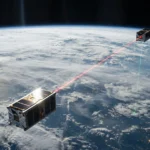
Digantara’s bet is built on SCOT — a Space Camera for Object Tracking. The satellite rode to orbit on 14 January 2025 aboard a SpaceX Transporter-12 rideshare from California, and on 8 March 2025 the company announced it had commissioned the spacecraft, publishing its first image. It sits in a sun-synchronous orbit, watching low Earth orbit with an optical sensor designed to track objects as small as five centimetres — debris fragments, not just whole satellites — with what the company describes as a high revisit rate.
The point is not imagery for its own sake. SCOT’s observations feed the company’s Space-MAP platform, which fuses tracking data into collision-risk analysis: conjunction screening, alerts when a satellite drifts too close to debris, and the beginnings of an independent Indian catalogue of resident space objects. The company calls it the world’s first commercial space-based space-surveillance satellite — a characterisation worth treating as a claim, but the operational fact is undisputed: it is flying, commissioned, and streaming data.
MOSAIC and the ground layer
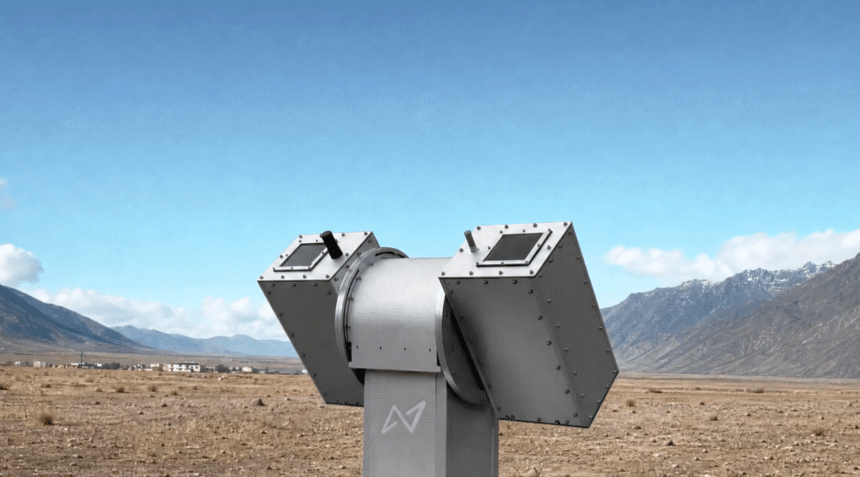
On 18 August 2026, Digantara unveiled the ground half of the system: MOSAIC, an AI-powered distributed optical-sensor network. The first deployment is five interconnected sensor nodes working as one coordinated network. Each node pairs an optical head unit — essentially a precision telescope for the sky — with an electronics head unit that handles onboard processing, communications, timing and autonomous operations. An AI and machine-learning detection system identifies stars and resident space objects, including faint satellites and debris, using what the company calls “Lost-in-Space” attitude-estimation techniques: the node works out what it is looking at without prior tracking information, so it can detect and catalogue new objects rather than just re-acquire known ones.
The hardware is built for Indian geography rather than a lab: solar-powered with battery backup, designed to run from the heat of the Thar Desert to Himalayan winters. And MOSAIC is not the company’s first ground infrastructure — in August 2022 it established what reporting describes as India’s first commercial space-situational-awareness observatory in the Garhwal region of Uttarakhand, chosen for altitude, clear skies and a strategic vantage over the subcontinent. A planned SKYGATE network would extend that ground layer further, across what the company calls “critical theatres of operations.”
The missile-warning pivot
The most consequential turn came in December 2025, when Digantara told the news agency PTI it was moving from debris tracking into missile tracking from space. The same sensing architecture that watches fast-moving space objects, co-founder and CEO Anirudh Sharma said, could be turned to detecting missile launches and precision tracking. The plan, as the company describes it: 15 more SCOT-series satellites plus two dedicated ALBATROSS satellites for early missile warning and precision tracking, launched through 2026 and 2027, all fused through an integrated infrastructure the company calls AIRA.
More Read

The commercial signal behind the pivot is international. In February 2026, Digantara announced a partnership with Singapore’s Defence Science and Technology Agency at the Space Summit in Singapore — the company says it is the first agreement Singapore’s defence arm has signed with an Indian space-tech firm. Digantara will provide flight-dynamics analysis and conjunction screening for Singapore’s national satellites, with co-development of space-surveillance tools and joint work on space-based sensing. In the United States, the company has begun building larger 100-kilogram-class spacecraft in Colorado, aimed at American defence needs such as missile tracking, and says it holds contracts with the US Air Force and Space Force and participates in the Space Development Agency’s TAP LAB programme.
The company behind the constellation
Digantara Industries was founded in 2020 by Anirudh Sharma with co-founders Rahul Rawat and Tanveer Ahmed — engineering graduates who began work on the idea while still at university and incubated it at the Indian Institute of Science’s Society for Innovation and Development. The funding arc maps the ambition: $2.5 million in seed funding from Kalaari Capital in 2021, a $10 million Series A led by Peak XV Partners in June 2023, a $2 million extension with Aditya Birla Ventures and SIDBI Venture Capital in February 2024, and a $50 million Series B in December 2025 led by 360 ONE Asset with SBI Investments of Japan and Ronnie Screwvala, alongside Peak XV and Kalaari.
Along the way it has collected the markers of a company being taken seriously by states, not just investors: the DPIIT Startup India National Startup Award in 2022, selection for the World Economic Forum’s Technology Pioneers community in 2025, and an AUD 8.5 million grant under the Space-MAITRI joint mission with Australia in 2024, with partnerships alongside Space Machines Company and Ananth Technologies.
The caveats that matter
Three calibrations are essential. First, the constellation is a plan, not a fact: 15 more SCOT satellites, two ALBATROSS missile-warning satellites and the SKYGATE ground network are the company’s roadmap for 2026–27, and none has launched yet. Second, the headline achievements — the “world’s first commercial space surveillance satellite” framing, the large defence and commercial order book, the revenue targets attached to US expansion — are the company’s own characterisations, reported by business press but not independently verified. Third, missile warning from space is genuinely hard: detecting a launch plume, discriminating it from background, and delivering a warning fast enough to matter is a capability that only a handful of states operate, and Digantara has not yet flown the hardware that would prove it can do so.
Why this one is worth watching
Strip away the caveats and the strategic logic is concrete. The months after Operation Sindoor — when India combined domestic assets like ISRO’s Cartosat and RISAT with reportedly sourced commercial imagery for strike assessment — underlined why an independent orbital picture matters when decisions must be made quickly. Space surveillance has historically been a capability reserved for states; if a Bengaluru startup can deliver a working commercial layer of it — one satellite flying, a ground network deploying, sovereign defence agencies signing on — it will not just be a space company. It will be a piece of strategic autonomy that India has never had before.