Most of the military drones flying in Indian skies run on imported engines. For a country trying to indigenise its defence supply chain, that is an uncomfortable dependency: the powerplant is the heart of the machine, and India has historically bought that heart from abroad. In Chennai, a small aerospace firm working with the country’s premier aerospace laboratory has now taken an indigenous alternative from the test bench to the armed forces.
TridenTech Engineering Pvt Ltd, a Chennai-based aerospace and defence company operating out of the IIT Madras Research Park, has formally handed over the first set of its 30 HP indigenous Wankel rotary engines for UAV applications to the armed forces, Indian Defence News reported in June 2026. The engines were developed over roughly eighteen months in close collaboration with CSIR-National Aerospace Laboratories (NAL) in Bengaluru, tested at NAL’s Belur campus, and have secured certification from CEMILAC, the Centre for Military Airworthiness and Certification.
From the lab to the factory floor
The story is as much about technology transfer as it is about engineering. The 30 HP Wankel at the centre of this programme is a CSIR-NAL developed four-stroke single-rotor rotary engine, and its journey to industry was formalised at the CSIR RISE Conclave, where the technology transfer ceremony was graced by Union Minister Dr Jitendra Singh, according to the Indian Defence Research Wing. TridenTech is the industry partner taking the design into commercial production.
That matters because the engine targets a specific strategic gap: unmanned aerial vehicles and loitering munitions in the small class, where India currently relies on imports for its powerplants. The programme’s stated aim is to give India a sustainable, domestic ecosystem for manufacturing small-class aero engines rather than a one-off demonstrator.
Eighteen months at Belur
More Read
The engine was unveiled after rigorous ground testing at NAL’s Belur campus, attended by senior NAL officials including the engine development team, the project leadership and the Chief Engineer of the Rotary Engine Department. TridenTech’s delegation was led by its Director and CEO, Shridhar Powar, alongside Prof. P. A. Ramakrishna of IIT Madras, the company’s founder board member and mentor. The programme underscores an academia-industry loop: a national laboratory’s design, an IIT professor’s mentorship, and a young company doing the industrialisation.
Critically, the engine has been built entirely with indigenous components, the company says. TridenTech has also declared technology readiness for limited series production, with the maiden consignment slated for delivery to IIT Madras for its drone technology development programme, and the company preparing to ramp manufacturing toward early-stage industrial output.
Why a Wankel
The choice of the Wankel rotary configuration is deliberate. Unlike conventional piston engines, a rotary engine uses a triangular rotor spinning inside an epitrochoid housing, giving it a higher power-to-weight ratio, fewer moving parts and smoother operation from continuous rotary motion. For unmanned aircraft — surveillance drones, loitering munitions, logistics UAVs — compactness, low vibration and endurance are the performance parameters that matter, and the Wankel’s characteristics map onto them neatly.
TridenTech describes its unit as a license-built engine incorporating several home-grown enhancements aimed at extending flight endurance, ensuring mission-critical reliability and performing under varied atmospheric conditions. The engineering focus, the company says, has been on thermal management, material durability and refined internal cooling and sealing mechanisms — the unglamorous details that determine the time between overhauls, a vital factor for sustained military operations. The company claims its refinements deliver higher bursts of speed and better climb rates, making the unit suitable for a spectrum of tactical roles.
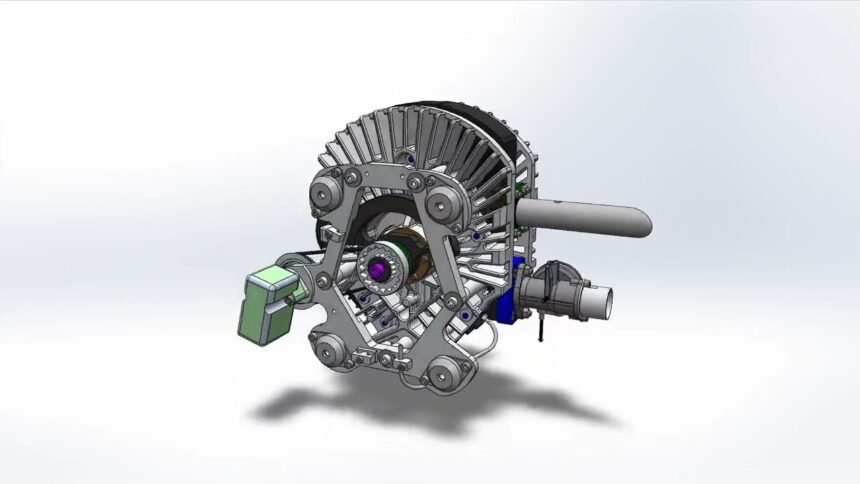
Here’s the company’s own look at the 30 HP engine assembly:
The caveats that matter
Two calibrations are essential. First, this is a technology-transfer success, not a startup that designed an engine from scratch: the engine’s underlying design is CSIR-NAL’s, and TridenTech’s achievement is industrialising it — adding home-grown enhancements, taking it through testing and certification, and standing up limited series production. That is still a genuinely hard thing to do, but it is not the same as indigenous clean-sheet design, and the post should not be read as claiming otherwise.
Second, the performance claims — thermal endurance, reliability gains, climb rates — come from the company and defence-press reporting, not from published independent test data or named customers. The first production batches are heading to IIT Madras and the armed forces for integration and further testing, which is where the engine will be proven or not. TridenTech itself remains an early-stage engineering firm best known for design, analysis and simulation services; this programme is its most visible manufacturing bet yet.
Why this one is worth watching
India’s drone ambitions have always had a missing middle: airframes and software get the headlines, but the small engines that power them have quietly stayed imported. What TridenTech and CSIR-NAL have demonstrated is the full loop — laboratory design, industry transfer, military certification, first delivery. If the limited series production ramps as planned, the next generation of Indian UAVs could finally fly on an Indian heart. That is a small engine with a large strategic footprint.