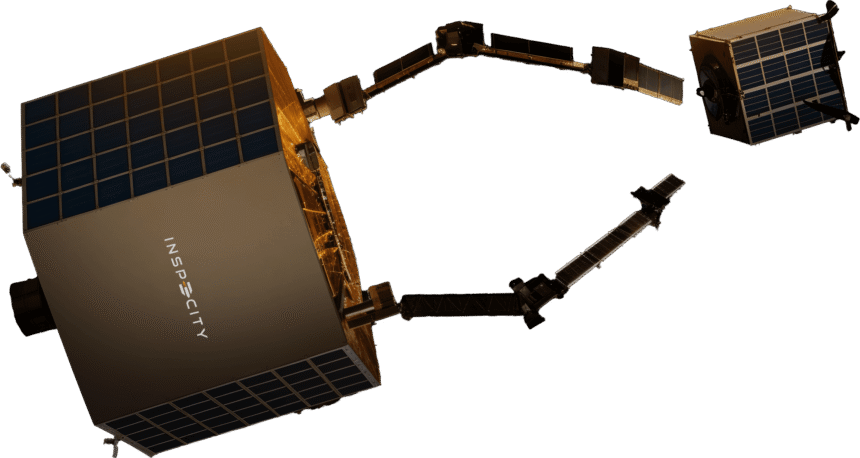
A satellite is one of the most expensive machines humans build — and most of them die of the most fixable causes. They run out of propellant, drift out of their orbital slot, or suffer a fault nobody can reach. The hardware is often perfectly fine; the satellite is simply too far away for a mechanic. Thane-based InspeCity is building the mechanic.
The company, incubated at IIT Bombay, is developing VEDA — short for Vehicle for Life-Extension and Deorbiting Activities — an autonomous spacecraft designed to fly to a satellite already in orbit, inspect it, dock with it, and then refuel, reposition or repair it. If the satellite is beyond saving, VEDA can guide it to a controlled deorbit instead of letting it become space debris, per the company’s site.
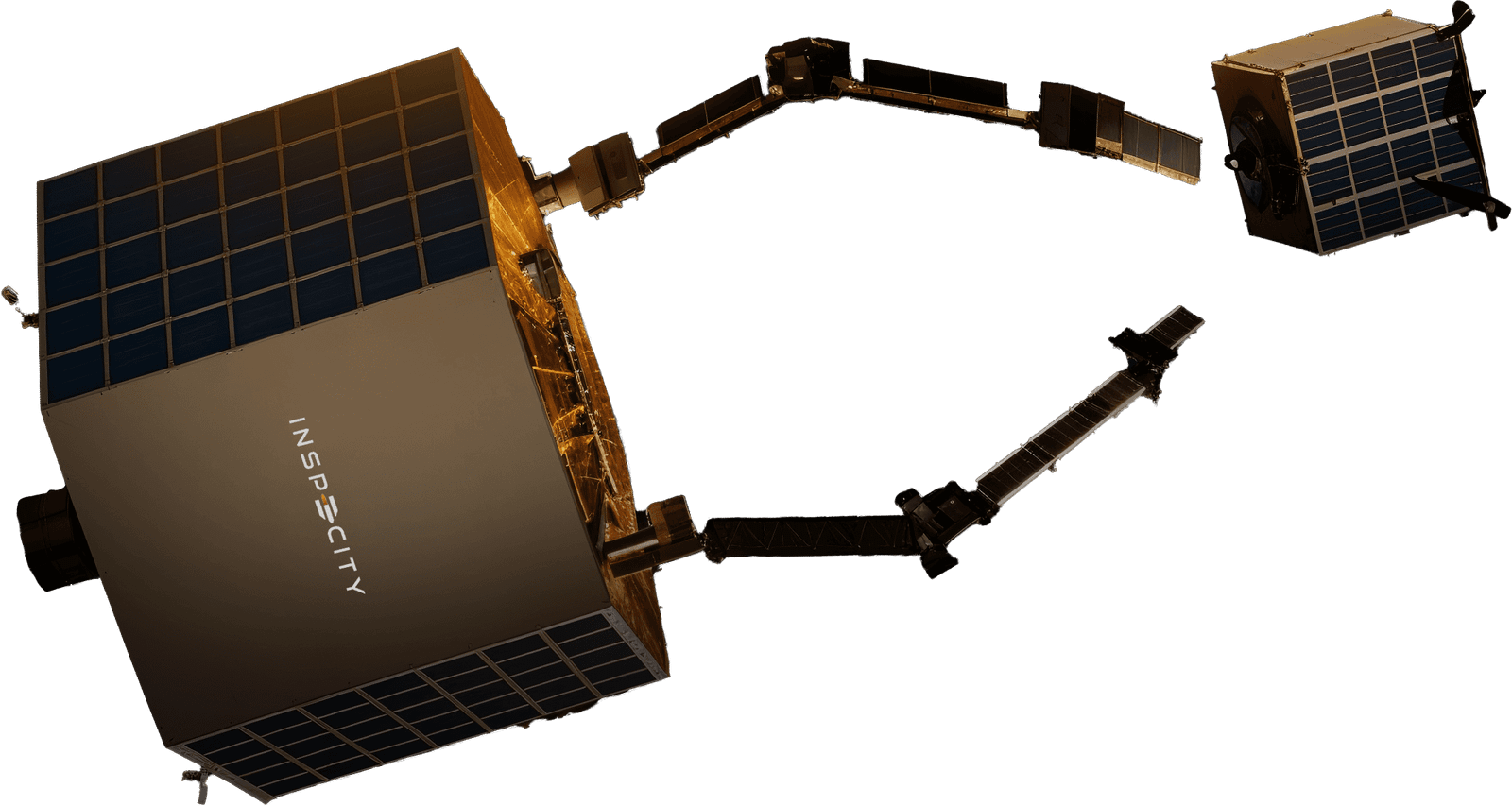
The engineering is deliberately modular. Four systems, each qualified separately before being assembled into a full servicing mission, make up the VEDA architecture: GITA, the propulsion and mobility unit; CHAKSU, an AI-enabled sensing, tracking and navigation system for proximity operations; RAMA, a remotely actuated robotic arm for manipulation; and SPARSH, a self-aligning docking port built for autonomous docking and in-orbit propellant transfer, per InspeCity’s technology page. GITA grew partly out of the company’s defence work: in May 2023, InspeCity became the first company to win an iDEX contract under Mission DefSpace — a challenge led by the Defence Space Agency — for a gas-based micropropulsion system for CubeSats, reported The Hindu BusinessLine.
That matters because the economics of space are quietly changing. Communication, defence, weather, navigation and banking satellites are expensive to replace and cheap to keep working — if someone can reach them. A servicing flight that extends a satellite’s life by a few years can save its operator crores and keep one more dead asset out of crowded orbits. India already knows this math: the company’s own vision statement is literally “Swach Antariksh Abhiyan” — a clean-sky campaign.
The immediate roadmap is concrete. On 27 August 2026, InspeCity confirmed a ₹100 crore (~$10.5 million) pre-Series A round co-led by Speciale Invest and investor Ashish Kacholia, taking its total funding near ₹150 crore. The company says the money goes to flight-qualifying its systems and executing four in-orbit missions over the next 12 to 18 months under a roadmap it calls RIG-X, VEDA-X and SAMA-X — progressively demonstrating inspection and proximity operations, then docking, then advanced servicing. Founder and CEO Arindrajit Chowdhury, a professor of mechanical engineering at IIT Bombay who started the company in 2022 with Tausif Shaikh, Sanket Dash and Ananth Ramesh, put it plainly: “The next phase is about execution: fly, qualify, and deliver,” per Analytics India Magazine.
The honest caveat: nothing has flown yet. VEDA is still a ground-tested architecture moving toward flight qualification, and in-space servicing is a race with well-funded global competition — Japan’s Astroscale, Starfish Space, Orbit Fab and Northrop Grumman are all chasing the same prize. What makes InspeCity worth watching is that it is building the entire stack — propulsion, sensing, robotics, docking and refuelling — under one roof in Thane, with an in-orbit demonstration targeted from 2027. If the four missions work, India gets its first orbital mechanic.