


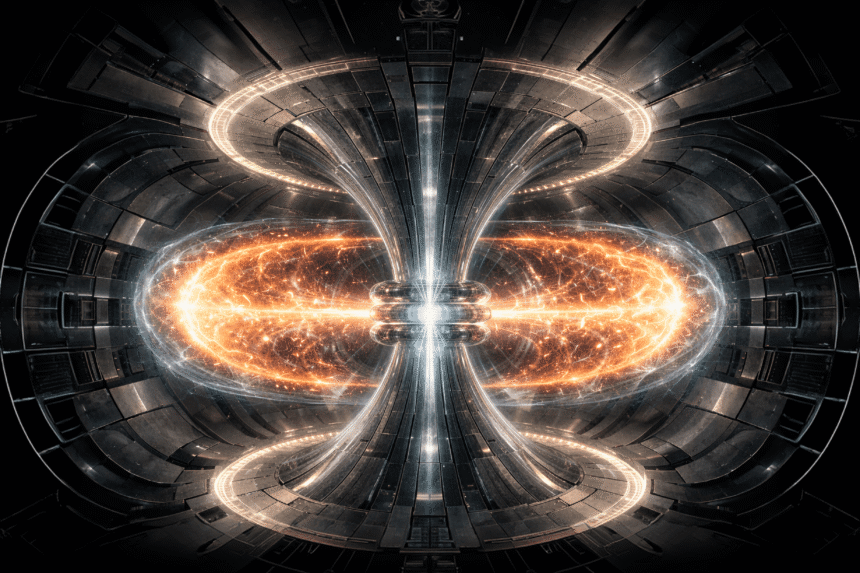
For seventy years, fusion energy has been the horizon that never gets closer. The physics is proven — laboratories have fused atoms repeatedly, and in recent years Chinese and French tokamaks have held plasma for over a thousand seconds at a stretch. What has been missing is the industrial apparatus around the physics: the magnets, the control systems, the design tools that turn an experiment into a power plant. A two-year-old Bengaluru startup called Pranos Fusion is building exactly that apparatus — and it started by building India’s first privately developed tokamak.

PRAGYA is tiny by fusion standards. The compact, low-aspect-ratio tokamak has a major radius of just 0.40 metres — small enough to sit on a lab bench — against the 6.2 metres of ITER’s machine. It is designed for a toroidal field of 0.1 Tesla and a plasma current of 20–25 kiloamperes. But small is the point. Pranos built the machine in about eight months, starting in June 2025, and in early September 2026 it produced plasma inside the device — the milestone that, as The Economic Times reported, moved India’s private fusion sector from theory to experimental prototyping.
PRAGYA is not a power reactor, and the company does not pretend otherwise. It is an experimental testbed: a place to study and control plasma, validate magnet configurations and test control software on real hardware instead of only in simulation. Pranos plans to operate it for nearly two decades, running 10–12 experimental shots a day — roughly 3,000 a year — to generate the operational datasets that train machine-learning models for plasma stabilisation. It even plans to offer PRAGYA as a low-cost testing platform for other fusion startups that would rather not build their own experimental infrastructure.
The machine is one third of a deliberately stacked architecture. JENGA is the company’s design and plasma-control software platform — a digital twin coupling the physics of the plasma to the engineering of the plant, so configurations can be tested in simulation before committing to hardware. MAGGA is the programme to build high-temperature superconducting (HTS) magnets in-house, the same magnet technology that has let well-funded Western rivals like Commonwealth Fusion Systems shrink their reactor designs. The philosophy, as the company puts it, is to take an engineering-first, vertically integrated approach — building the digital, magnetic and hardware infrastructure simultaneously.
The ambition beyond that is steep: Pranos says it aims to have its HTS magnet technology operational by 2027 and to build a net-gain reactor it calls PraniQ by 2030. That timeline should be read as the company’s own target — no one has yet put net-energy fusion on a grid anywhere in the world. But the engineering posture is real. Pranos was founded in 2024 by Shaurya Kaushal, who holds a doctorate in computational physics from JNCASR and has worked with the UK Atomic Energy Authority, and Roshan George, a computer scientist who spent years building digital platforms for the energy industry. The company works with support from JNCASR and the Institute for Plasma Research — the national lab that runs India’s three existing tokamaks, ADITYA-1, ADITYA-U and SST-1 — with collaborations across IISc, BITS Pilani and IIT Kharagpur. A $6.8 million seed round in March 2026, co-led by pi Ventures and Ankur Capital with Industrial47 participating, funds the push.
More Read
Fusion has always been a government game in India. PRAGYA, all 40 centimetres of it, is the first sign that the private sector is ready to play too.







