Almost every medicine, microchip and polymer on Earth is made by following a recipe — a synthesis route drawn up decades ago, handed down through the industry like folklore. Each extra step burns energy, consumes solvents, and shrinks the yield. NuSynth Technologies believes most of those recipes can be rewritten: fewer steps, lower temperatures, hazardous reagents swapped for air and water. It is a quiet revolution in industrial chemistry, and it is being engineered in Mysuru.
The company was founded in March 2026 by four veterans of the chemical and pharmaceutical industry. Co-founder and CEO Poorvank Purohit previously served as Managing Director and CEO of Solara Active Pharma Sciences; co-founder and CTO Dr Ramesha A R brings three decades of process chemistry after a postdoctoral stint at the US National Institutes of Health; Abhishek Deo (CBO) and Dipak Bajaj (COO) complete a founding team the company describes as combining scientific depth, industry experience and execution capability.
NuSynth calls itself an R&D-led process innovation collaborative platform, and its method is summed up in three words on its website: problem first, chemistry second, technology third. Instead of tweaking legacy processes incrementally, it re-examines starting materials, reaction pathways and process economics from first principles, benchmarking every programme on cost, yield, safety, sustainability and supply resilience. Predictive synthesis models propose alternative routes, and every experiment — successful or not — is captured as structured data that feeds an AI engine, which the company says makes each R&D cycle smarter than the last, compounding its knowledge over time.
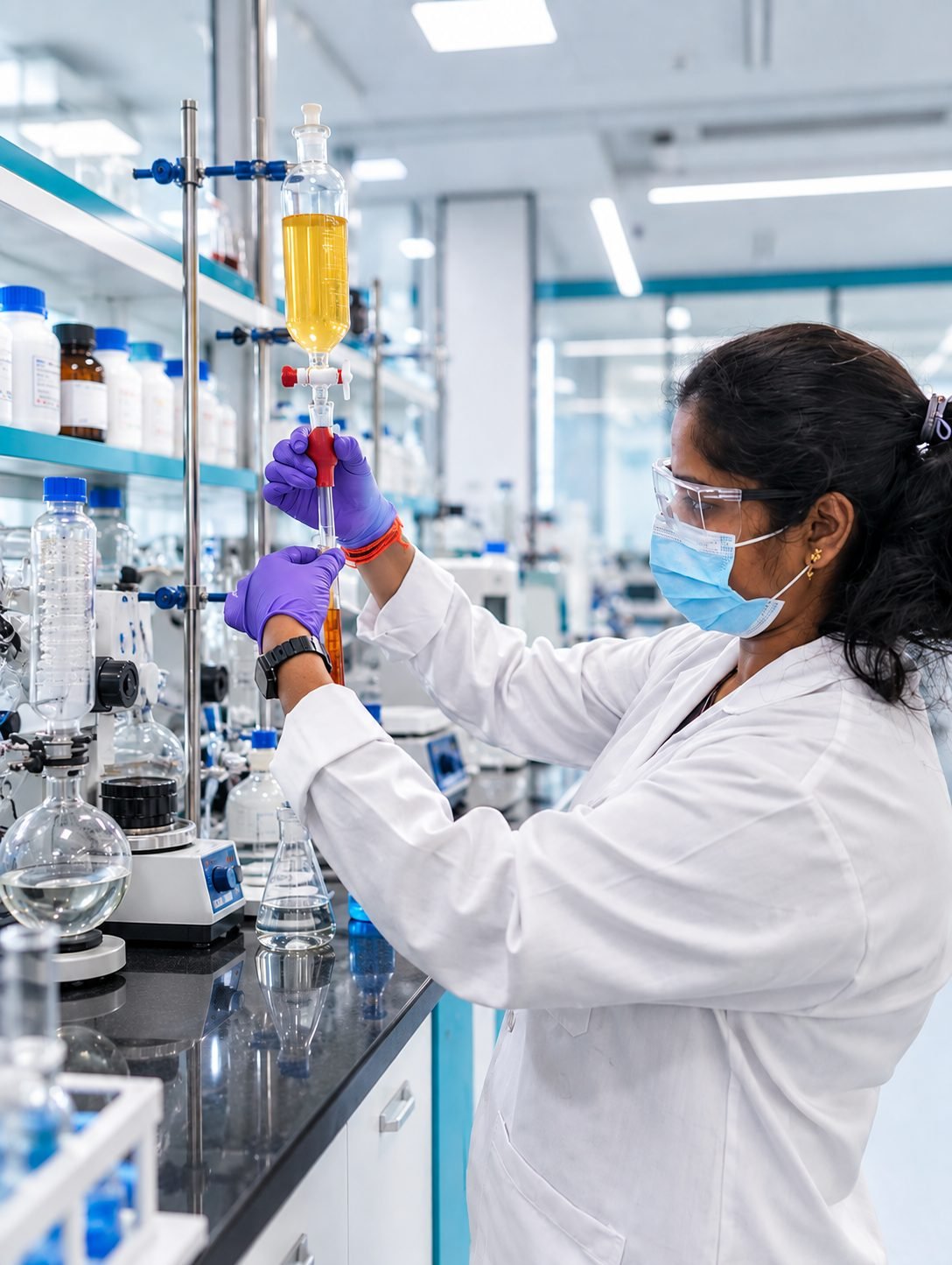
The company illustrates its approach with a case study on an intermediate synthesis: an 11-step route with a 230–250°C step, hazardous reagents and import dependence, redesigned from first principles into four or five steps at around 120°C — phosgene- and bromine-free, built on local raw materials, at what the company says is a significantly lower process cost and with improved safety. It has also built a set of niche reaction capabilities: on-demand hydrogenation at room temperature, dehydrogenation and oxidation using air instead of bromine, room-temperature catalytic trans-esterification, and N-alkylation in water for pharmaceutical intermediates. Behind the platform sits real infrastructure: an operational R&D centre in Mysuru with a Bengaluru facility under development, a pilot plant in Mysuru, and more than 20 verified manufacturing partners across India.
The momentum has drawn institutional backing. On 13 October 2026, NuSynth raised ₹36.5 crore (about US$4 million) in a seed round co-led by Avaana Capital and Shastra VC, to deepen its R&D and technology capabilities, build an initial portfolio of proprietary processes, and strengthen scale-up. “At NuSynth, we are going back to first principles — questioning established routes, redesigning processes and engineering them for commercial scale from day one,” Purohit said. “Our ambition is to build proprietary processes from India that can deliver superior economics and sustainability, and serve customers across global markets.” Shastra VC managing partner Avijeet Alagathi said the firm is excited by how NuSynth uses AI to make chemical R&D faster and more efficient, reducing trial and error by learning from experiments and enabling faster development and scaling of new chemistries.
The company frames its mission as a shift for India itself: from manufacturing established chemistry to originating new chemistry — R&D in India, process IP from India, global markets at the end of it. If NuSynth’s engine delivers on its promise, the molecules the world depends on could soon be made with fewer steps, lower heat and cleaner chemistry — designed, for the first time, in Mysuru.